
- Collection type
- Object
- Description
- Square piece of recycled hessian sack with cross-stiched picture of grazing animals and a tree [RTS 22/2/2005].
- Long description
- Piece of light brown coloured hessian (Pantone 465C), recycled from a sack with a loosely woven checkweave pattern of over 1, under 1. This has been cut into a rough square, with one finished edge; one edge adjacent to this has been sewn across using a loose tacking stitch in a fine, twisted olive green cotton thread, presumably to prevent the edge pulling (Pantone 451C). The other two edges have not been finished off. All 3 of these edges have fringes where the warp or weft of the hessian have been exposed, something that may have been done deliberately to create a soft frame around the design. A square picture has been embroidered onto the upper surface of the backing material; this is not completely centred, so that 2 sides extend right to the fringed edge of the sacking, while the other 2 sides have a bordering hessian strip of between 13 and 20 mm before the fringe begins. The picture is formed from cross-stitching in brightly coloured 4-ply wool, onto a yellow background (Pantone 7402C). The base of the design is formed by a narrow, horizontal brown ground line positioned about two-thirds the way down the scene (Pantone 725C). There are 3 quadrupeds standing above this, with short tails, prominent ears and in one case, a pair of long horns; their bodies are brown with black outlines and black dots over their torsos (Pantone Black 6C), pale brown eyes (Pantone 726C) and red noses (Pantone 485C). The central animal stands with its head upright, flanked by 2 other animals with their heads down as they graze. A bright green wool has been used for 3 tufts of grass around this group (Pantone 3415C). To the right of the animals there is a single tree with brown trunk and leaves in 2 shades of green (Pantone 3258C at edges and Pantone 323C at centre). 2 further grass tufts flank its base (Pantone 3258C), while 3 black fork-shaped motifs above the leaves probably represent birds. The design is given a border of red triangles (Pantone 1797C) on a blue background (Pantone 287C). The object is complete, although there is some fraying at the edges, with a few minor patches of dirt discolouration on the front. There is also a major crease line running across the centre where it has been folded in two, and a less obvious crease at right angles to this where there has been a secondary fold. It has a weight of 115.3 grams, and is 500 mm long and 490 mm wide, while the actual image measures 465 by 460 mm [RTS 22/2/2005].
- Geographical reference
- Cultural groups
- Acholi
- Date / Period
- Date made: Before 1997
- Date collected
- 1997
- Acquisition information
- Purchased: 19/01/1998
- Materials and processes
- Material Plant Fibre Textile, Material Wool Yarn Animal, Material Cotton Seed Fibre Yarn Plant, Process Embroidered, Process Woven, Process Chequer Woven, Process Recycled
- Dimensions
- Width 490 mm, Length: max 500 mm, Width 460 mm actual image, Length 465 mm actual image, Weight 115.3 g
- Object numbers
- Accession number: 1998.9.20 Other numbers: Kaiser no. 26 Other numbers: PRM invoice item 20 (see RDF)
- Research and responses
This object is one of a collection made by Tania Kaiser, a D.Phil. student of Linacre College, during her fieldwork in the Kiryandongo Refugee Settlement. She conducted fieldwork in the camp from October 1996 to March 1997, and between June and November 1997. The population of the camp had originally come from Parajok in the Torit district of Southern Sudan, and was a mix of Acholi from that area and previously displaced Sudanese refugees (For details of her work, see: T. Kaiser, 1999, Living in Limbo: Insecurity and the Settlement of Sudanese Refugees in Northern Uganda (Unpublished PhD); T. Kaiser, "Making Do and Making Beautiful: Recycling in an African Refugee Settlement", in: J. Coote, C. Morton and J. Nicholson (eds), Transformations, the Art of Recycling, 44-47; T. Kaiser, 2000, UNHCR's Withdrawal from Kiryandongo: Anatomy of a Handover, New Issues in Refugee Research Working Paper No. 32, 1, 3).
The spotted coats might suggest that these were not intended to be goats, but some other kind of small horned quadruped, possibly wild rather than domesticated [RTS 16/2/2005].
Search terms: Textile, Picture and Graphic Art, Furniture Dwelling, Embroidery, House-ornament
Further items to explore
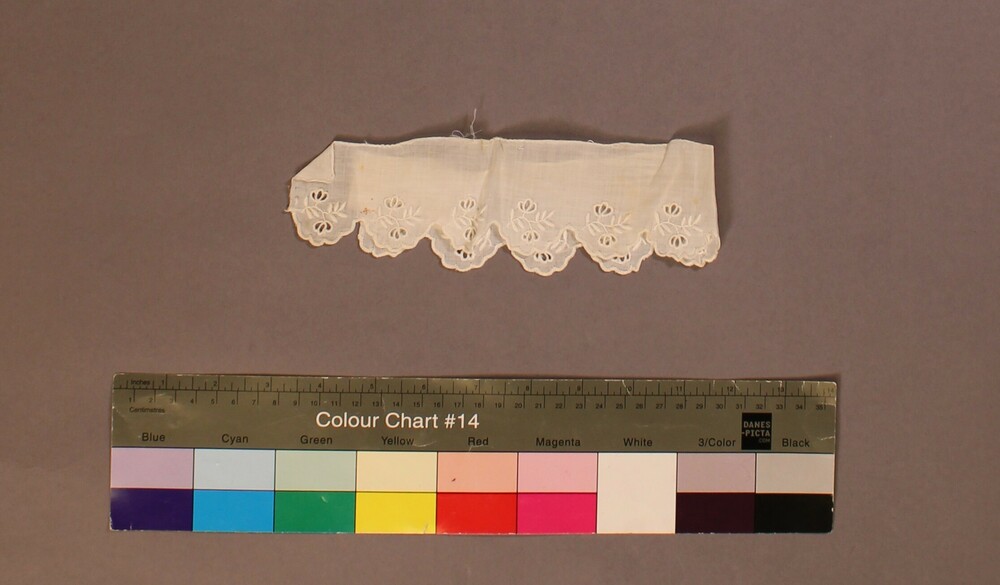 1949.9.295.3Piece of embroidered edging1949.9.295.3
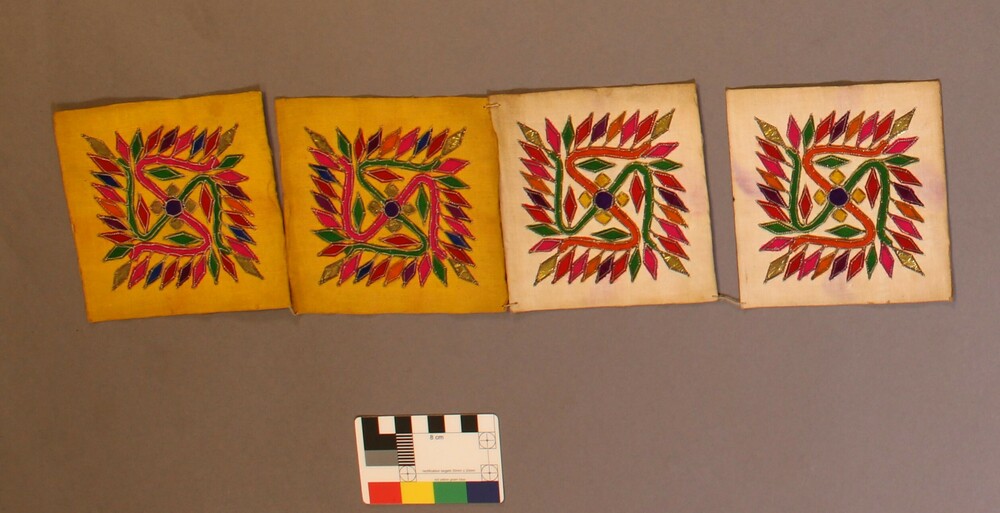 1918.37.3Small panel of embroidery with swastika design.1918.37.3
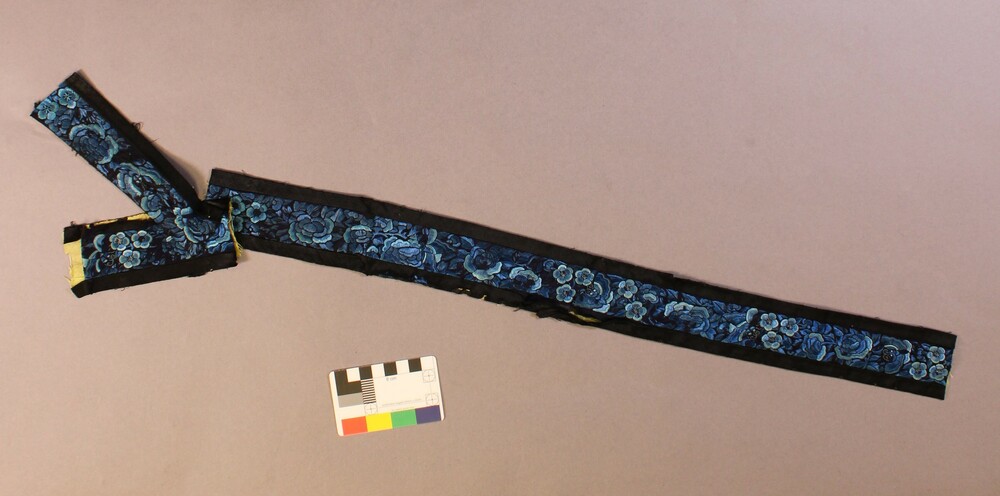 1949.8.66.1.1-3Three strips of silk embroidery1949.8.66.1.1-3
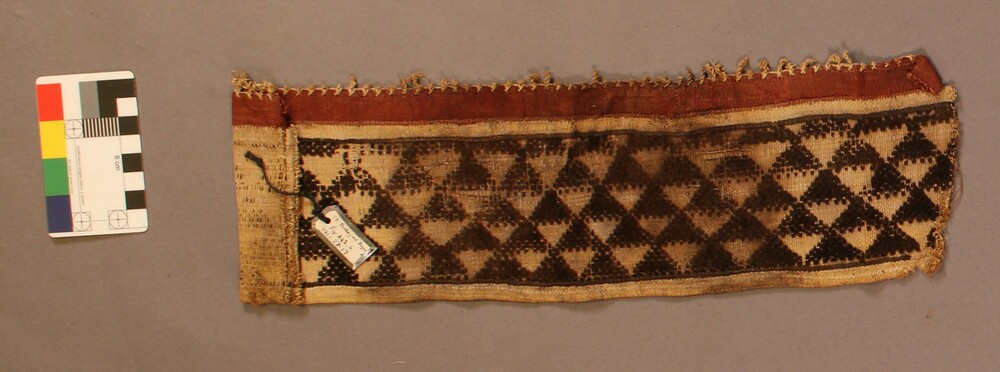 1911.27.17Embroidered cloth1911.27.17
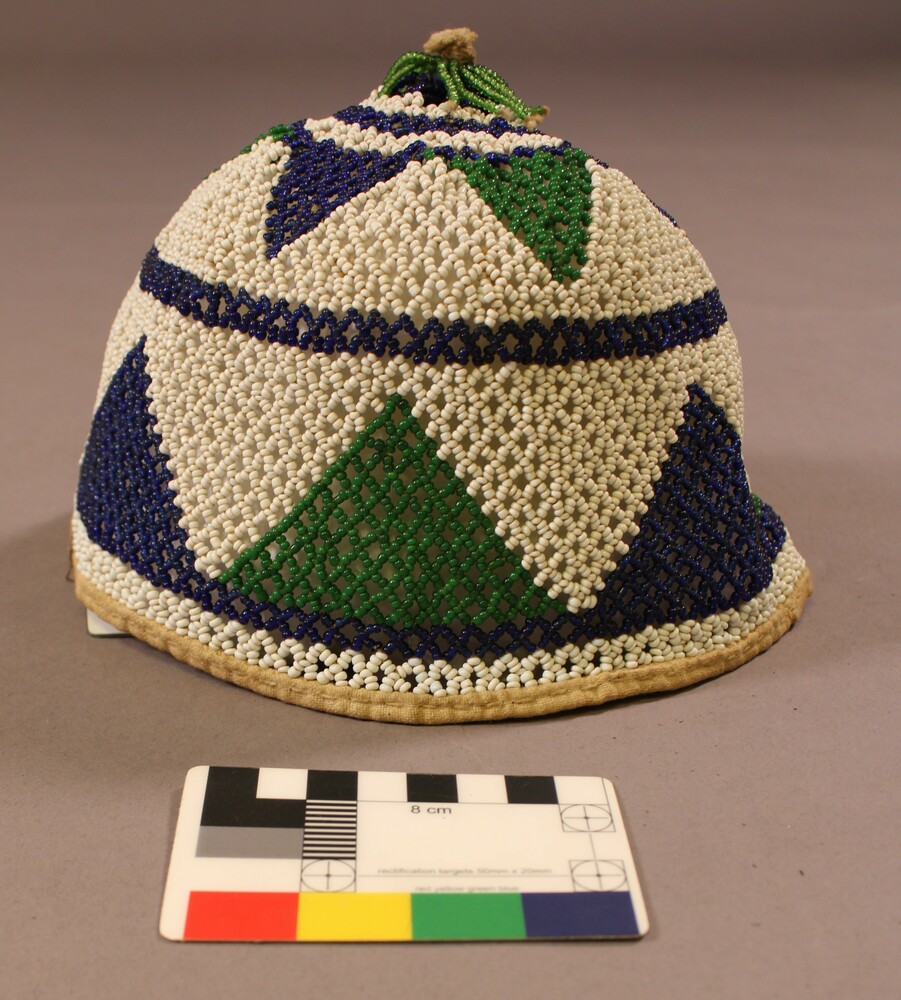 1978.9.5Close-fitting hat of beadwork. Green, blue, white glass beads.1978.9.5
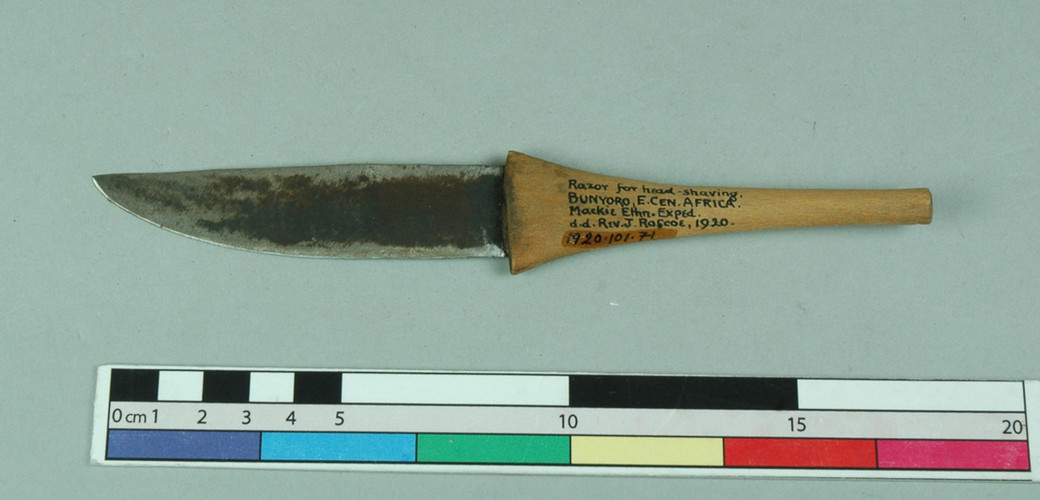 1920.101.71Razor shaped like a knife, with wooden handle. [El.B DDF Body Arts Project 2010/2011 27/08/2010]1920.101.71
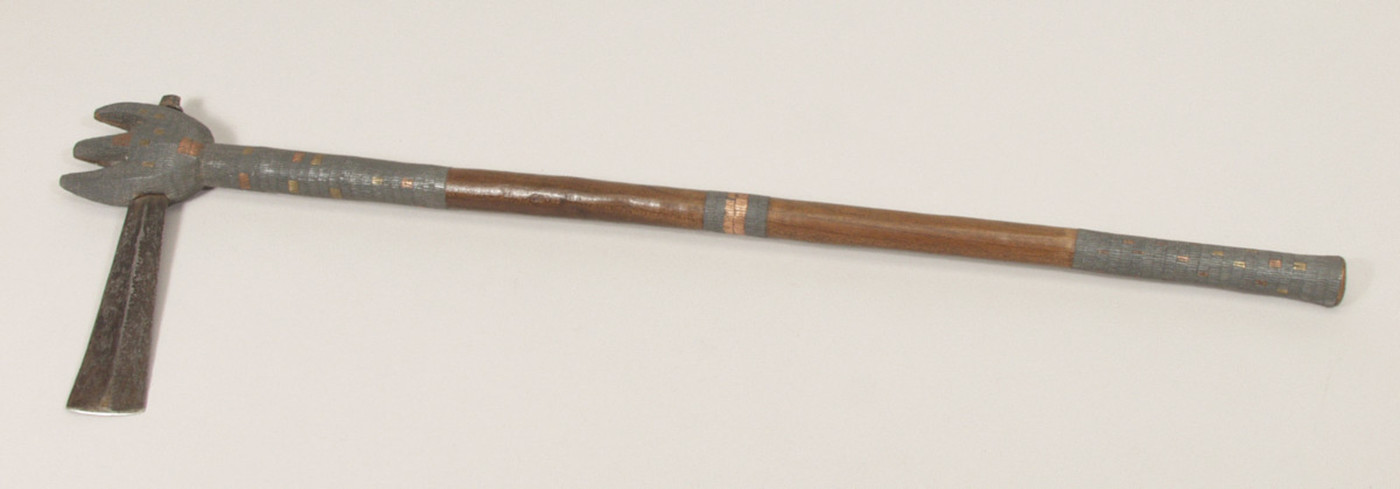 1922.48.1Ornamental iron axe with a wooden 3-pronged head and handle inlaid with lead, copper and brass strips [RTS 20/9/2004].1922.48.1
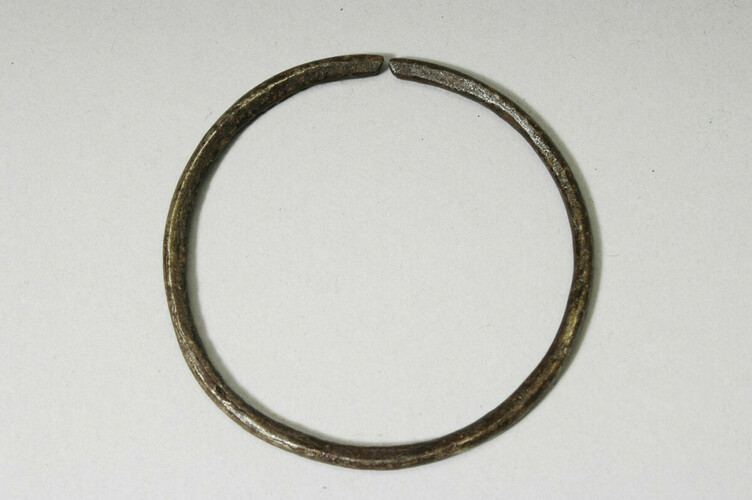 1966.1.517.6Penannular iron arm or leg ornament with square to oval section and almost touching ends [RTS 21/7/2005].1966.1.517.6