
- Collection type
- Object
- Description
- Oil lamp with cylindrical body and strap handle, made from recycled pesticide can [RTS 14/7/2005].
- Long description
- Oil lamp made in several parts from at least 2 types of recycled aluminium containers, which have a base colour of metallic grey (Pantone 877C). An unidentified type of container with Arabic writing was used to make the nozzle, while the body was made from a pesticide can. The nozzle has been made as a separate part that fits into the top of the body, and can be removed to fill the lamp with oil. It consists of an upright section made from a rectangular piece of sheet metal rolled into a narrow cylinder with overlapping ends, and the printed surface facing to the inside. This is not clearly visible, but has black Arabic script printed onto a pale pink surface. This has been pushed through the centre of a horizontal metal disc with the unprinted side of the sheet facing outwards. This probably has a stoppered base, but it is jammed tightly into the neck of the lamp and consequently not visible. Its edge overhangs the neck below slightly, which is similarly formed from a metal cylinder with a seam running up the side. This is heavily coated with a dull gray solder (Pantone 430C), as is its base where it fits into the centre of a conical sloping shoulder. Both neck and shoulder have no printing on their visible surfaces. This fits over a squat, cylindrical body, made from the upper part of a pesticide can, with the join sealed by yet more solder. The can has a seam running down one side, and a flanged bottom; the underside is formed by what was the top of the original can, with a moulded surface made up of concentric ridges, around a central nozzle where the aerosol spray fitting was originally attached. This has been removed, and a small patch of solder neatly dropped over the central hole to seal it. The sides of the can are printed with a yellow background (Pantone 106C), with the red (Pantone 186C) and black text positioned upside down. The text is bilingual, with English on one face of the can, and an as yet unidentified African language on the other. The centre of the English side consists of the phrase 'SUPER FAST-ACTING' above a white star, outlined in black, yellow and red, with the trademark name 'DOOM' at its centre. A block of text to one side in black reads: 'Household pesticide - Domestic class. DIRECTIONS FOR USE. Flying insects: spray directly at insect. To clear room of flying insects, spray into the air, keeping doors and windows closed for 19 minutes after spraying. Crawling insects: spray directly onto the insect. GUARANTEE: Contains 0.19% pyrethrun 0.105% permethrin (25.75 cis trans isomers), 0.5% dichlorvos, 0.5% piperonyl butoxides, with perfume, propellant and solvents to 100%. Average net contents: 275 ml/200 g. CAUTION - READ LABEL BEFORE USE. Pressurized container. Protect from direct sunlight. Do not store at temperatures over 50° C. Do not puncture or incinerate even when empty. Do not spray on naked flame or any incandescent material. Avoid contamination of foodstuffs. Keep away from children. Harmful to fish'. Below, a red rectangular box contains the warning 'HIGHLY INFLAMMABLE'. The African side contains what is presumably the same text. The logo caption reads: 'SUPER huangamza wadudu mara moja', while the side panel text reads: 'Household Insecticide - Domestic Class. JINSI YA KUITUMIA. Wadudu wanaoruka: Wanyunyizie wadudu wenyewe. Ukitaka kuwaua wadudu wanaoruka waliomo chumbani, nyunyiza dawa katika chumba na uhakikishe umeyafunga madirisha na milango kwa muda wa dakika kumi hivi. Wadudu wanaotambaa: Wanyunizie wadudu wenyewe. GUARANTEE: Vilivyomo [then with chemicals and amounts listed above] manukato na nyenyusho kufikia 100%. Kipimo cha wastani: 275 ml/200g. ONYO: SOMA MAELEZO KABLA YA KUTUMIA. Mkebe huu umeshindiliwa upepo. Jiepushe na popote penye joto linalozidi kipimo cha 50° C. Usiutoboe au kuuchoma mkebe hata ukiwa mtupu. Usinyunyize dawa karibu na moto wa aina yoyote. Usitumie dawa karibu na vyakula. lweke mbali na watoto. Yaweza kudhuru [...]'. Finally, a rectangular strip of metal has been bent into a vertical loop handle and soldered to the edge of the shoulder and the lower body. This has printing visible on the inside surface, with a white background and blue area on top (Pantone 2746C), and the single letter 'M'. The lamp is complete, with patches of surface rust and some surface scratches; the nozzle, which is made as a removable piece, has rusted into its current position. It has a weight of 57.1 grams, and is 107 mm high. The nozzle has a diameter of 7.5 mm, while the neck diameter is 21.3 mm, the shoulder measures 67 mm across, and the base is 63.4 mm in diameter. The strap handle is 8.8 mm wide and 34.5 mm long [RTS 14/7/2005].
- Geographical reference
- Masindi District Kibanda County Bweyale [Kiryandongo Refugee Settlement]
- Cultural groups
- Acholi
- Date / Period
- Date made: Before 1997
- Date collected
- 1997
- Acquisition information
- Purchased: 19/01/1998
- Materials and processes
- Material Aluminium Metal, Process Recycled, Process Hammered, Process Bent, Process Soldered, Process Printed
- Dimensions
- Height: max 108 mm, Diameter: max 64 mm, Length: max 80 mm, Weight 57.1 g
- Object numbers
- Accession number: 1998.9.9 Other numbers: Kaiser no. 10 Other numbers: PRM invoice item 9 (see RDF)
- Research and responses
This object is one of a collection made by Tania Kaiser, a D.Phil. student of Linacre College, during her fieldwork in the Kiryandongo Refugee Settlement. She conducted fieldwork in the camp from October 1996 to March 1997, and between June and November 1997. The population of the camp had originally come from Parajok in the Torit district of Southern Sudan, and was a mix of Acholi from that area and previously displaced Sudanese refugees (For details of her work, see: T. Kaiser, 1999, Living in Limbo: Insecurity and the Settlement of Sudanese Refugees in Northern Uganda (Unpublished PhD); T. Kaiser, "Making Do and Making Beautiful: Recycling in an African Refugee Settlement", in: J. Coote, C. Morton and J. Nicholson (eds), Transformations, the Art of Recyclying, 44-47; T. Kaiser, 2000, UNHCR's Withdrawal from Kiryandongo: Anatomy of a Handover, New Issues in Refugee Research Working Paper No. 32, 1, 3).
Kaiser comments that: "Aerosol cans of 'Doom' insecticide are particularly popular [for making into recycled objects], both for their bright yellow colour and for the fact that they feature pictures of bugs and cockroaches" (Kaiser in Coote et al., 2000, p. 46) [RTS 18/7/2005].
Further items to explore
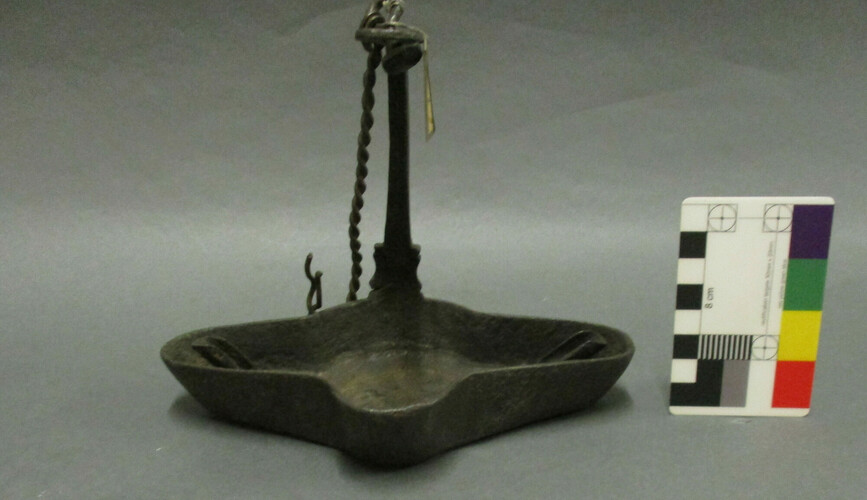 1932.88.269Saucer lamp of iron. Two wick holders within bottom of the quatrefoil-shaped pan. Curved vertical handle from which a twisted metal wire hook is attached. [BA [OPS Move] 12/4/2017]1932.88.269
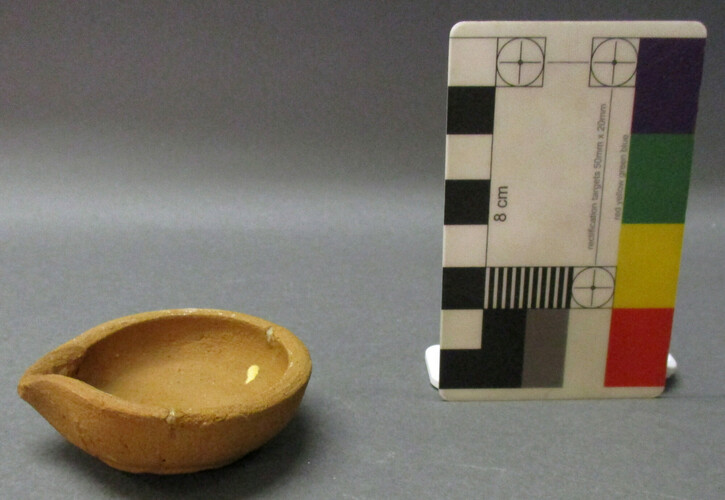 1915.32.5Pottery lamp of red ware. Bowl shaped saucer lamp with flat bottom, rounded sides and a single pinched wick nozzle. [MOBB [OPS move] 07/10/2016]1915.32.5
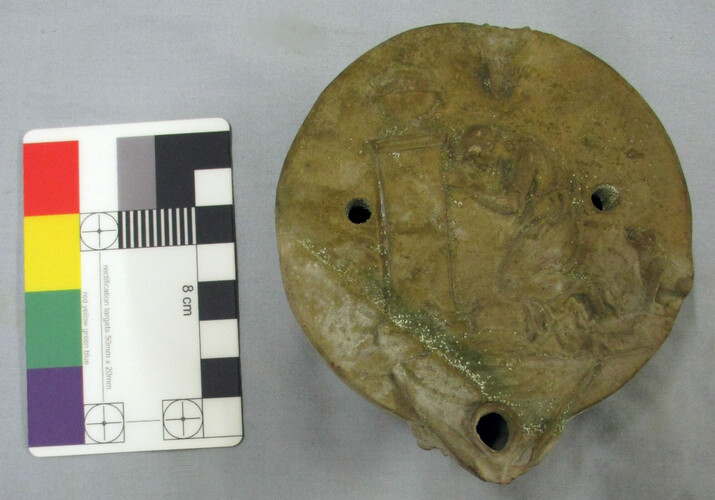 1932.88.509Pottery lamp of buff ware. Circular body with foot and flat top and slightly raised and projecting wick lip and no handle. The wick lip is supported by the face of a man which is on the side of the body. The top of the object is decorated with the scene in relief of a woman kneeling in front of a pillar on top of which is perched an urn. Behind her is an animal. [MOBB [OPS move] 8/9/2016]1932.88.509
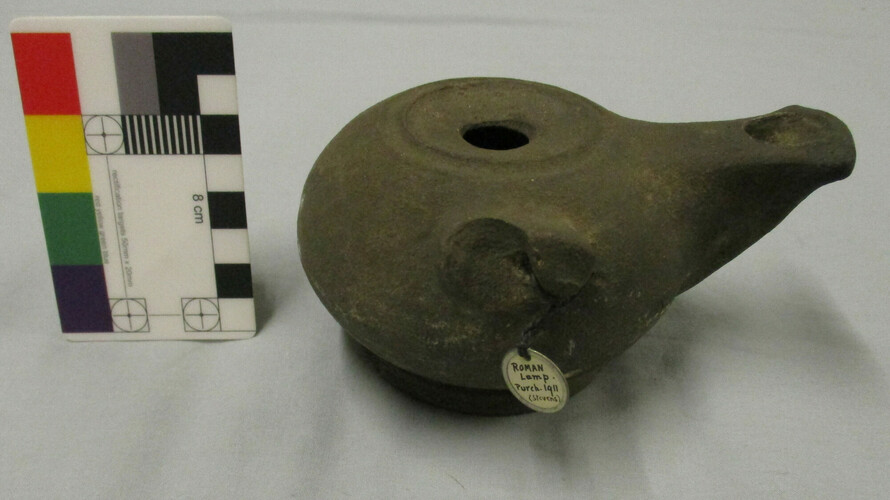 1911.59.8Pottery lamp of black or brown ware. Rounded body with nearly flat top with ridge around the central section. There is a projecting wick nozzle with axe-head shaped terminus. Expanded foot. There is a laterally perforated lug with a curved finger rest behind. [MOBB [OPS move] 6/9/2016]1911.59.8
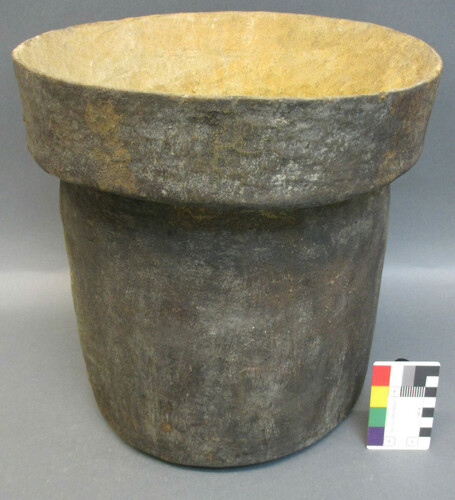 1921.9.12Wooden water pail, used for drawing water for cows. Slightly rounded base with an overhanging rim. [RM [OPS move] 22/9/2016]1921.9.12
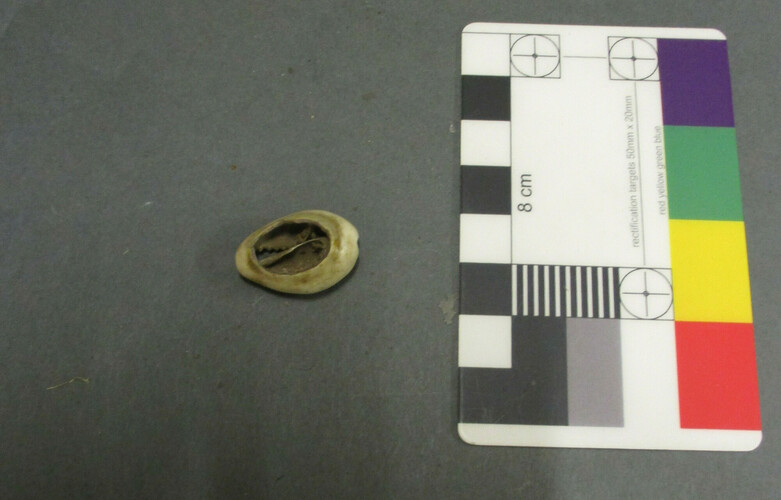 2017.121.17Cowrie shell. Part of a rainmakers outfit. [FB 1/6/2017]2017.121.17
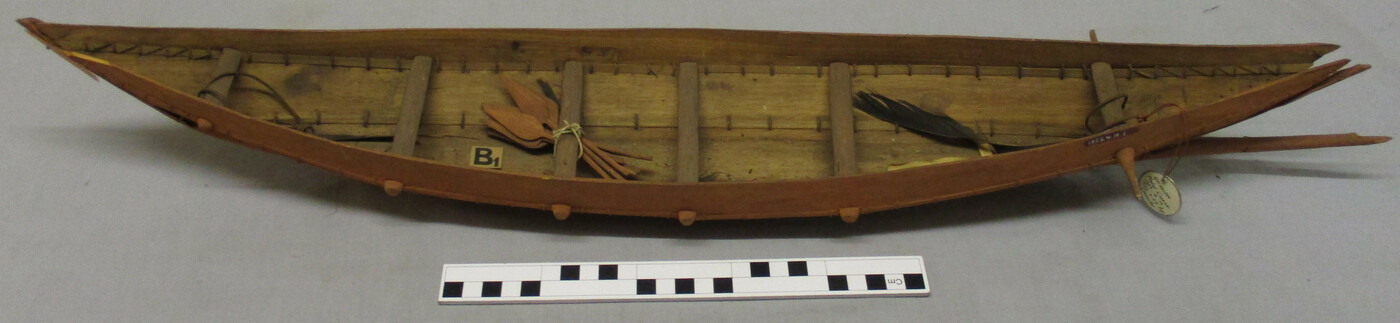 1953.4.19.1Model sewed bark canoe, lashed together with plant fibre and cane. At the prow there is a protrusion running extended from the keel. There are 6 seats across its inner-width. The outer surface has been painted with red ochre. For the walkway please refer to [1953.4.19 .2], for the bundle of 8 paddles please refer to [1953.4.19 .3], and for the grass fringe please refer to [1953.4.19 .4]. [BH [OPS move] 12/09/2016]1953.4.19.1
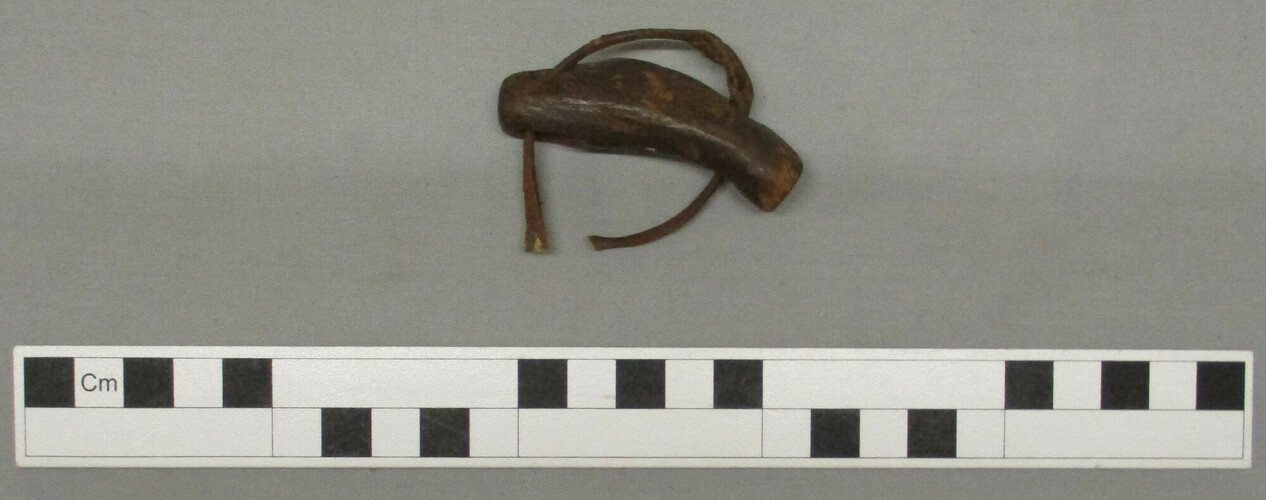 1884.30.60.2Curved rectangular wooden toggle perforated with a piece of hide. For the shield see 1884.30.60 .1. [CW [OPS move] 10/8/2016]1884.30.60.2