
- Collection type
- Object
- Description
- White-face mask with features highlighted in brown [ZM 12/12/2013]
- Long description
- Face mask. Carved wooden mask with the appearance of a human face. The features are quite naturalistic but exaggerated, with a very prominent brow ridge, nose and lips. There are large eye holes. Some of the features are highlighted with pigment - reddish brown on the lips, black / brown on the eyebrows, nostrils and forehead marking. There is a carved and pigmented area at the top possibly representing a hat or hair. There is also some whitish pigmentation as the background / skin colour. The right ear is missing and the tip of the nose is damaged. There are a row of holes all around the edge of the mask. The inner side of the mask is roughly carved. [ZM 08/04/2013]
- Geographical reference
- Southeastern Nigeria Niger Delta Akwa-Ibom State Opobo
- Cultural groups
- Ogoni
- Date / Period
- Date made: Before 1914
- Date collected
- By 1914
- Acquisition information
- Donated: 1914
- Materials and processes
- Material Wood Plant, Material Pigment, Process Carved, Process Painted, Process Perforated
- Dimensions
- Width: max 150 mm, Height: max 210 mm, Depth: max 120 mm
- Object numbers
- Accession number: 1914.26.19
- Research and responses
Jill Salmons examined this mask during a consultation visit to look at the Ogoni masks on 18 September 2013 and noted the following: All five of the Ogoni masks in the Museum collection can be categorised as the small, delicately carved face masks representing men and women, generically referred to as elu (spirit), which are used for a variety of masquerades. This style of mask generally does not completely cover the wearer's face. The holes around the edge of the mask are for the attachment of a masquerade costume, as the mask itself is only part of a full regalia. The accession book description of a 'mask of the Ogoni (Ibo) of the Opobo district' contains a number of contradictions as the Ogoni and the Ibo (now called the Igbo) are two entirely different cultural groups, plus the Opobo district is an Ibibio area rather than Ogoni or Igbo. This mask does look Ogoni, although the closed mouth, and shape of the eyes and nose is unusual. Many, like the other four in the Collection have either round or slit eyes, an open mouth with narrow teeth, and a pert, upturned nose (see 1919.73.16 and 1938.15.30 to 32). Only Ogoni men or boys wear masks for masquerade, female masquerades do not include masks. For more information about Ogoni see Sonpie Kpone-Tonwe and Jill Salmons, 2002, 'The Arts of the Ogoni' pages 274-305 in Anderson and Peek (editors), Ways of the Rivers: Arts and Environment of the Niger Delta, Los Angeles: UCLA Fowler Museum of Cultural History.] [ZM 19/09/2013]
Search terms: Mask
Further items to explore
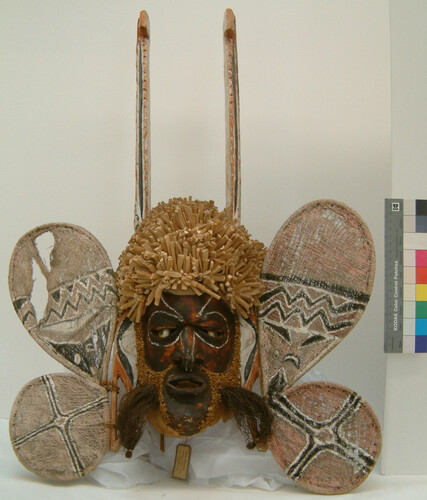 1900.55.475Mask with an elaborate coiffure, a wide, projecting nose, pierced and distended earlobes, side whiskers, a big mouth, and sound teeth.1900.55.475
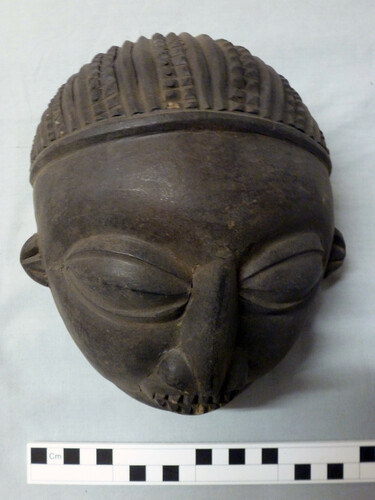 1942.13.254Pottery mask. Depicting a human face with lozenge-shaped eyes, rounded cheeks and a braided hairstyle. The pottery is black in colour and the underside of the mask is hollow. [AB [OPS Move] 30/08/2016]1942.13.254
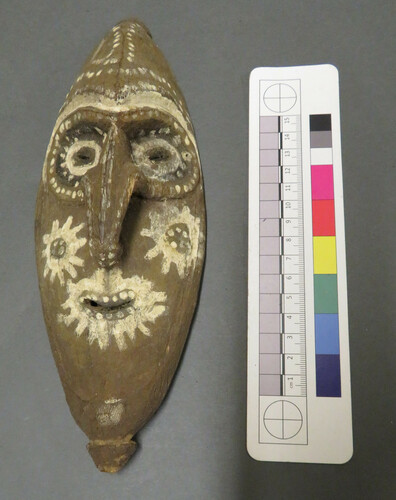 1938.36.1518Wooden mask. Oval in shape with decoration painted on in white pigment. There are perforations at the eyes and mouth. [AF [OPS Move] 22/3/2017]1938.36.1518
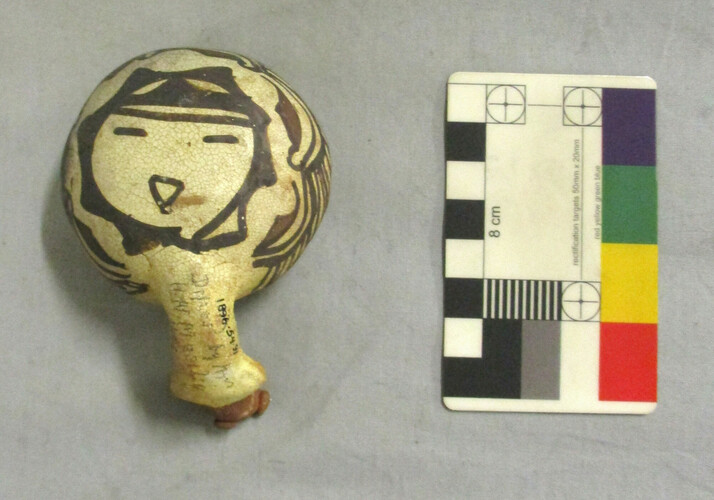 1896.54.91Buff ware ladle or spoon with a white wash exterior and painted decoration on the exterior. [ASh [OPS move] 04/04/2016]1896.54.91
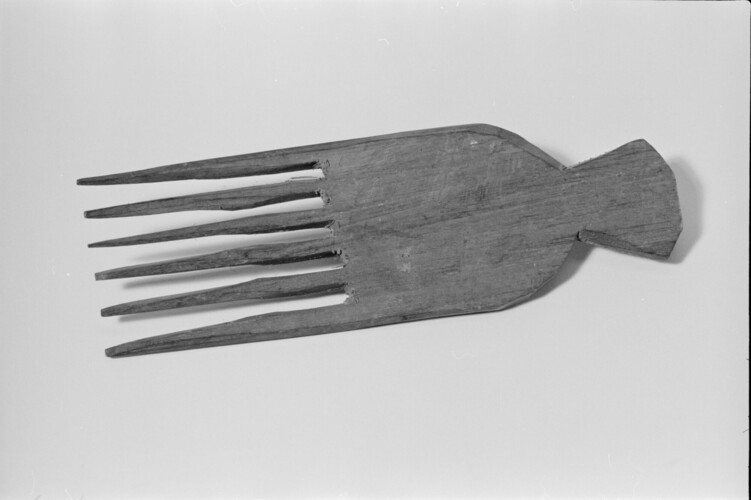 1993.68.58Plain wood comb. [LM 'DCF 2004-2006 What's Upstairs?' 31/1/2006]1993.68.58
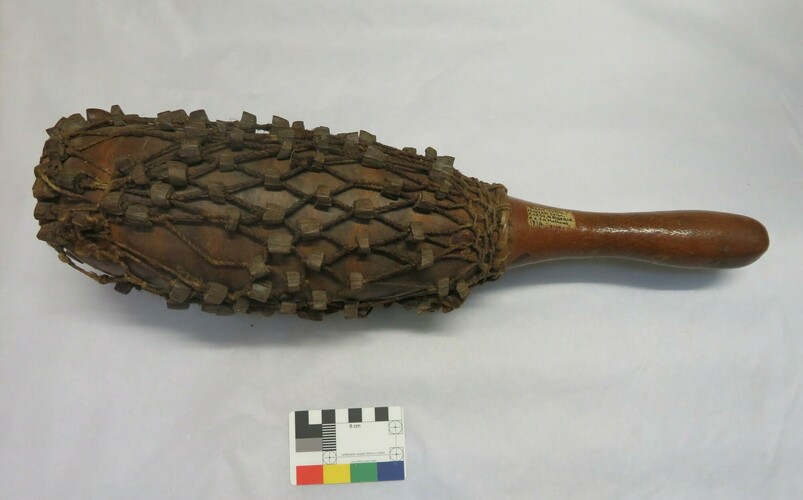 1914.54.34Vessel rattle1914.54.34
 1942.13.712.2Charm. Brass manilla ring attached to a strip of plant fibre that has been looped to create a string of charms. The charms alternate between Manilla rings and bell-shaped charms. Also attached to the string are 1942.13.712 .1 - .8 [ASh [OPS move] 22/3/2017]1942.13.712.2
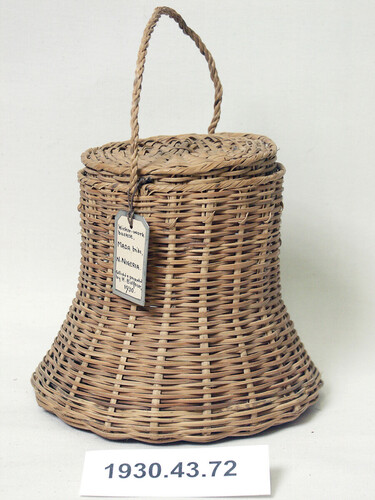 1930.43.72.1Wicker basket with splaying out base and circular lid.1930.43.72.1