
- Collection type
- Object
- Description
- Wooden headdress mask in the form of a bird's head and beak, inscribed with nsibidi writing.
- Long description
- Wooden headdress mask in the form of a bird's head and beak, inscribed with nsibidi writing. With basketwork cushion for resting on head. A headpiece for the 'cult agency' Obasinjom. [JC 23 7 1997, 9 10 2004]
- Geographical reference
- Cultural groups
- Ejagham
- Date / Period
- Date made: Before 1914
- Date collected
- By 1914
- Acquisition information
- Donated: 1914
- Materials and processes
- Material Wood Plant, Material Plant Fibre, Process Pyroengraved Pokerwork, Process Plaited, Process Basketry, Process Inscribed
- Dimensions
- Width: max 90 mm, Length: max 445 mm, Height 163 mm
- Object numbers
- Accession number: 1914.26.6
- Research and responses
Examined by Dr Ute Röschenthaler of Berlin, 23 July 1997 (see correspondence in RDF). [JC 23 7 1997]
According to Dr Ute Röschenthaler, this is a headpiece for the 'cult agency' Obasinjom. For Dr Röschenthaler's account of this 'cult agency', see 'Transacting Obaninjom: The Dissemination of a Cult Agency in the Cross River Area', by Ute Röschenthaler, in Africa, Vol. LXXIV, no. 2 (2004), pp. 241-76. In note 8 on page 249, she notes: 'An Obasinjom headpiece collected by Talbot is in the Pitt Rivers Museum, Oxford'. (Offprint in RDF.) [JC 9 10 2004]
This object was examined by David Pratten, during a research visit/student seminar in March 2009. He noted that this headdress was Obasinjom. Most masks are silent, however, this one was capable of speech. In his opinion this might explain why it is inscribed with writing. Obasinjom masks/headdresses are shaped like crocodiles, therefore this one is in fact a crocodile even though it does resemble a bird. Originally it would have had feathers projecting from the top. [SM 20/03/2009]
According to Keith Nicklin's entry in the Grove Dictionary of Art Online: 'The Ejagham are often referred to in the literature as 'Ekoi', a derogatory name used by the Efik, that has now largely been abandoned by scholars. The old designation 'Ekoi' is often extended to those of their neighbours - including the Yako and Mbembe to the west, Bokyi to the north, Widekum to the north-east and Bangwa to the east - who have adopted aspects of Ejagham ritual and material culture. The Ejagham are thus not a single 'tribe' or ethno-linguistic group but, rather, a loose confederation or congeries of peoples sharing major cultural features but with distinct socio-political systems.' [for full article see Nicklin, Keith. "Ejagham." Grove Art Online. Oxford Art Online. Oxford University Press. Web. 2 May. 2013. http://www.oxfordartonline.com/subscriber/article/grove/art/T025751. [ZM 02/05/2013]
Search terms: Mask, Theatre and Drama, Writing, Figure, Basketry, Clothing Headgear, Headdress, Bird Figure, Inscription
Further items to explore
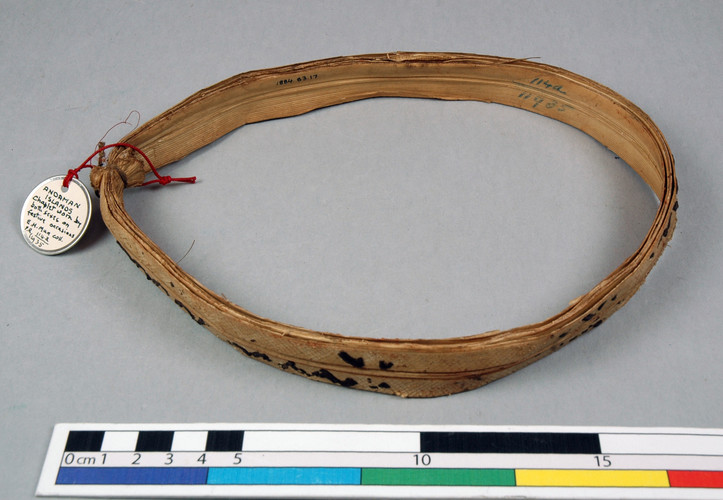 1884.83.17Headdress of pandanus leaves in a band with painted zigzag lines. [MJD DDF Body Arts Project 2010/2011 19/08/2010]1884.83.17
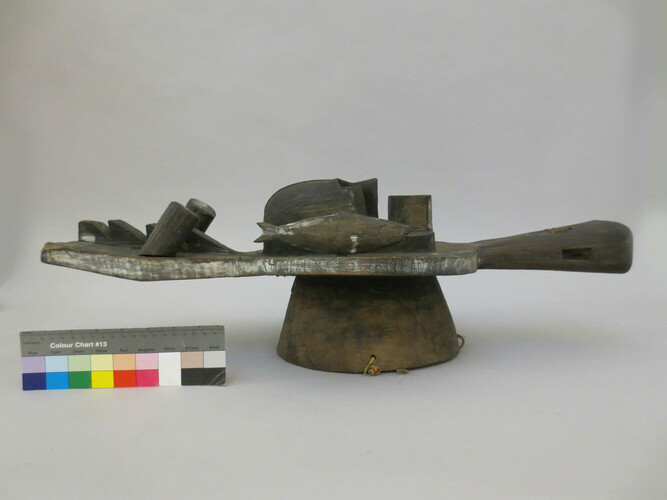 1938.15.40Head mask carved in a geometric style with skull-like features and aquatic elements, including fishes, fins and flared tail or canoe prow. [ZM 09/10/2013]1938.15.40
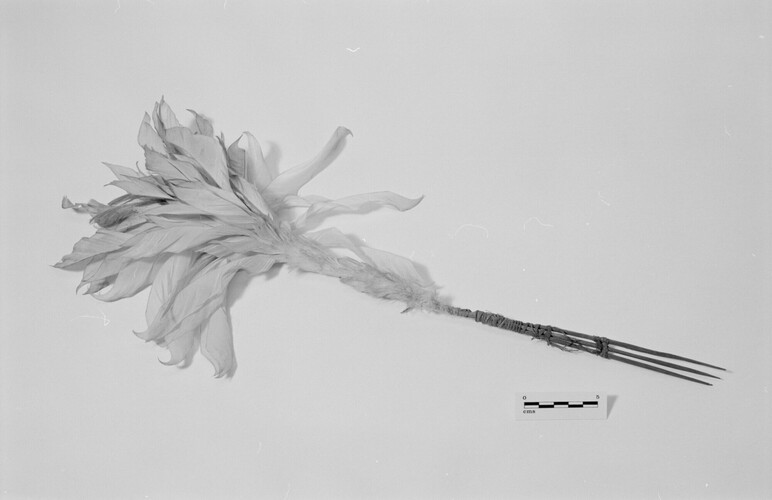 1938.36.1270Feather head ornament consisting of three-pronged wooden comb attached by binding to a stick. The length of the stick is covered with down feathers and a large number of full feathers are attached to the end.1938.36.1270
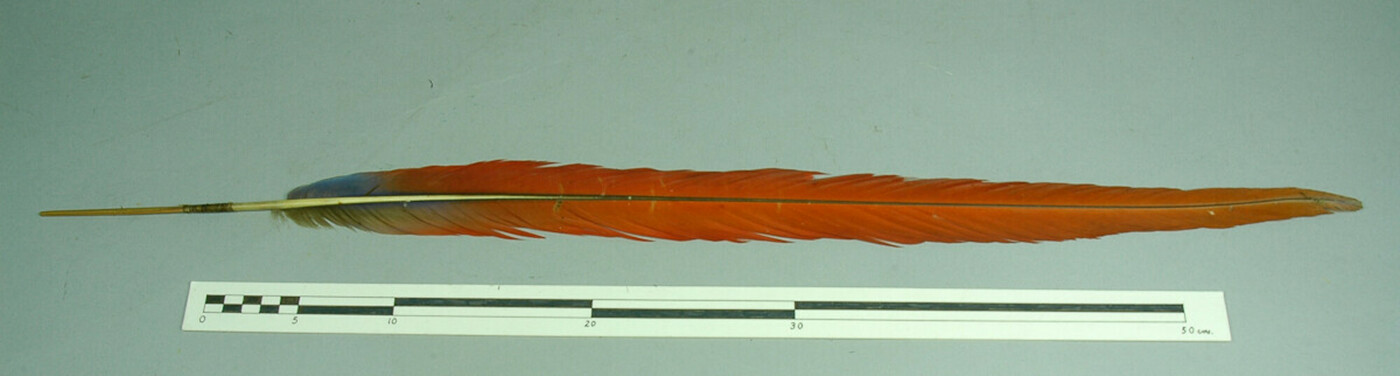 1941.3.42.1.3Long red feather, with some blue at the base. [El.B 02/12/2008]1941.3.42.1.3
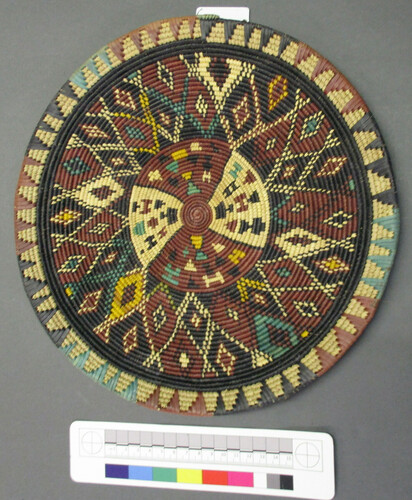 1978.6.34Circular coiled basketry grass tray. The tray is patterned with geometric designs dyed black, yellow, green and red on a natural ground. [CW [OPS move] 8/12/2016]1978.6.34
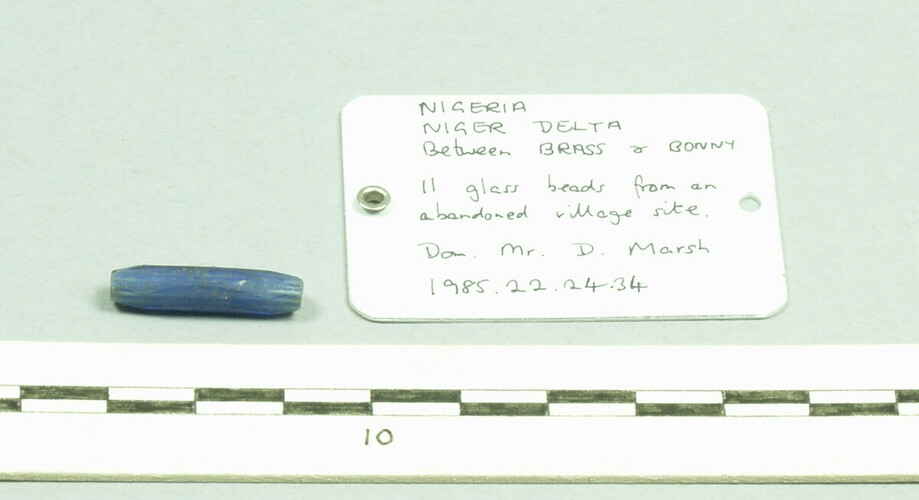 1985.22.29Tubular dark blue glass bead. [N.B. 'DCF 2004-2006 What's Upstairs?' 1/7/2005]1985.22.29
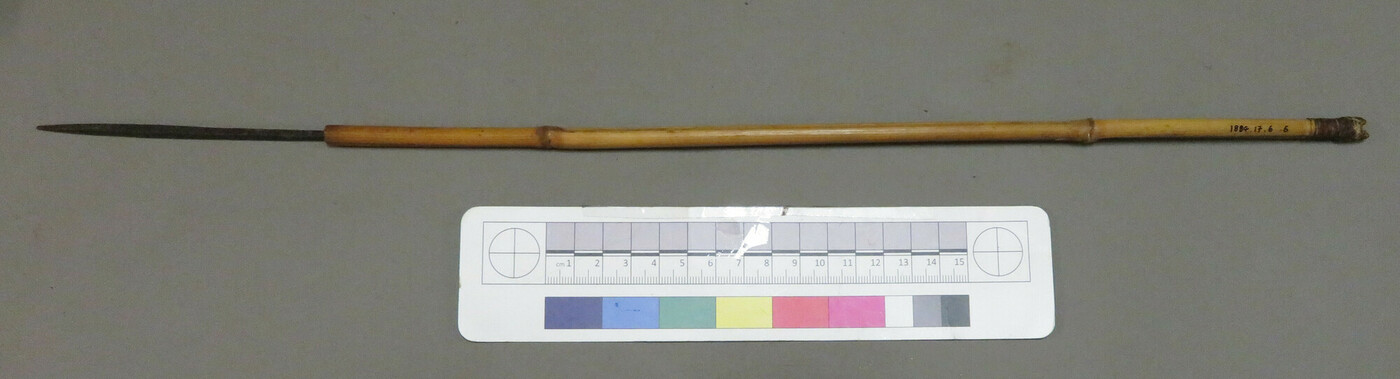 1884.17.6.6Arrow with bamboo shaft and pointed metal head. The head is square section. The tail end is notched and bound with plant fibre. [SB [OPS move] 3/10/2017]1884.17.6.6
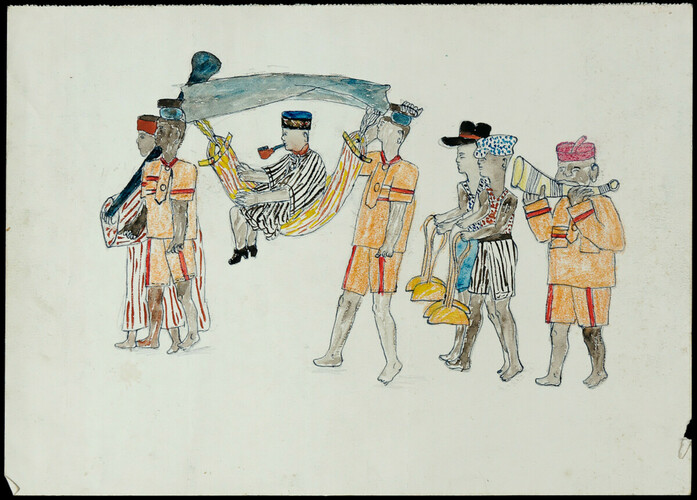 1996.5.44Polychrome drawing of men in a procession carrying one man on a hammock1996.5.44