
- Collection type
- Object
- Description
- Dark green unclassified polished jade stone axe with four side. The top of the but is flat. The lower part of the body is broken away. [Fumiko Ohinata, Japanese Archaeology Project 1996-2000]
- Cultural groups
- Japanese
- Date / Period
- Archaeological period: Jōmon 縄文時代
- Date collected
- By 1907
- Acquisition information
- Donated: 1907
- Materials and processes
- Material Jadeite Stone, Process Flaked, Process Ground, Process Polished
- Dimensions
- Depth: max 19 mm, Length: max 53 mm, Width: max 42 mm, Weight 60.5 g
- Object numbers
- Accession number: 1907.52.25 Other numbers: JAC 293
- Research and responses
Listed and described as JAC293 on page 85 of the unpublished draft typescript 'The Japanese Archaeology Collections at the Pitt Rivers Museum, University of Oxford', by Fumiko Ohinata and Jeremy Coote (dated 2002): 'Stone Tools ... Stone Axes ... Polished axes … There are numerous variations in the shapes of polished axes, but in this section all the polished axes housed in the Pitt Rivers Museum are classified into three main categories after the traditional classification scheme [see S Hayakawa, 1983, ‘Masei sekifu’ in Jomon bunka no kenkyu 9 (Studies of Jomon Culture), edited by S. Kato, T. Kobayashi and T. Fujimoto, published in Tokyo by Yuzankaku] A: four-sided polished axes with rectangular sections. B: axes with rounded cutting edges and biconvex sections, C: Pestle-shaped polished stone axes with a pointed butt. The handle was attached perpendicularly to the body of Type A axes and they were probably used as hand axes or chisels ... The helves of Type B and Type C axes were attached in parallel to the working edge of the bodies and because of their weight and large size they were probably used for cutting down wood ... / JAC 293; Plate 32.2 / North Japan / Dark green jade / (5.3)×4.2×1.9 cm; 60.5 g / Unclassified polished stone axe with four side. The top of the but is flat. The lower part of the body is broken away. / Purchased from Chamberlain in November 1907; PRM 1907.52.25.' Also illustrated in Plate 32.2. (Copy of typescript in RDF: Researchers: Ohinata and Coote). [MN 24/08/2009]
Further items to explore
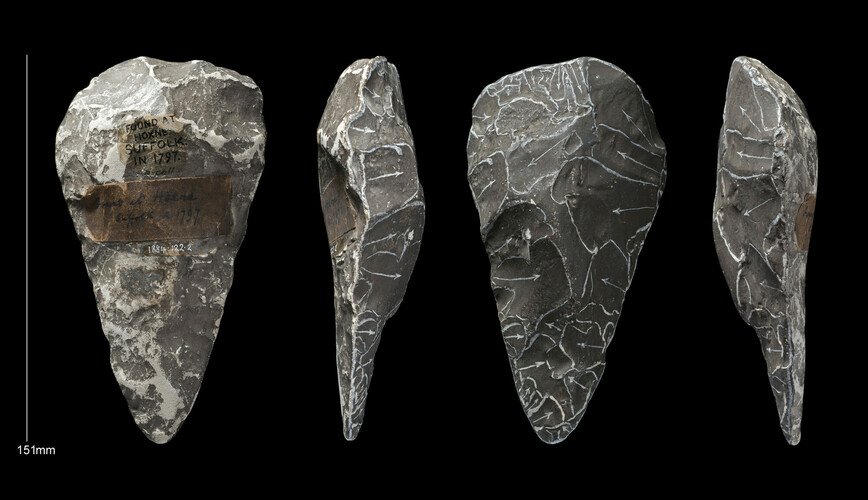 1884.122.2Cast of a Palaeolithic hand-axe [SM (Verve) 22/9/2016]1884.122.2
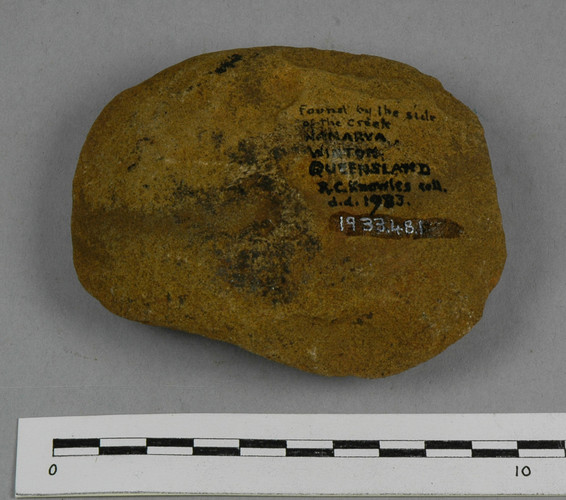 1933.48.1Axe of ground light brown porous stone. [LM 01/08/2007]1933.48.1
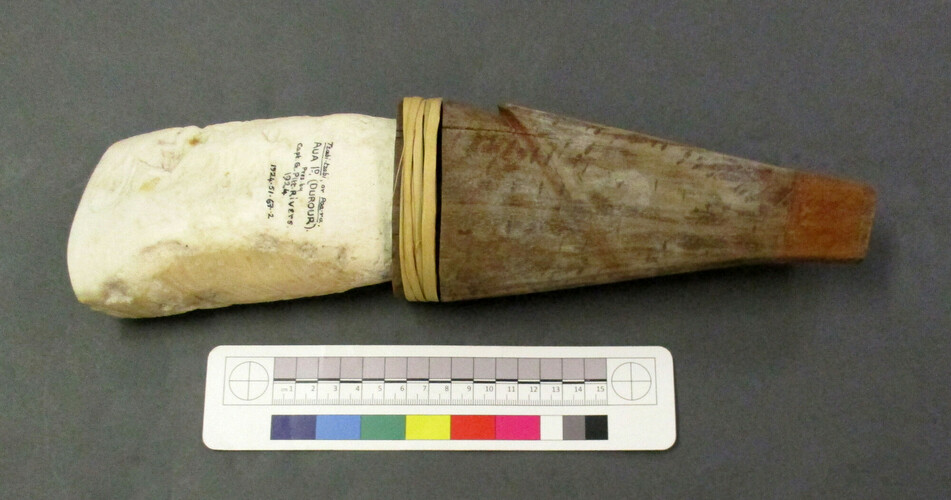 1924.51.67.2Tridacna shell blade of an axe. Bound to wooden foreshaft with cane. For the wooden haft see [1924.51.67 .1] [RM [OPS Move] 20/1/2017]1924.51.67.2
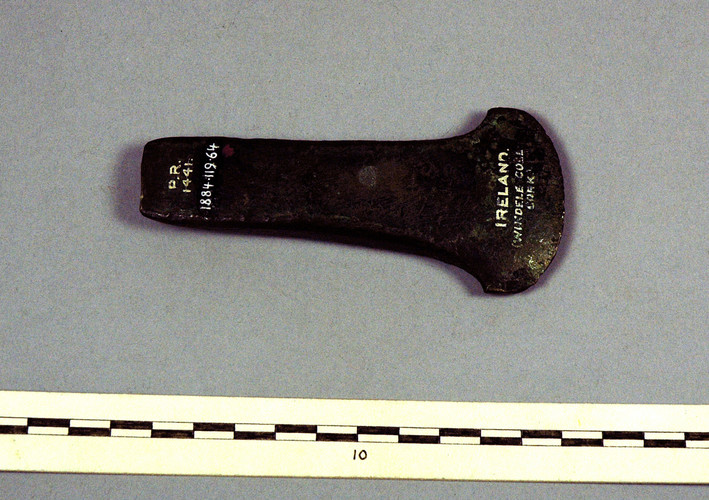 1884.119.64Bronze flat axe1884.119.64
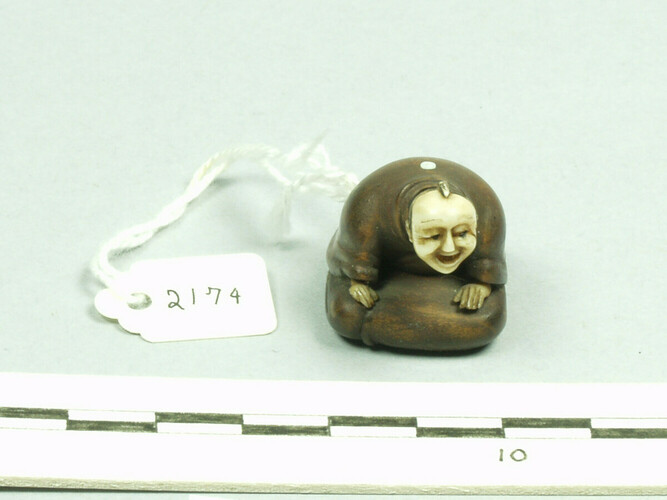 1980.34.2174Wood and ivory netsuke of a kneeling storyteller figure. [El.B 'DCF 2004-2006 What's Upstairs?' 3/5/2005]1980.34.2174
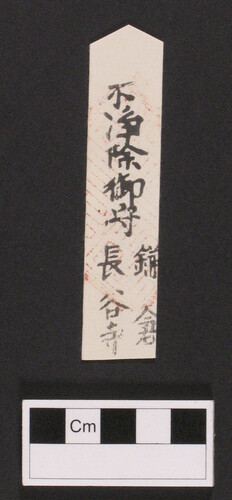 1985.53.404Paper amulet folded into a narrow strip, triangular at the top, with black inscription and red stamp. [El.B 18/10/2013]1985.53.404
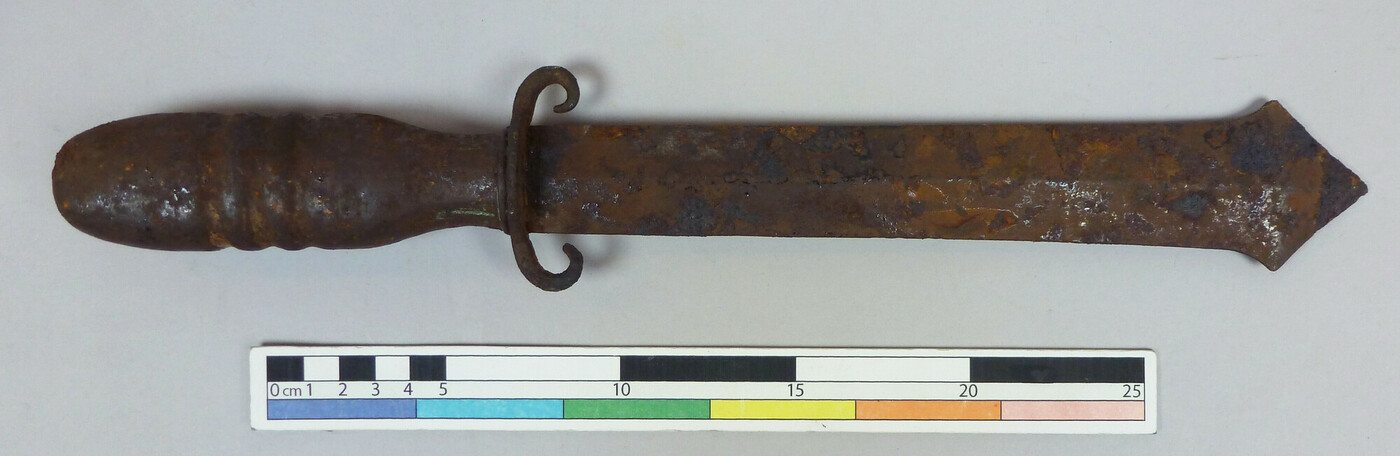 1985.53.641Dagger entirely made from iron, blade with triangular tip, traces of black pigment on the blade and handle. [El.B 15/11/2013]1985.53.641
 1996.17.65.1Circular incense box with a flat base and rounded sides. There is a blue band below the rim that has a ridge within it to allow the lid to placed on top. Glazed all over. Makers mark above the foot rim on the side. Please note that the lid associated with this object is 1996.17.65 .2. [ASh [OPS move] 01/03/2016]1996.17.65.1