
- Collection type
- Photograph
- Description
- Portrait of a peregrine falcon (shahin), belonging to Sheikh Zayed bin Sultan Al Nahyan's hunting party, resting in the sands near Al Ain. A peregrine falcon perches on a carved wooden wakir (block) staked in the sand, facing towards the near left. The falcon's burqa (hood) lies in the sand to the right of the wakir. In the background a vast expanse of sand continues into the far distance.
- Geographical reference
- Abu Dhabi Emirate; Al Ain Region; Al Ain City
- Person
- Photographer Wilfred Patrick Thesiger
- Expedition or compiler Wilfred Thesiger United Arab Emirates and Oman Winter 1949-50
- PRM source Wilfred Patrick Thesiger
- Date / Period
- Date of photograph: 01/12/1949 - 12/01/1950
- Acquisition information
- Acceptance in Lieu: 03/2004
- Dimensions
- Image dimension 35 mm
- Object numbers
- Accession number: 2004.130.25351.1 Previous PRM number: WT.1950.2.34 Previous other number: 1950/2.34
- Research and responses
Research Notes - 'Last winter I spent three weeks hawking with the Abu Falah sheikhs on the Trucial Coast at the southern end of the Persian Gulf.... The Arabs here use the peregrine, which they call "shahin", whereas on the open gravel plains of the Nejd they prefer the saker falcon or "hurr". The peregrine is swifter, bolder and more persevering, but the saker is said to have better eyesight and is worth up to twenty pounds, whereas a peregrine can be had for ten pounds.' Wilfred Thesiger, 'Hawking in Arabia', Listener, 42 (1949), p.803. [AK 23/05/2011]
Research Notes - 'I spent the next month hawking with Zayid in the Khatam sands. The Al Bu Falah and Bin Maktum sheikhs of the Trucial Coast look forward eagerly to the hawking season which in these parts starts in November and usually ends in March. Zayid uses peregrines (shahin, pl. shuahin) mostly of the Eastern race, though I noticed one Barbary falcon among his birds, in preference to saker falcons (hurr pl. harar) which are preferred on the open plains of the Najd. The saker has better eyesight than the peregrine and can see a bustard on bare ground at an incredible distance, but among the sands, where bustards are easily tracked and where they can be approached from behind the dunes, the Arabs fancy the peregrine since it is swifter, bolder and more persevering than the saker. These peregrines are caught on the islands and salt flats along the Trucial Coast while on migration in November and December.' Wilfred Thesiger, pp. 143, in 'Desert Borderlands of Oman', Geographical Journal, 116, Oct. - Dec. 1950, pp. 137-168. [AK 23/05/2011]
Research Notes - 'I have been told that in England it takes fifty days to train a wild falcon, but here the Arabs had them ready in a fortnight to three weeks. This is because they were never separated from them. A man who was training a falcon carried it about everywhere with him. He even fed with it sitting on his left wrist, and slept with it perched on its block beside his head. Always he was stroking it, speaking to it, hooding it and unhooding it.' Wilfred Thesiger, pp. 269, Arabian Sands (London, 1959). [AK 23/05/2011]
Further items to explore
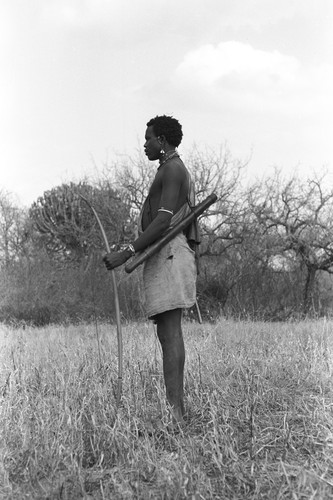 2004.130.1901.1Profile portrait of an Endo man holding a bow and carrying a quiver of arrows over his shoulder.2004.130.1901.1
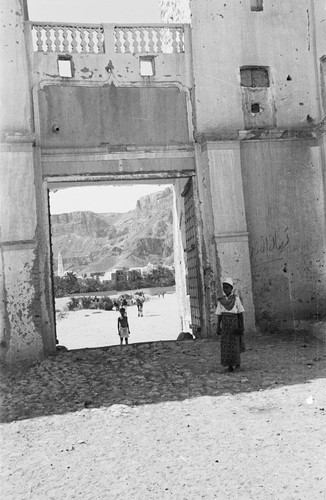 2004.130.3147.1A gateway between two buildings in the city of Seiyun.2004.130.3147.1
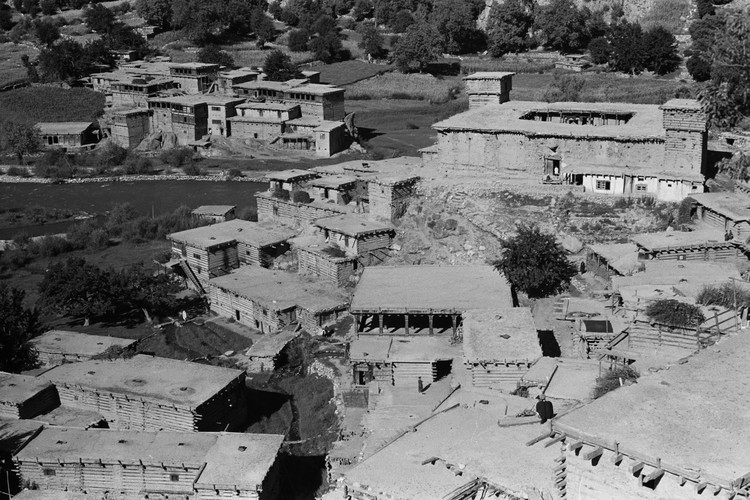 2004.130.5071.1View looking down onto some buildings in a valley.2004.130.5071.1
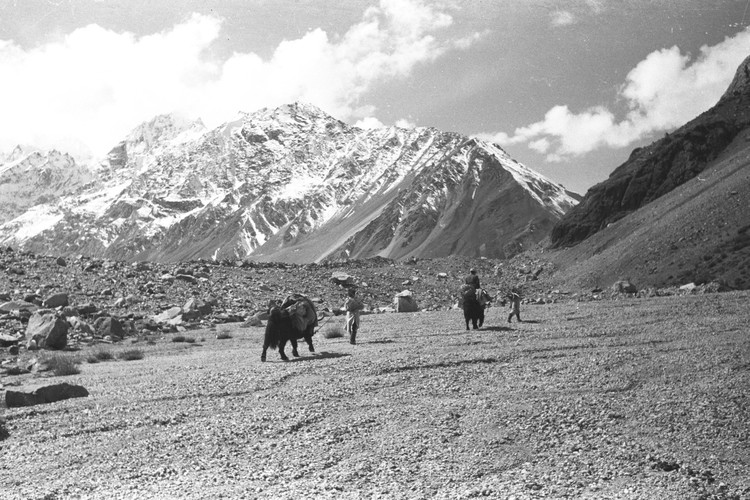 2004.130.7227.1View of Wilfred Thesiger's porters walking with two laden yaks, with snow-capped mountains in the distance.2004.130.7227.1
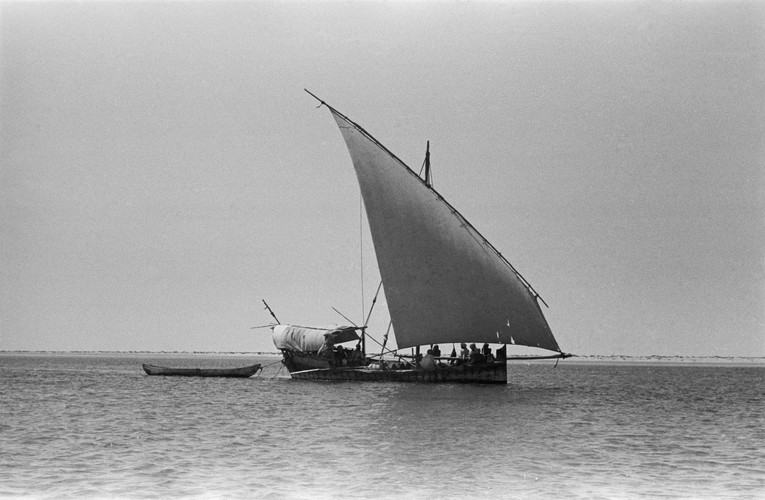 2004.130.17641.1View of one of the dhows (sailboats) on which Wilfred Thesiger sailed through the Abu Dhabi islands with Sheikh Hazaa bin Sultan Al Nahyan and his retainers. A dhow under full sail glides across a flat sea. Men sit crowded together on the deck of the dhow. At the back of the dhow a cloth covered awning is blown by the wind. A small canoe is towed behind the dhow. In the far distance a low sand bank stretches across the horizon. This image was taken during Wilfred Thesiger's week and a half long sailing trip around the Abu Dhabi Islands with Sheikh Hazaa bin Sultan Al Nahyan, Sheikh Khalid bin Sultan Al Nahyan and their retainers in March 1948.2004.130.17641.1
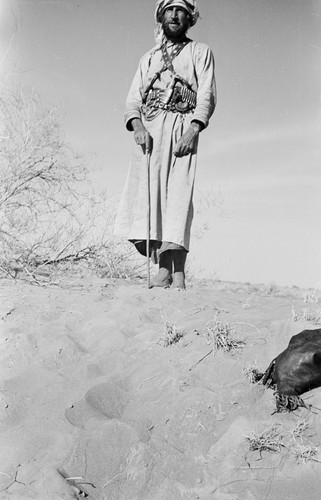 2004.130.25537.1Standing full length portrait of Wilfred Thesiger taken by an unknown photographer in the region surrounding Al Ain / Buraimi Oasis. Wilfred Thesiger stands in the sand holding a camel stick (his head is partially cut off by the frame). He wears a khanjar (dagger) on a cartridge belt with leather suspenders over his thobe (shirt). Behind him on the left a dry bush grows in the sand.2004.130.25537.1
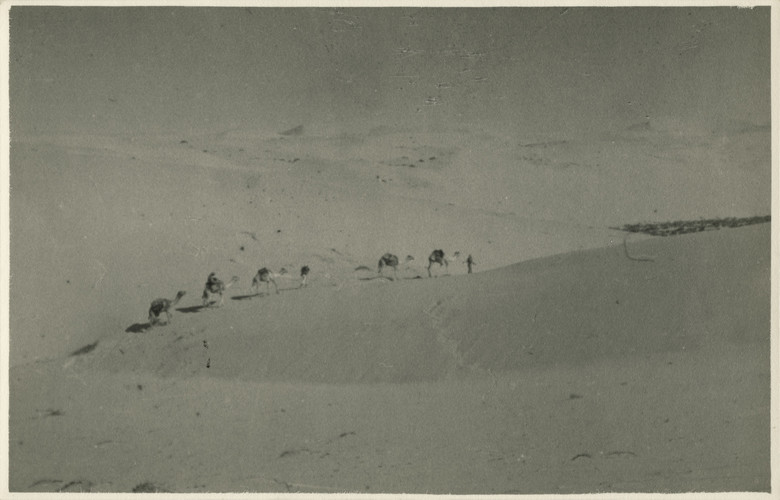 2004.130.6604.2View of Wilfred Thesiger's party trekking through dunes in the Al Batin sands, near Liwa oasis. Three of Wilfred Thesiger's Bedouin companions lead a line of camels through a gap between sand dunes. They are heading towards a small plain dotted with salt bushes, which can be seen in the far right distance.2004.130.6604.2
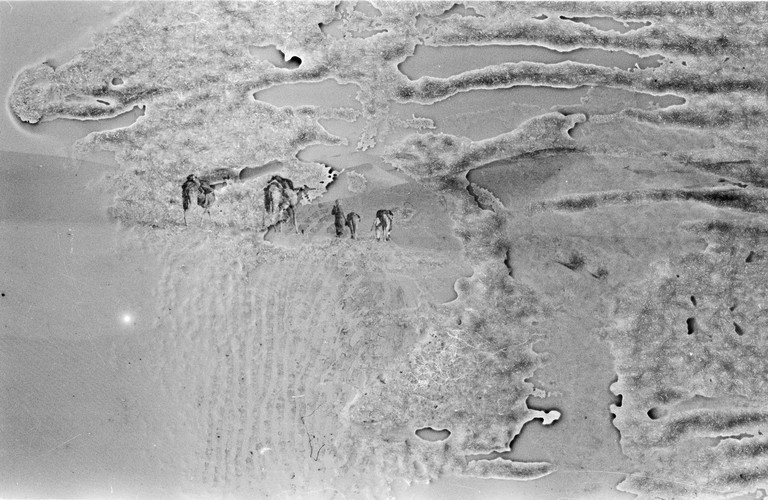 2004.130.6593.1View of Wilfred Thesiger's party travelling across high dunes in the region of Kidan plains (Suhul al Kidan) or Al Batin sands in the Empty Quarter (Rub‘ al Khali). Wilfred Thesiger's Bedouin companions lead their camels down a slight slope towards another dune in the near distance.2004.130.6593.1