
- Collection type
- Photograph
- Description
- Portrait of Muhammad bin Fadil, a falconer in Sheikh Zayed bin Sultan Al Nahyan's hunting party, sitting on a camel with a peregrine falcon on his arm in the Al Khatam sands near Jebel Hafeet (Jabal Hafit). Muhammad bin Fadil kneels on his camel, which is saddled with a dark sheepskin and a burlap sack (most of the camel is outside the frame). He wears a patterned ghutra (headscarf), a thobe (long shirt) and a wraparound skirt. A hooded peregrine falcon perches on a mangalah (cuff) on his near hand and he holds a camel stick in his other hand. In the far distance a sheer faced rock mountain (likely Jebel Hafeet [Jabal Hafit]) sits below the horizon. This image was taken between December 20, 1948, and January 27, 1949, during which time Wilfred Thesiger stayed with Sheikh Zayed bin Sultan Al Nahyan in Al Ain and joined him on a number of hunting excursions.
- Geographical reference
- Abu Dhabi Emirate; Al Ain Region; Al Khatam - Abu Dhabi Emirate; Al Ain Region; Jebel Hafeet [Jabal Hafit]
- Cultural groups
- Arab
- Person
- Named Person Muhammad bin Fadil
- Photographer Wilfred Patrick Thesiger
- Expedition or compiler Wilfred Thesiger United Arab Emirates Winter 1948-49
- PRM source Wilfred Patrick Thesiger
- Date / Period
- Date of photograph: 20/12/1948 - 27/01/1949
- Acquisition information
- Acceptance in Lieu: 03/2004
- Dimensions
- Image dimension 35 mm
- Object numbers
- Accession number: 2004.130.22142.1 Previous PRM number: WT.1949.39.6.18 Previous other number: 1949.39/6.18
- Research and responses
Research Notes - 'Last winter I spent three weeks hawking with the Abu Falah sheikhs on the Trucial Coast at the southern end of the Persian Gulf.... The Arabs here use the peregrine, which they call "shahin", whereas on the open gravel plains of the Nejd they prefer the saker falcon or "hurr". The peregrine is swifter, bolder and more persevering, but the saker is said to have better eyesight and is worth up to twenty pounds, whereas a peregrine can be had for ten pounds.... Zaid planned the hunt in a wide circle among the sand dunes to the south-west of Buraimi. There were many wells of sweet water there, which would be a convenience, while heavy rain earlier in the year had produced rich grazing in the sands.' Wilfred Thesiger, 'Hawking in Arabia', Listener, 42 (1949), p.803-804. [AK 07/04/2011]
Research Notes - 'I spent the next month hawking with Zayid in the Khatam sands. The Al Bu Falah and Bin Maktum sheikhs of the Trucial Coast look forward eagerly to the hawking season which in these parts starts in November and usually ends in March. Zayid uses peregrines (shahin, pl. shuahin) mostly of the Eastern race, though I noticed one Barbary falcon among his birds, in preference to saker falcons (hurr pl. harar) which are preferred on the open plains of the Najd. The saker has better eyesight than the peregrine and can see a bustard on bare ground at an incredible distance, but among the sands, where bustards are easily tracked and where they can be approached from behind the dunes, the Arabs fancy the peregrine since it is swifter, bolder and more persevering than the saker. These peregrines are caught on the islands and salt flats along the Trucial Coast while on migration in November and December.' Wilfred Thesiger, pp. 143, in 'Desert Borderlands of Oman', Geographical Journal, 116, Oct. - Dec. 1950, pp. 137-168. [AK 07/04/2011]
Further items to explore
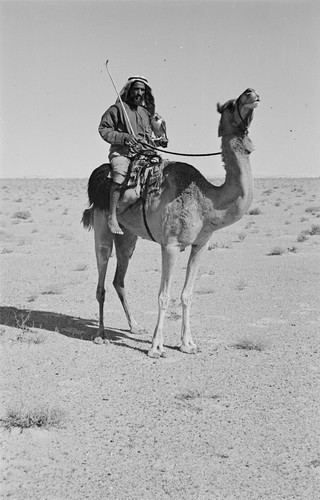 2004.130.22231.1Portrait of Muhammad bin Fadil, a falconer in Sheikh Zayed bin Sultan Al Nahyan's hunting party, riding a camel with a peregrine in Al Khatam sands near Al Ain. Muhammad bin Fadil sits astride his standing camel, which faces towards the near right foreground, its head looking up into the sky. Muhammad bin Fadil's ghutra (headscarf) is blown back behind his shoulders by the wind and he holds a camel stick up in the air with one hand. A hooded peregrine falcon perches on a mangalah (cuff) on his other arm. Behind him a vast sand flat dotted with small tufts of vegetation stretches without interruption into the far horizon. This image was taken between December 20, 1948, and January 27, 1949, during which time Wilfred Thesiger stayed with Sheikh Zayed bin Sultan Al Nahyan in Al Ain and joined him on a number of hunting excursions.2004.130.22231.1
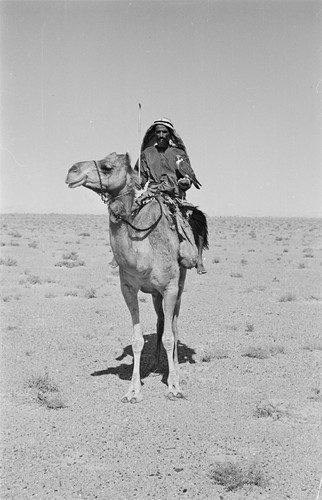 2004.130.22230.1Portrait of Muhammad bin Fadil, a falconer in Sheikh Zayed bin Sultan Al Nahyan's hunting party, riding a camel with a peregrine in Al Khatam sands near Al Ain. Muhammad bin Fadil sits astride his camel, which faces forward, its head turned to the left. Muhammad bin Fadil's ghutra (headscarf) is blown back behind his shoulders by the wind and he holds a camel stick up in the air with one hand. A hooded peregrine falcon perches on a mangalah (cuff) on his other arm. Behind him a vast sand flat dotted with small tufts of vegetation stretches without interruption into the far horizon. This image was taken between December 20, 1948, and January 27, 1949, during which time Wilfred Thesiger stayed with Sheikh Zayed bin Sultan Al Nahyan in Al Ain and joined him on a number of hunting excursions.2004.130.22230.1
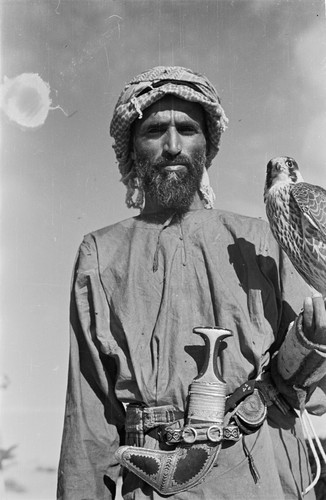 2004.130.22168.1Standing half length portrait of Muhammad bin Fadil, a falconer in Sheikh Zayed bin Sultan Al Nahyan's hunting party, with a peregrine falcon in Al Khatam sands near Al Ain. Muhammad bin Fadil stands with a peregrine falcon perched on a mangalah (cuff) over his arm. He wears a patterned ghutra (headscarf) tied closely around his head a dark coloured thobe (long shirt) topped with a khanjar (dagger) and cartridge belt. This image was taken between December 20, 1948, and January 27, 1949, during which time Wilfred Thesiger stayed with Sheikh Zayed bin Sultan Al Nahyan in Al Ain and joined him on a number of hunting excursions.2004.130.22168.1
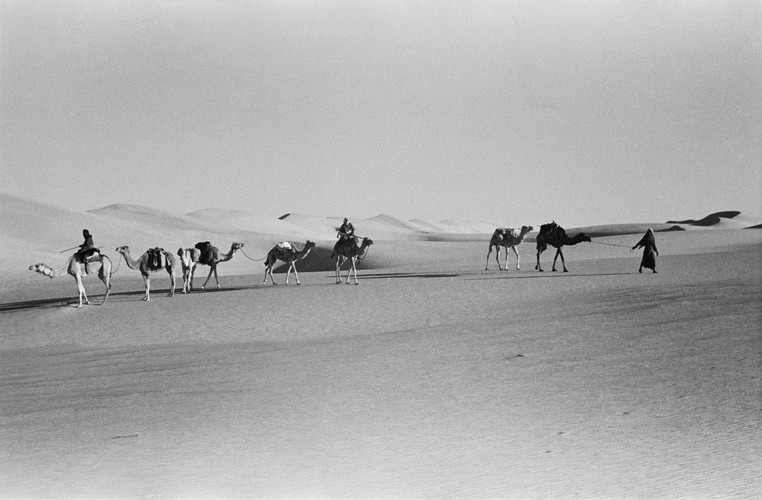 2004.130.17891.1View of Wilfred Thesiger's travelling party trekking through Al Dhafra sands during their journey across the Empty Quarter (Rub' al Khali) from Dhibi well to Al Batin sands. Three of Wilfred Thesiger's travelling companions, tribesmen of the Bayt Imani lineage of Rashid Bedouin, walk with their camels in a dune trough between two low continuous dune chains. The two men on the left are mounted on camels. The man on the right leads his two camels on foot. In the right background the crest of the dune stretches into the far distance.2004.130.17891.1
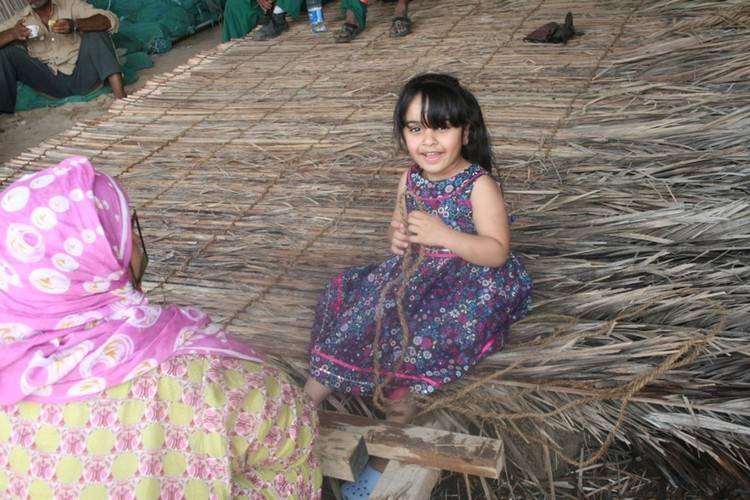 2010.49.19Manal Rashid Al Mazrouei, 3 years old daughter of Fatima.2010.49.19
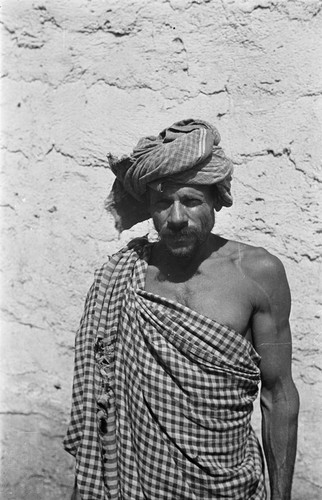 2004.130.22899.1Close up portrait of a porter, possibly from Iran, standing in front of a wall in Dubai. A man with a thick moustache stands facing foreward against a wall. He wears a checked cloth wrapped like a toga around his torso and a patterned ghutra (headscarf) on his head.2004.130.22899.1
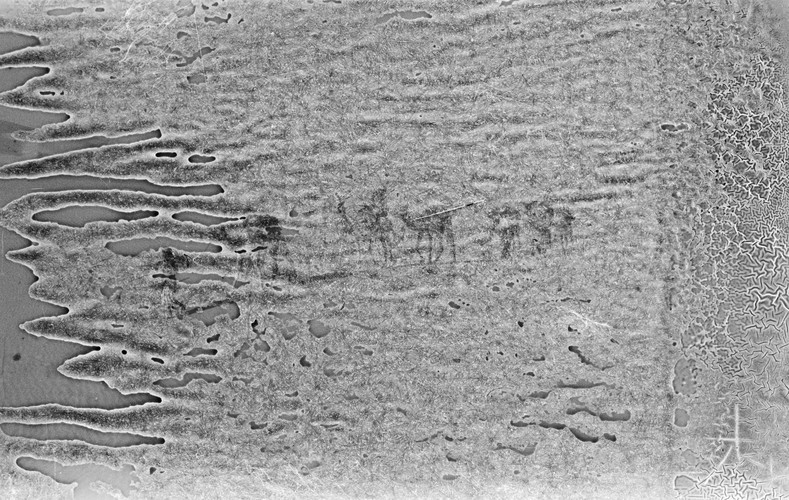 2004.130.6618.1View of Wilfred Thesiger's travelling party trekking through the Ramlat ar Rabbad sands. Two of Wilfred Thesiger's Bedouin companions lead six camels down the slope of a sand dune.2004.130.6618.1