
- Collection type
- Object
- Description
- Gourd vessel. Possibly a very large ladle. Made of one half of a gourd which has been sliced in half longitudinally. The outside of the gourd is decorated with blackened incised lines in a geometrical design. These lines are pyroengraved.
- Geographical reference
- Date / Period
- Date made: Before 1960
- Date collected
- Circa 1960?
- Acquisition information
- Donated: 15/03/1996
- Materials and processes
- Material Pigment, Material Gourd Plant, Process Perforated, Process Incised, Process Burnt, Process Pyroengraved Pokerwork
- Dimensions
- Length: max 205 mm, Diameter: max 165 mm
- Object numbers
- Accession number: 1996.21.36
- Research and responses
In 2020 the Pitt Rivers Museum was a partner in the project lead by the Horniman Museum 'Rethinking Relationships and Building Trust around African Collections' The project commissioned community researchers from Africa to develop new practice around Kenyan and Nigerian collections at the Horniman, the Pitt Rivers Museum, the Cambridge University Museum of Archaeology and Anthropology and the World Museum in Liverpool. These comments are from community researcher Njeri Gachihi: "The object is known amongst the Agikuyu as Kiihuri/kiuga. Depending on its size, it was used as a cup, bowl, plate or tray for eating, drinking, serving or storing food, porridge, milk or cereals. When I was growing up, my grandmother had several such objects that were used as food vessels. Today, it is still a popular item in local hotels and in traditional Agikuyu, ceremony for serving traditional porridge. The incised geometrical lines on the outside are for aesthetic and identification purposes. The identification of this as a spoon is also not farfetched because the object also acts as a serving spoon for food and drinks such as soup and porridge.
The object is sourced from a crop plant in the family Cucurbitaceae. This kind of gourd is made from cutting the fruit of plant in to two, removing the seeds, incising some lines on the outside, then leaving the hollow shell to dry-out. When fully dehydrated, the shell becomes hard.." [FB 5/1/2021]
Search terms: Vessel, Food and Drink, Spoon, Food Accessory
Further items to explore
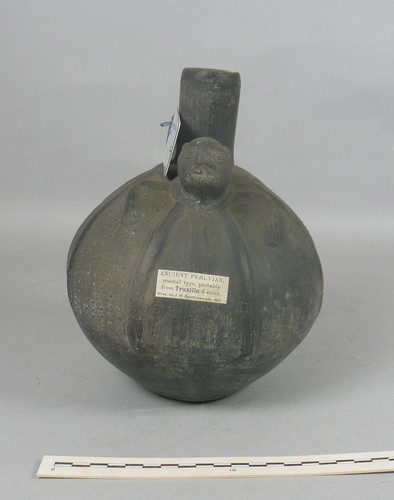 1921.78.72Ceramic vessel1921.78.72
 1884.1.3.28Wooden pole for tent support tapered at both ends. (see 1884.1.3)1884.1.3.28
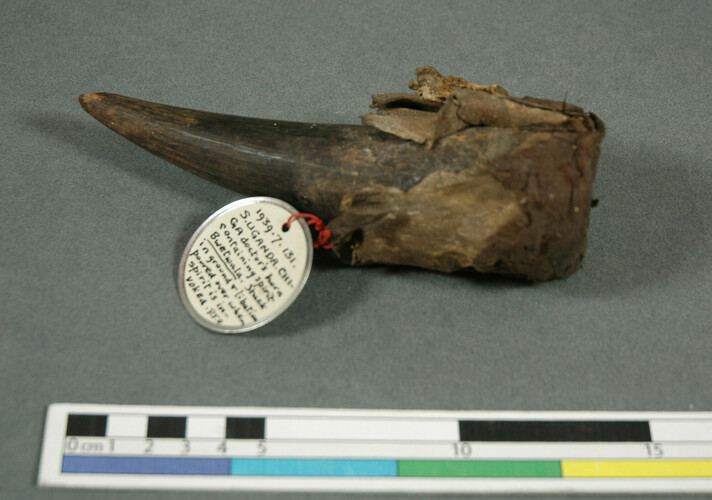 1939.7.131Horn containing a spirit.1939.7.131
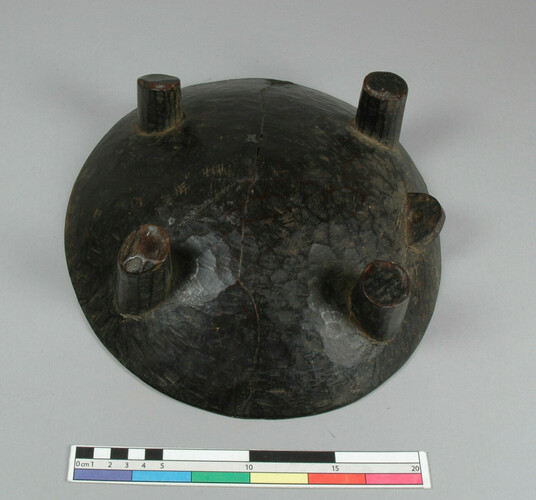 1933.38.8Solid wooden bowl with four legs. Small lug on underside with perforation. [RM [OPS move] 8/9/2016]1933.38.8
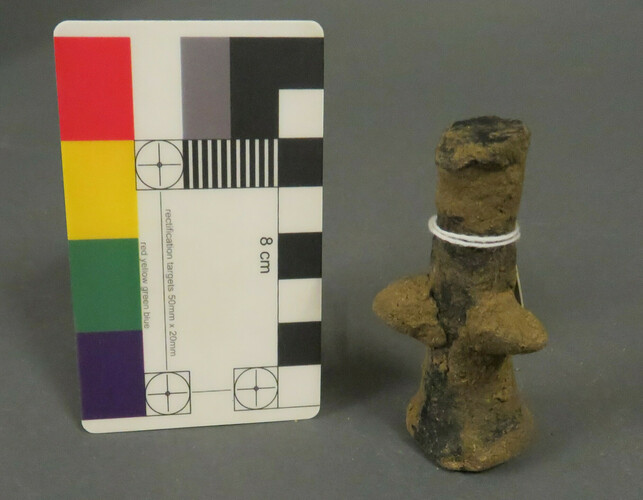 1958.11.2.355Clay Mkaramo figure. Cylindrical figure, with circular flared base. Two pointed protrusions, representing breasts or arms. No distinction between the main body and the head. Flat top of the head. Painted black horizontal and vertical lines. [BH [OPS Move] 16/5/2017]1958.11.2.355
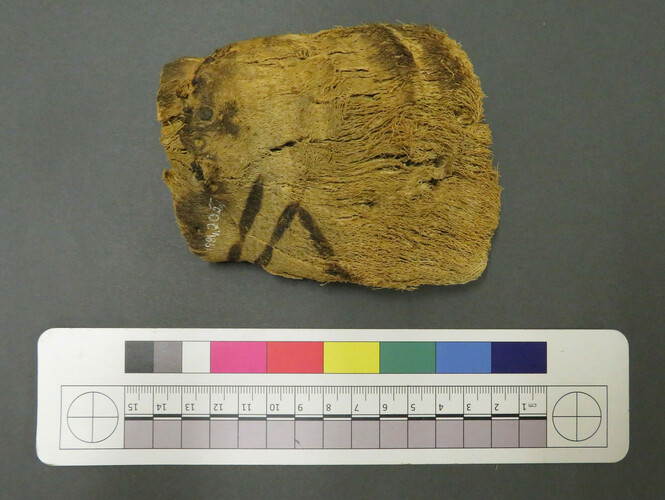 1984.20.5.3Plant root specimen. Light brown in colour with some scorch marks on the exterior. Fibrous material. [ASh [OPS move] 20/3/2017]1984.20.5.3
 1884.19.172.2Wooden spear with with a pointed metal butt with incised bands. For the spear head see 1884.19.172 .1 [VS [OPS move] 4/7/2018]1884.19.172.2
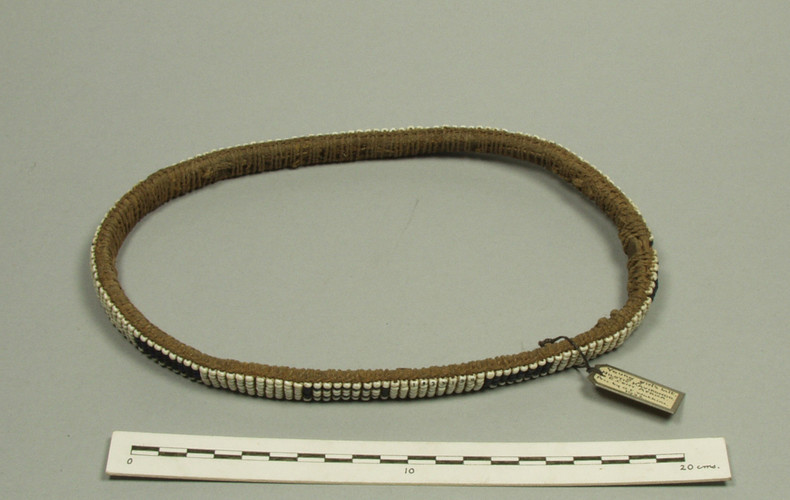 1922.12.4Waist belt of bark and string, exterior covered with blue and white trade beads [L.Ph 'DCF 2004-2006 What's Upstairs?' 29/4/2005]1922.12.4