
- Collection type
- Object
- Description
- Hollow gourd cup cut straight at one end.
- Geographical reference
- Date / Period
- Date made: Before 1960
- Date collected
- Circa 1960?
- Acquisition information
- Donated: 15/03/1996
- Materials and processes
- Material Gourd Plant, Process Hollowed
- Dimensions
- Diameter: max 50 mm, Length: max 180 mm
- Object numbers
- Accession number: 1996.21.13
- Research and responses
In 2020 the Pitt Rivers Museum was a partner in the project lead by the Horniman Museum 'Rethinking Relationships and Building Trust around African Collections' The project commissioned community researchers from Africa to develop new practice around Kenyan and Nigerian collections at the Horniman, the Pitt Rivers Museum, the Cambridge University Museum of Archaeology and Anthropology and the World Museum in Liverpool. These comments are from community researcher Njeri Gachihi: "This is a special African beer cup. It may be used by a number of communities in Kenya and Tanzania to serve African wine. Amongst the Agikuyu, it is known as ‘ndahi’ and among the Mijikenda ‘kopo’.
It is made by cutting the lower half of a special elongated gourd called mbuthu. It is used as a njohi drinking vessel for women while the ruhia (horn vessel) is for the men. Both have a special role in serving wine during traditional ceremonies such as marriage. During such ceremonial drinking, one ruhia serves an important role. Prior to the ceremony, the brewer was not supposed to sleep with his wife, and woke up early, filled the ruhia and ndahi went to the fireplace, poured out the hornful on the stones of the hearth while calling the spirit of his father to bless him, his family, and his party, calling also on his deceased male relatives. Then did the same with the wine in the ndahi, this time calling on his deceased mother(s) and deceased female relatives, praying likewise to them. Then he refilled the ruhia and ndahi and went out to the entrance area of the homestead, called out to the male and female deceased relatives, poured a little njohi from each and then added a special prayer asking the spirits to keep watch and prevent workers in witchcraft (arogi) from coming the beer drink. The same was done at the altar of the home (a tree where sacrifices for the family were done). If the brewer’s father was alive, he did not perform that ritual but rather called on his father to perform the ritual. Lastly, he took a drink from the horn and spat it out on his chest kwirathima (to bless himself) and then drank the rest of the ruhia, and handed the ndahi to his wife who likewise “blessed herself” and drunk the cupful. The same ruhia and ndahi was passed on to the party as per the level of seniority. The lead brewer, just like in the Eucharist, blessed the njohi brewed with muratina (Kigelia africana), honey and sugar cane and passed it on to the invited party. Beer brewing was done for definite ceremonies either ritualistic or social and no man ever brewed beer as a drink for himself, hence drinking was always a big ceremony." [FB 5/1/2021]
Further items to explore
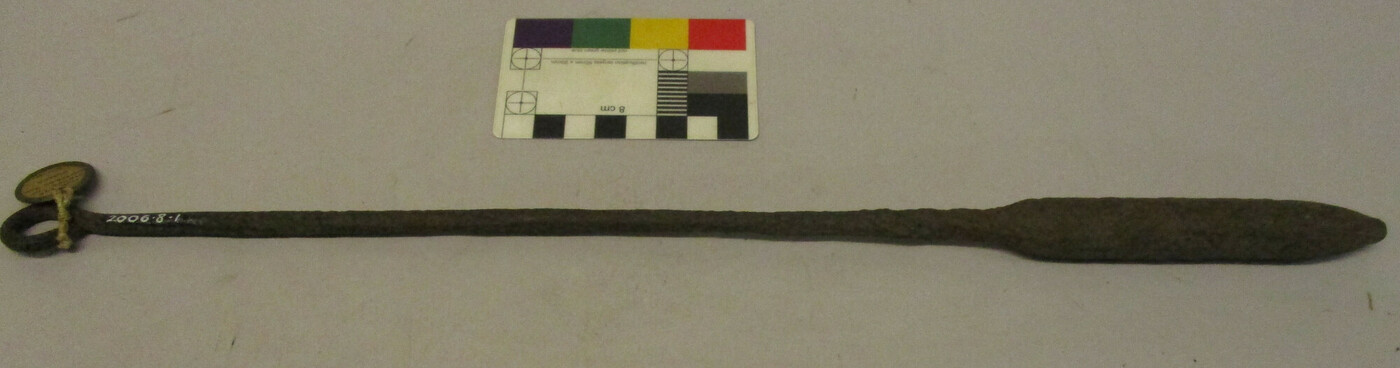 2006.8.1Iron rod used to heat the goffering iron. [BH [OPS move] 28/7/2016]2006.8.1
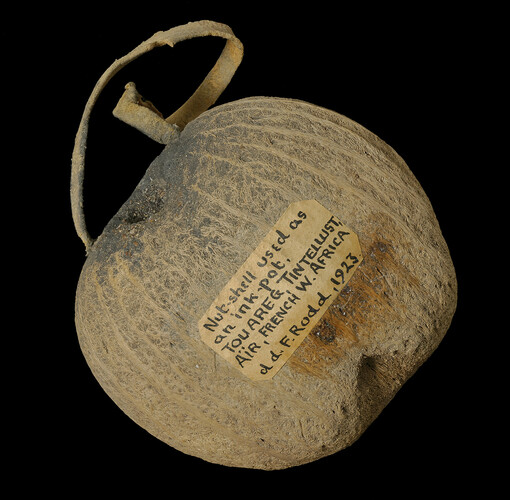 1923.36.25Nut-shell used as an inkpot. [DCF Court Team 2/1/2003]1923.36.25
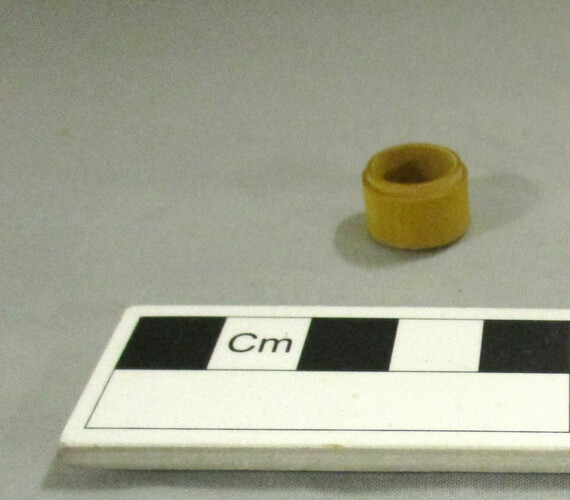 1985.36.148.4Wooden vessel. Flat base with a round body and vertical sides. Lip at the rim to allow the lid [1985.36.148 .5] to be secured. Part of a set of miniature vessels in a basket with a lid [1985.36.148 .1 - .6] [ASh [OPS move] 29/06/2016]1985.36.148.4
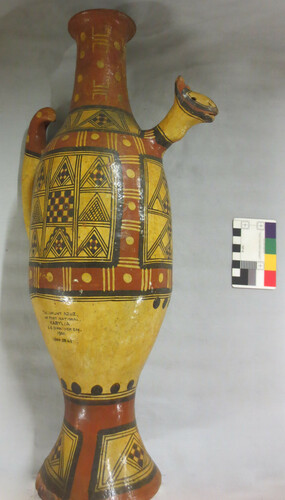 1900.38.44Pottery vessel with a long flared neck, single side handle and animal head ?spout. [ASh [OPS move] 12/02/2016]1900.38.44
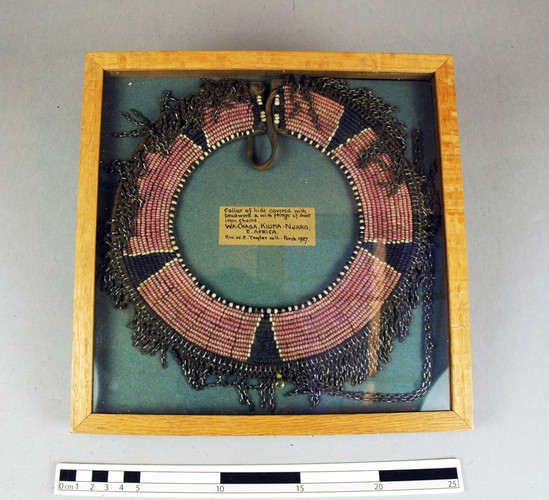 1927.84.53Flat collar of hide covered with beads.1927.84.53
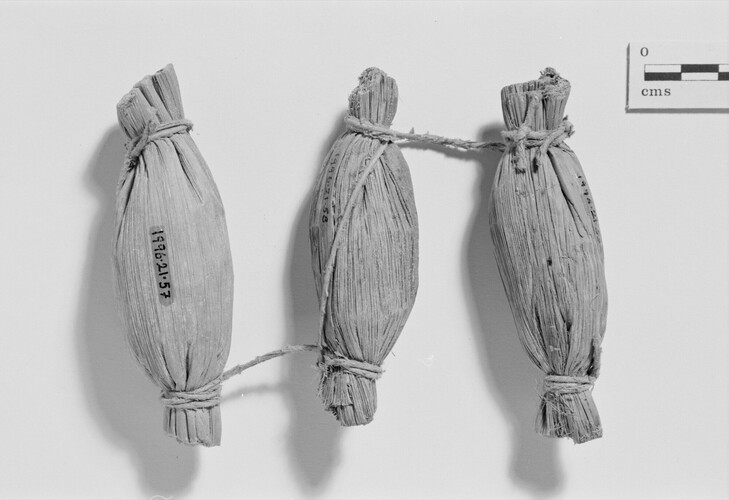 1996.21.57Tobacco pouch or container of plant leaf tied at both ends with fibre string. One long piece of string has been used to tie all three pouches. Contains tobacco?1996.21.57
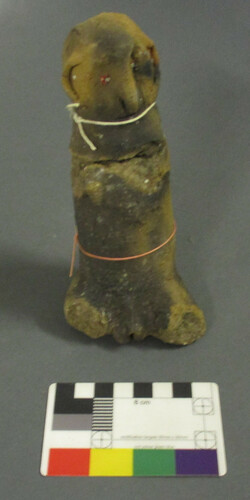 1958.11.2.230Clay Mkaramo anthropomorphic figure. Cylindrical body, with two forward extended legs. Female genitalia in-between the legs. Moulded facial features, with red and white beads in the eye socket. Black patches across the surface, signs of burning. [BH [OPS Move] 8/5/2017] [BH [OPS Move] 8/5/2017]1958.11.2.230
 1984.30.22Arrow fletched with striped feathers [JFK 23/3/2017]1984.30.22