
- Collection type
- Object
- Description
- Painted wooden shield with a symmetrical design on the front. [ZM 1/8/2005]
- Long description
- The shield is of curved oval shape, narrower at the top, with a double cane grip on the back. It is painted red on the back, and on the front with curvilinear designs in red and black on a white ground. [LM 09/05/2007]
- Geographical reference
- Milne Bay Province Kiriwina Goodenough District Trobriand Islands
- Date / Period
- Date made: Before 1893
- Date collected
- By 1893
- Acquisition information
- Purchased: 25/07/1893
- Materials and processes
- Material Wood Plant, Material Pigment, Material Cane Plant, Process Carved, Process Painted
- Dimensions
- Length: max 760 mm, Width: max 330 mm
- Object numbers
- Accession number: 1893.68.1
- Research and responses
The PRM collection of Trobriand war shields was apparently examined by Patrick Glass; see page 61 of ‘The Trobriand Code: An Interpretation of Trobriand War Shield Designs’, by Patrick Glass, Anthropos, Vol. LXXXI (1986), pp. 47-63. [JC 26 2 1997]
Trobriand Islands war shields bear intricate and complex painted designs. The designs are always similar – and appear to represent the same kind of thing – but no two shields are ever exactly the same. Traditionally, prior to a battle, the village magician would cast a spell over each shield by resting it on his knees, and speaking his spell into the decorated surface from centimetres away, empowering it with his breath. The result was such that the shield became impervious to spears. The design was seen to have magical power, which could be invoked. There has been a great amount of debate over the meaning of the decoration on Trobriand Islands shields. Some scholars have seen the design as representing a mulukuausi – a flying witch, the most fearful thing in Trobriands mythology – which would terrify and petrify the enemy. Others have seen the shields as depicting the copulation of a husband and wife – the most obscene insult in Trobriands thinking - as well as a number of mythologically-significant animal species. In the central cluster of motifs, hornbills and snakes are clearly discernible. Others have interpreted the designs as representing single human figures, and being derived from the shell-inlaid human figures depicted on high-status shields from the Solomon Islands to the east. In this interpretation, the three major ‘zones’ of the shield represent the figure’s head, throat and abdomen; magical power was understood to reside in the Belly by the Trobrianders, and it has been suggested that the design represents the path by which magical power manifests in the world. Warfare in the Trobriand Islands was pursued with long thrown spears up to 4m in length, wooden sword clubs (See the display in U30A), and shields such as these. Relevant Reading: Malinowski, B. (1920) War & Weapons Among the Natives of the Trobriand Islands. In: Man, Vol.20, pp.10-12. E.R. Leach (1954) A Trobriand Medusa? In: Man, Vol.54, 103-5. Guiart, J. (1963) The Arts of the South Pacific. London: Thames & Hudson. Newton, D. (1975) Massim: Art of the Massim Area. New York: Museum of Primitive Art. Malinowski, B. (1978) Argonauts of the Western Pacific. London: Routledge. Research Conducted for DCF Cutting Edge 2006/2007 [AM].
Further items to explore
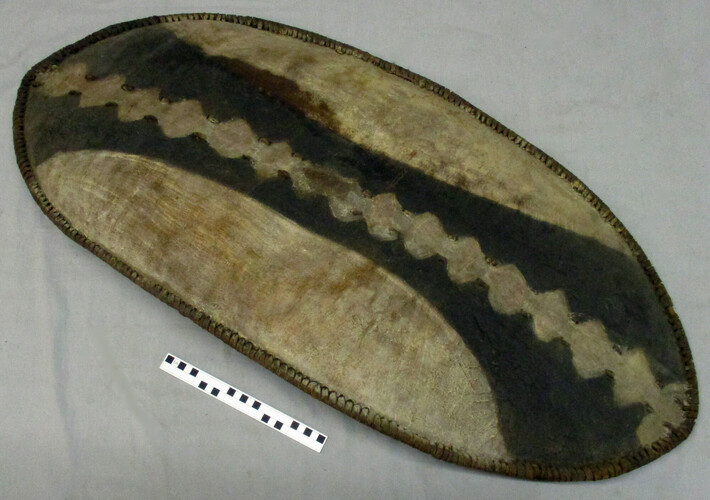 1949.5.13Oval shaped hide shield with pointed ends and domed central boss. The front of the shield is decorated with two curved sections and a central band of triangular designs in black and white pigments. The rim is perforated along the entirety of the rim through which strips of hide are woven. On the reverse in the centre there is a disc of hide with notches cut away from the edge. There is a carved handle which also serves as a central supporting rib which is bound to the shield with strips of hide threaded through perforations in the surface. There is a twisted plant fibre loop tied to the handle. [CW [OPS move] 17/8/2016]1949.5.13
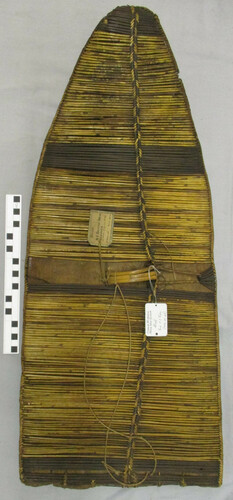 1904.60.45Shield. Made from wood with overlaid cane work. The shield is pointed at one end and curves inwards more pronounced here than at the straight end. Small cane handle in the centre of the shield. Plaited decoration on the exterior near to the base and wavy lines in the central band on the exterior. [ASh [OPS move] 27/7/2016]1904.60.45
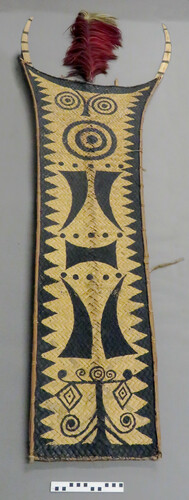 1923.84.16Ceremonial Angami shield of palm leaf basketry with a bamboo edge. [CW [OPS move] 24/8/2016]1923.84.16
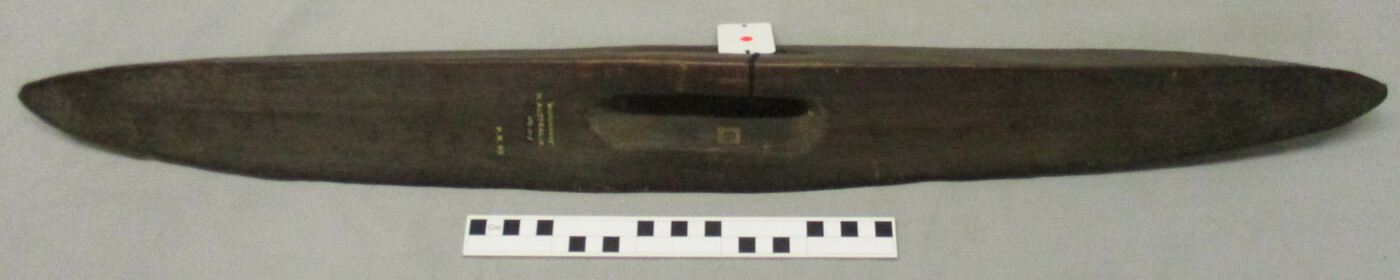 1884.30.8Australian shield made of wood. The handle is carved from the whole. The front is decorated, the inside is plain. The shield is covered with red and white pigment, some of which has been lost. Lines are lightly incised in most places, deeper in others.1884.30.8
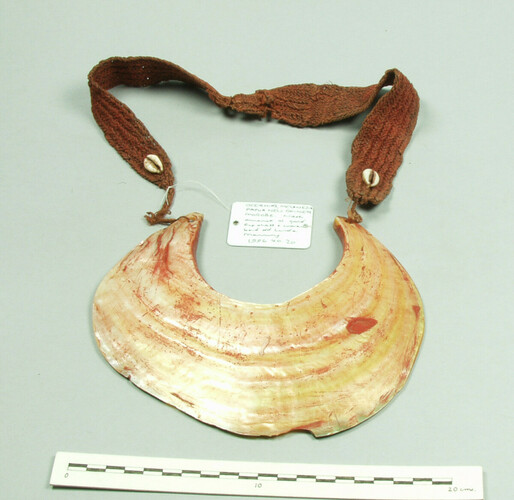 1996.40.20Large crescent of a gold-lipped shell with red staining and a red woven band with two cowrie shells attached [EC 'DCF 2004-2006 What's Upstairs?' 23/9/2005]1996.40.20
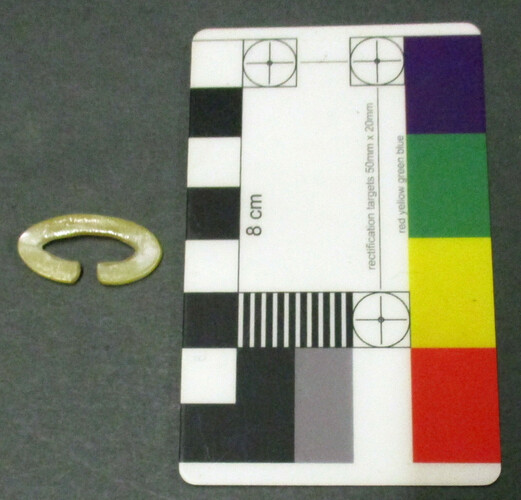 1938.36.1665.2Pearl shell nose piece. Oval and pennanular in form with squared off ends. [BS [OPS Move] 14/11/2016]1938.36.1665.2
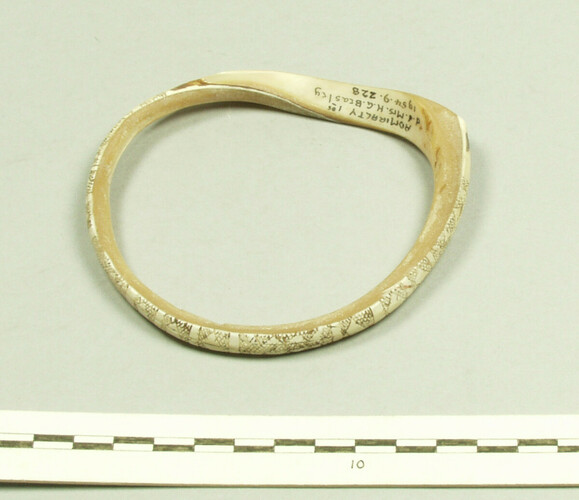 1954.9.228Armlet of trochus shell with incised and blackened designs. [El.B 'DCF 2004-2006 What's Upstairs?' 21/11/2005]1954.9.228
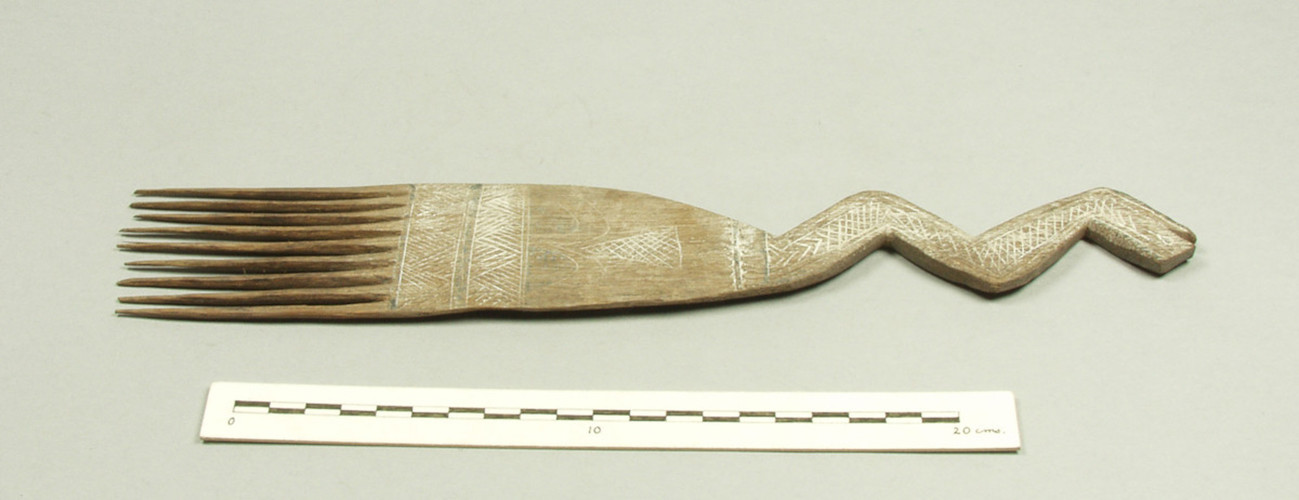 1903.55.141Carved wooden comb with the top forming a zig-zag line, with incised decorations. [El.B 'DCF 2004-2006 What's Upstairs?' 6/10/2005]1903.55.141