
- Collection type
- Object
- Description
- Carved figure from a semi-submerged storehouse [ZM 20/02/2015]
- Long description
- Weathered carved doorway from a storehouse representing a grotesque human figure with protruded tongue & with three fingers on the right and four on the left. [DCF Court Team 28/1/2003]
- Geographical reference
- North Island Whanganui (Wanganui)
- Cultural groups
- Māori
- Person
- Field collector Charles Smith
- PRM source The Executors of the Charles Smith Estate
- PRM source Alfred T. Collier
- Date / Period
- Date made: Circa 1820-1840
- Date collected
- 1860 - 1869?
- Acquisition information
- Purchased: 1923
- Materials and processes
- Material Wood Plant, Process Carved, Process Inscribed
- Dimensions
- Width: max 430 mm, Height: max 810 mm
- Object numbers
- Accession number: 1923.87.188
- Research and responses
The accounts by Simmons and Neich referenced in 'Publications History...' are limited and contain some errors. For example, the image was not reversed in Simmons 1985, but has been reversed in Neich 1996, making his written account of the figure contradict what can be seen in the photograph. The confusion has probably arisen because the name on the stomach was actually inscribed in 'mirror' writing; the letters ‘P’ and ‘K’ are clearly reversed. Thus, the ‘writing’ looks the wrong way round on the figure and in photographs, but when the image is reversed it looks the right way round. The writing in fact runs up the body, not down it, with the figure's true left at the top. Moreover, the first letter is clearly a 'T' and not a 'P'. The name is thus ‘TAIKAPOIA’. The figure is not number 45 in the Smith collection, but it is listed on page 45 of the Museum’s catalogue of the Smith collection. The maximum width of the figure is not 410 mm but 430 mm. Three lashing holes are visible on the figure’s true right side, but it seems that there was a fourth at the bottom, opposite one on the figure’s true left side. Four lashing holes are visible on the figure’s true left side, and it seems likely that there would have been a fifth at the top, opposite one on the figure’s true right side. It seems that the figure once had genitals. The base of a circular protrusion can be seen in the figure’s crotch, suggesting perhaps that the figure was male. The area from which the genitals was removed is noticeably weathered, suggesting that they were removed some time before the object was collected by Smith. An iron (?) nail protrudes through from the front to the back of the figure in the crook of the figure’s true right arm. There are the remains of two wooden pegs in holes between the figure’s legs. [JC 26 2 1997, 9 2 2008]
Discussing the ‘constructional possibilities’ of such objects, Neich (1996: 99) states that ‘in all of them [i.e. in all the examples discussed] the rear of the projecting head is a flat extension of the same flat plane of the rear of the main slab. This means that the head could not have been projected forward in front of the wall.’ In this case, however, while in general the back of the figure is a flat plane, a section has been removed from the top of the back of the figure which is thus curved rather than flat. [JC 28 2 1997]
In 1978, David Simmons recorded the holdings of Māori material in a number of museums in Europe and North America including, in May 1978, the Pitt Rivers Museum. (For copies of his notes and related correspondence, see RDF: Researchers: Simmons.) In 1996, Simmons put together the ‘draft catalogues’ he had prepared, depositing copies in, at least, the National Library of New Zealand / Te Puna Mātauranga o Aotearoa and the British Museum. The ‘draft catalogue’ of the Māori material in the PRM, which includes photocopies of some of the relevant catalogue index cards and annotations supplied by PRM assistant curator Lynne Williamson in 1982, was included in ‘Draft Catalogues of Maori Material in English Museums II. Prepared by David Simmons from records made in 1978… Compiled in Auckland in 1996’. It is now widely accepted that Simmons’s assertions about the provenance and history of individual Māori objects are not to be trusted without further evidence and/or documentation. Nevertheless, as the entries in this document have been referred in the literature, in July 2016 I obtained from the British Museum scans of the pages devoted to the PRM’s collections (numbered by hand as pages 43 to 62), printing out a copy for the RDF. For the probable entry for this object, see page 57 (page 13 of Simmons's original list). [JC 28 7 2016]
- Associated publications
- Reproduced in black and white as figure 85 on page 93 of Whakairo: Maori Tribal Art, by D[avid]. R. Simmons (Auckland: Oxford University Press, 1985). Caption reads: 'NGATI RUANUI - NGA RAURU A kuwaha, a door jamb from a pataka carved in south Taranaki style. It is part of the Smith collection in Oxford, most of which came from south Taranaki, Wanganui and Horowhenua in 1923. The print has been reversed. The name on the stomach is Paikapoia [sic, Taikapoia; see 'Research Notes'], which is inconsistent as the carving is almost certainly done with stone tools so the name is probably a later addition. The five whakaironui spirals and the use of pakura as in Hokianga are diagnostic features for south Taranaki work. Length 83 cm.' NB In the list of figures or 'Catalogue', Simmons gives 'BIV 136' as the Museum's reference for this object. This refers to part of the Staples-Browne/Makereti collection (1930: 85) and is incorrect. [JC 19 2 1997, 9 7 2008, 28 7 2016] Illustrated in black and white as figure 7 on page 89 of 'Carved Entrances of Maori Semi-Subterranean Storehouses', by Roger Neich, in Records of the Auckland Institute and Museum, Vol. XXXIII (1996), pp. 79-109. It is described in detail on page 88: 'Entrance of rua tahuhu, from Whanganui District ... No definite locality of origin is recorded for this carving but it was formerly item number 45 [sic; see 'Research Notes'] in the collection of Charles Smith who lived in Whanganui from 1859 to 1900. It was collected by him, probably in the Whanganui area in the 1860s, and purchased by the Pitt Rivers Museum in 1923. [para] Measuring 81 cm high and 41 cm wide [sic; see 'Research Notes'], this carving has three lashing holes down each side [sic; see below]. There is no bevelling or rebating on the edges and no slots for pegs or bars to be inserted. Carved in high relief, probably with stone or early metal tools, the figure has a plain head and body with a rauponga spiral on its left shoulder and plain spirals on the other shoulder and both hips. Pakura patterns cover the arms, hands and legs, but some of this surface carving is unfinished on the figure's right side. On the left hand are four fingers but only three fingers on the right hand. Gender is not indicated [sic; see 'Research Notes']. The ancestor name, Paikapoia [sic; see 'Research Notes'], has been lightly inscribed down [sic; see 'Research Notes'] the body, probably at a later date than the original carving. Most indications are that this carving was probably produced sometime about the 1820s or 1830s. [para] Simmons (1985: 93 [see 'Research Notes']) described this carving as a pataka doorjamb. This can be questioned on the evidence assembled here [i.e. in this article], which clearly suggests that it served as a perepere or, less likely, as a kopani. On both stylistic grounds and possible locality of origin, he attributed it to either Ngati Ruanui or Nga Rauru tribal groups, which seems reasonable even if the grounds for this stylistic attribution are not entirely clear.' [JC 17 2 1997] Illustrated in black and white as Figure 1 on page 250 of Tradition and Change in Māori and Pacific Art: Essays by Roger Neich, eds Chanel Clarke, Fuli Pereira, and Nigel Prickett (Auckland: Auckland: War Memorial Museum, 2013). This book includes on pages 250-83 a reprint of Roger Neich's 1996 essay 'Carved Entrances of Māori Semi-Subterranean Storehouses'. The text relating to the present object appears on page 261. [JC 12 2 2014]
Search terms: Dwelling, Food and Drink, Figure, Writing, Carving, Building Part, Inscription, Food Accessory
Further items to explore
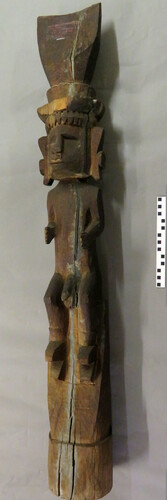 1894.26.35Carved post from canoe house. The post is carved in the form of a human figure wearing a tall headdress. [FC 24/06/2010]1894.26.35
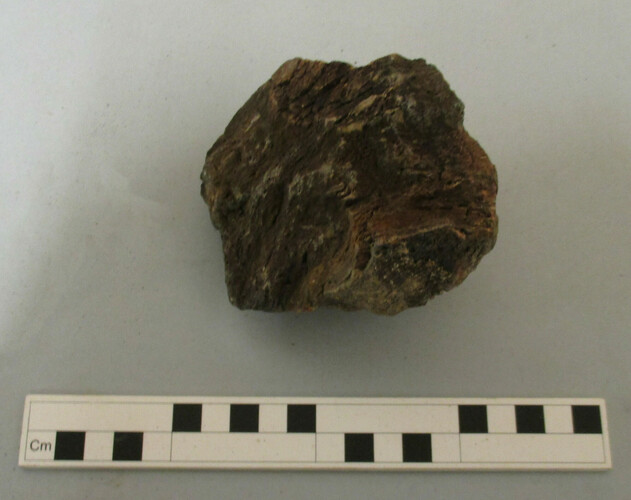 1900.18.6Conglomerate portion of a "vitrified fort", reddish brown on one side, and dark grey on the other. [CW [OPS Move] 29/6/2017]1900.18.6
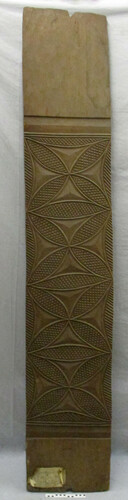 1942.13.1695Carved wooden panel. [RH [OPS Move] 13/7/2017]1942.13.1695
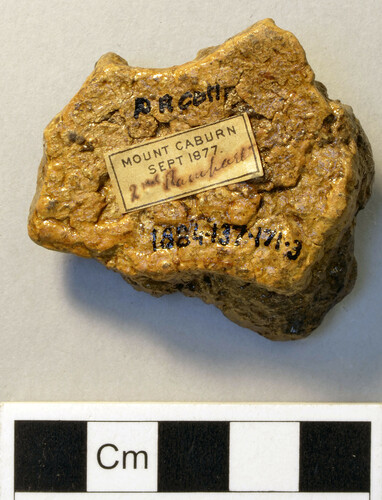 1884.137.171.3Daub fragment1884.137.171.3
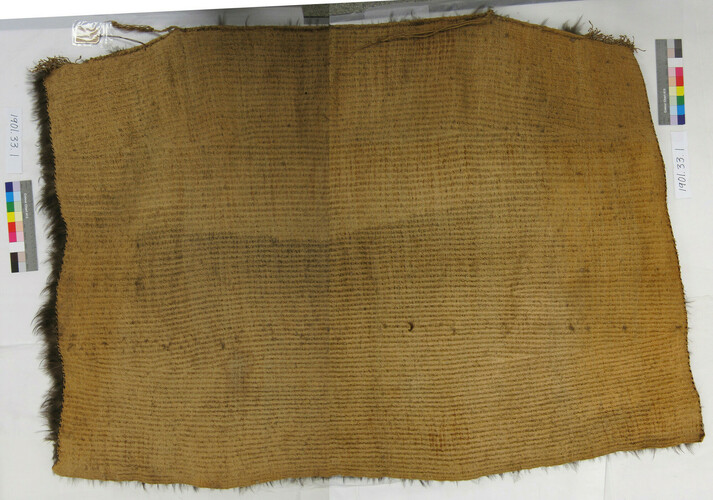 1901.33.1Kahu kiwi, cloak made of muka (New Zealand flax; Phormium Tenax) covered with kiwi feathers.1901.33.1
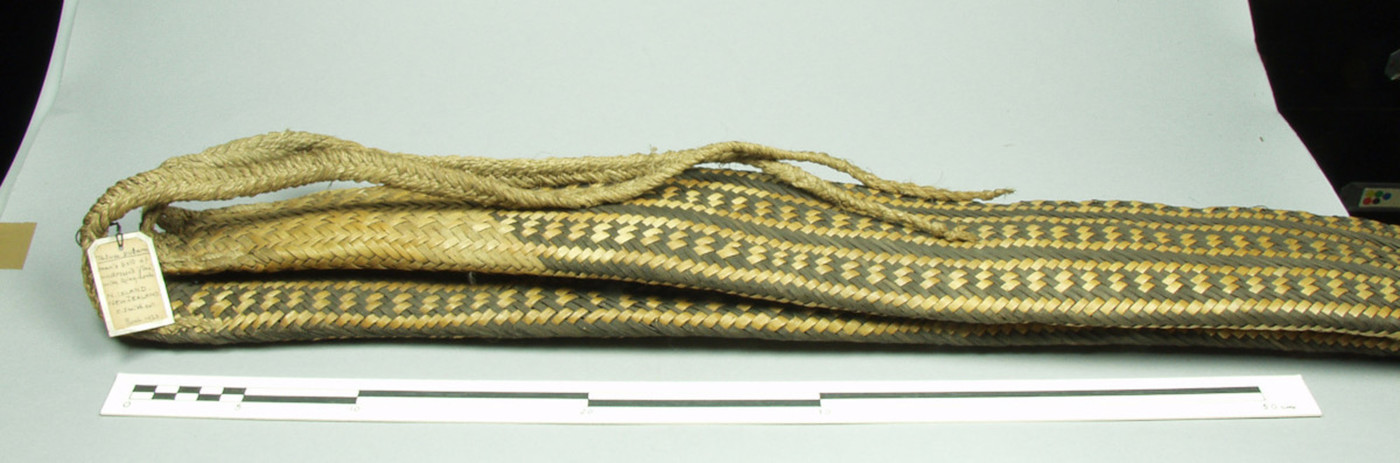 1923.87.156Plaited flax belt in black and white pattern, with a flax tie cord at either end.1923.87.156
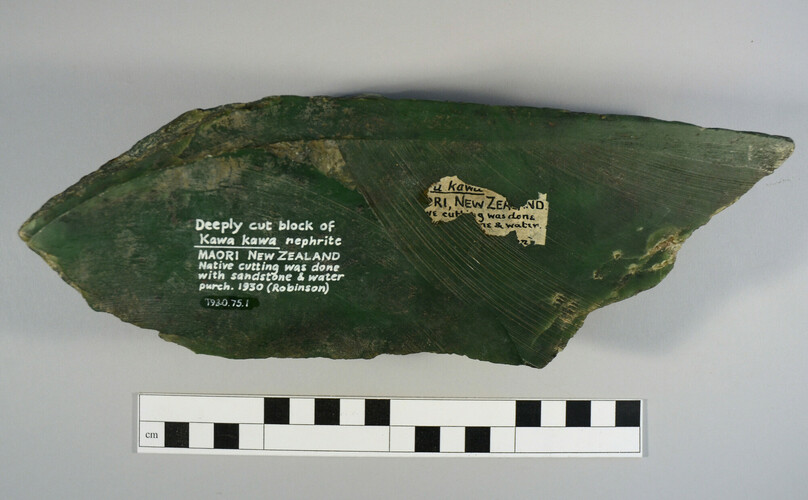 1930.75.1Block of nephrite with very deep cut mark on one surface.1930.75.1
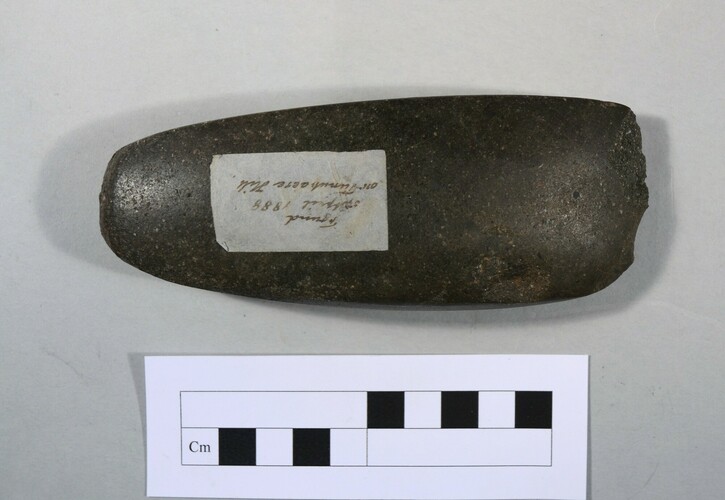 1923.87.32Adze of dark grey stone with a rounded butt, curved cutting edge and convex surfaces. [SM 4/3/2009]1923.87.32