
- Collection type
- Object
- Description
- Carved wooden figure (moai kavakava)
- Long description
- Seated, carved, wooden human figure. The top of the head is grooved with designs, although it is difficult to say whether these represent hair or figures. The prominent brow ridge is incised with upright lines. The head faces slightly right. The eyes are large and round and are inlaid with shell and glass. The nose is straight and prominent with nostrils carved-out. The V-shaped ‘’smiling’ mouth appears closed, although teeth have been added. There is a small carved grooved beard connected to the bottom lip which falls to hang below the chin. The ears are positioned far back on the head and the earlobes are distended, including carvings which indicate ornamentation of some sort (earrings or plugs). The neck is quite short and thick. There is a long groove cut into the back of the head which runs down to the neck. The chest is broad and smooth and there is a distinct navel, comprised of two carved circles, a smaller one set inside a larger one. It is situated slightly right of centre on the torso. The arms are set quite far back on the body, and are attached all the way down. They curve and are carved so that the hands encircle the stomach at the waistline. There are four digits incised on each hand. On the back, the shoulder blades are visible due to being sculpted as slightly bulging and with a groove cut between them. Otherwise, the back is smooth and unmarked. A carved phallus is present. The legs are bent at the waist, indicating a seated position. The right leg is slightly raised, meaning that the figure does not sit on its own without support. The knees have been formed to be visible, although the legs are straight, and there are seven toes incised on each foot. Damage: There are a number of cracks and wear marks, the most obvious being a large crack which runs from the lower back down the buttocks through to the groin. [Notes compiled by Emily Stokes-Rees, April 2003, in response to the detailed enquiries of Dederen Francois Te Pito.]
- Person
- Field collector William Scoresby Routledge
- Field collector Katherine Maria Routledge
- PRM source William Scoresby Routledge
- Date / Period
- Date made: Before 18/08/1915
- Date collected
- Between 29 March 1914 and 18 August 1915
- Acquisition information
- Donated: 1916
- Materials and processes
- Material Wood Plant, Material Shell, Material Glass, Process Carved, Process Inlaid
- Dimensions
- Width: max 110 mm, Length: max 330 mm, Weight 860 g
- Object numbers
- Accession number: 1916.36.314
- Research and responses
Dr Jo Anne Van Tilburg and Christian Arevalo Pakarati (a Rapanui speaking artist from Easter Island) noted during a research visit on 26/2/2004 that the correct local Rapanui term for this object is 'moai kavakava', not moai kaua. [ZM 10/3/2004]
Please note that the Routledges' published account of their journey includes many specific object references, drawings, maps and photographs. Please refer to: Routledge, Mrs. [Katherine] Scoresby Routledge (1919) The Mystery of Easter Island: The Story of an Expedition. London: Sifton, Praed & Co. Ltd. [L.Ph 29/4/2004]
Please note that the unpublished field notes relating to this expedition are at the Royal Geographical Society. This information was found on p. 334 of the biography of Katherine Routledge (Pease): van Tilburg, Jo Anne (2003) Among Stone Giants: The Life of Katherine Routledge and her Remarkable Expedition to Easter Island. London: Scribner. [L.Ph 29/4/2004]
- Associated publications
- Published as number 252 in Corpus Rapa Nui: Inventaire mondial de la statuaire en bois de l'îles de Pâques / Global Inventory of the Wooden Statuary of Easter Island, by François Dederen ('Te Pito'), Braine-L'Alleud, Belgium: François Dederen (2013). The author's annotated line drawings (front and back) are on page 414 (see photocopy in RDF). On page 112 of his 'Description sommaire des pieces principales / Concise Description of the Principal Pieces', Dederen writes: 'Planche 252 (Pitt Rivers Museum) 1916.36.314. Moai vahiné décadente, en position assise, bouche en forme de V, mains sur le ventre.'; 'Plate 252 (Pitt River [sic] Museum) 1916.36.314. This sitting moai wahine is decadent, the mount is in form of V, the hands are on the belly.' The figure is also listed on page 99. [JC 10 10 2013]
Search terms: Figure
Further items to explore
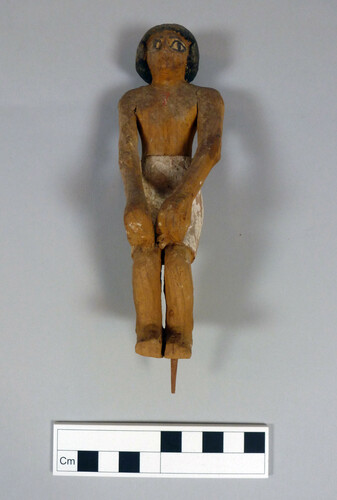 1884.81.10.4Wooden figure of a rower, part of an Egyptian funerary boat model [see 1884.81.10 .1]. [FB 09/01/2013]1884.81.10.4
 1886.1.1275Wooden footrest for a stilt. [CW [OPS Move] 31/5/2017]1886.1.1275
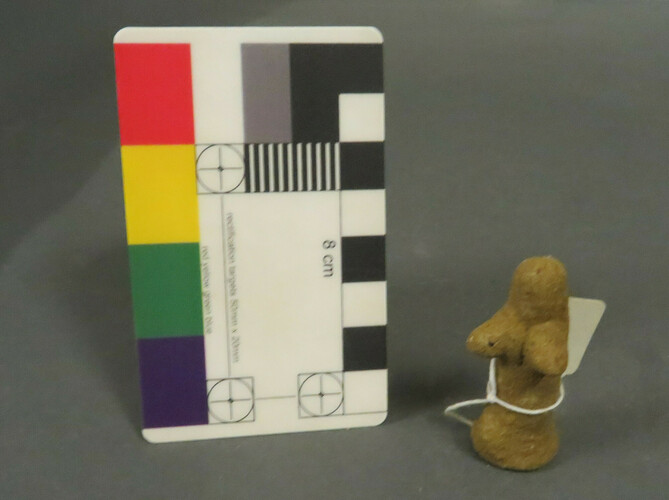 1958.11.2.359Clay Mkaramo figure. Cylindrical figure, with circular flared base. Two pointed protrusions, representing breasts or arms. No distinction between the main body and the head. [BH [OPS Move] 17/5/2017]1958.11.2.359
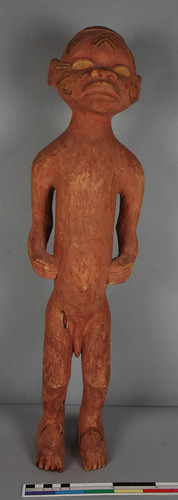 1918.44.1.1Male wooden figure.1918.44.1.1
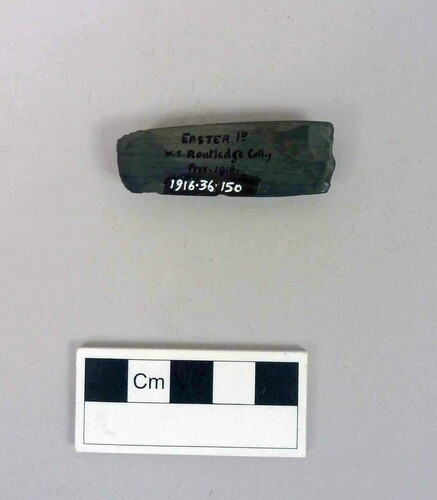 1916.36.150Ground stone adze. [FB 26/06/2014]1916.36.150
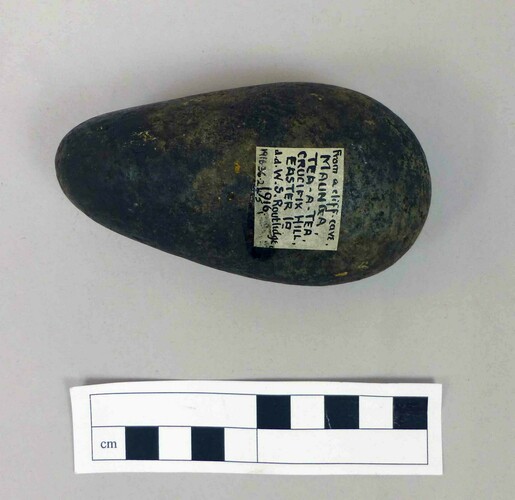 1916.36.145Stone tool. [ZM 28/4/2004]1916.36.145
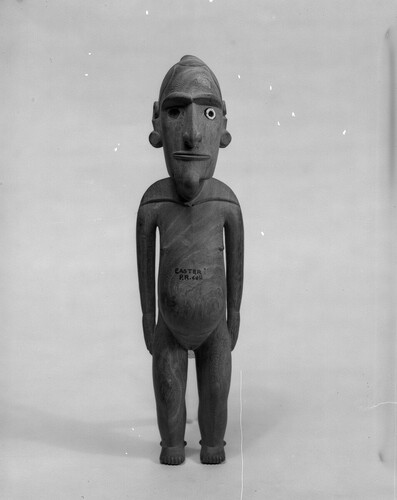 1884.65.43Carved wooden moai papa figure of a female with beard and bone or shell eyes.1884.65.43
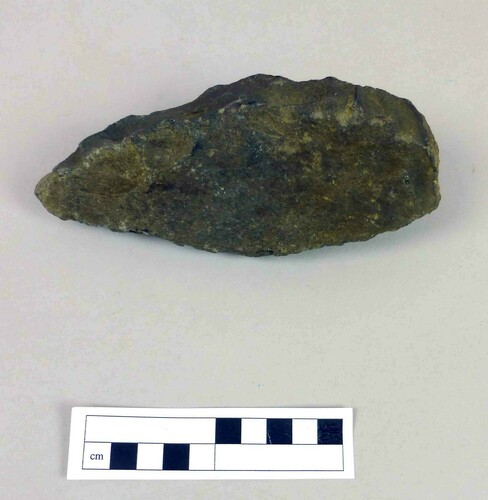 1916.36.201Rough stone tool, toki, from Easter Island. [FB 11/07/2014]1916.36.201