
- Collection type
- Object
- Description
- Piece of rock from a cave, on to which four figures of quadrupeds (probably reedbuck or rhebuck) have been painted. [JC 23 8 2001; JC 19 3 2003]
- Cultural groups
- Khoe-San
- Date
- Date collected
- 1893
- Acquisition information
- Donated: 1894
- Dimensions
- Length: max 195 mm, Width: max 130 mm
- Object numbers
- Accession number: 1894.15.4
- Associated publications
- This collection is listed in 'Table 1. Early Southern African Rock Art Records in the Pitt Rivers Museum' on page 44, and referred to briefly on pages 43 and 53, of 'Early Rock Art Records in the Collections of the Pitt Rivers Museum, University of Oxford', by John Hobart, Peter Mitchell, Jeremy Coote, Marina de Alarcón, and Gwyneira Isaac', in Southern African Field Archaeology, No. 9 (2000), pp. 43-54; copy in RDF: Researchers: Hobart. [JC 4 10 2002] Discussed on page 74 of ‘A Rock Art Pioneer: Louis E. Tylor, and Previously Undescribed Painted Rock Fragments from KwaZulu-Natal, South Africa’, by John Hobart, Peter Mitchell, and Jeremy Coote, in Southern African Humanities, Vol. XIV (2002), pp. 65–78: 'Piece 4: Bovid group: 1894.15.4 (14 x 7 cm) The original rock was broken into three pieces, now refitted and glued together. The images are too faint for reproduction. The painted scene shows four small to medium sized bovids, probably reedbuck or rhebuck. There is also an unclear figure that may be a human about to spear one of the buck. The scene is painted in red. The four buck are arranged in a group with three standing facing to the right, and one buck on the right lying down and facing to the left. To the extreme left and at the bottom of the scene is a small buck facing up and right. Its head is held forward and two ears are clear, the animal has a short tail. At the top left of the scene is another small buck, again the ears and tail are clear, although this animal is walking to the right. The front legs are straight and vertical, but one of the back legs is bent forwards and crosses the rearmost of the front legs. The second back leg is painted straight and vertical. The head is again held forward. In front of the two smaller animals is a slightly larger buck. This animal is standing still and grazing. The tail and ears are again clear. Directly in front of the grazing buck is the largest of the group. This animal is lying down with its head held up and facing to the left. The rear legs (on the right) are bent and tucked underneath the body, as are the front legs. Above and to the right of the lying buck is an angle in the rock-face, ‘behind’ this angle is an unclear figure that may be a small person holding a long spear. This scene may be interpreted as a family grouping, and might therefore be of use in determining the season of occupation of the region by the Bushmen who created the painting, as demonstrated by Mazel (1983).' Copy of original article in RDF. The reference to Mazel 1983 is to 'Eland, Rhebuck and Cranes: Identifying Seasonality in the Paintings of the Drakensberg, Natal, South Africa', by A. D. Mazel, in South African Archaeological Society, Goodwin Series, 4 (1983), pp. 34-7. [JC 13 3 2003] Referred to on page 21 of 'Stone Age Sub-Saharan Africa', by Peter Mitchell, in World Archaeology at the Pitt Rivers Museum: A Characterization, edited by Dan Hicks and Alice Stevenson (Oxford: Archaeopress, 2013), pp. 16-34. Mitchell writes: ‘The PRM holds two important collections of San rock art from South Africa, both removed from their in situ locations in the late 19th century. The larger group comprises of 6 panel fragments (1894.15.1-6) extracted from rockshelters in the Giant's Castle area of the uKhahlamba-Drakensberg Mountains of KwaZulu-Natal by Louis Tylor in 1893 ... The 6 painted fragments were described and published, along with an extensive biography of their collector (Hobart et al. 2002). They were subsequently traced by Dr David Pearce (Rock Art Research Institute, University of Witwaterstand, South Africa) during a research visit to the PRM in 2006 supported by the Oppenheimer Fund.' [MJD 14/11/2014] Illustrated in colour and as a tracing as Figure 5 on page 176 of 'Further Analysis of Six Painted Rock Fragments Collected by Louis Tylor', by David G. Pearce and John Hobart, in Southern African Humanities, Vol. 22 (September 2010), pp. 171-9. Also described and discussed on page 177: 'PIECE 4: "BOVID GROUP" (1894.15.4) Piece 4 is 180 x 120 mm in maximum dimensions and 65–70 mm in thickness. There are chisel marks at the top and bottom of the stone, probably relating to its removal from its original site. A pencil line circumscribes the stone part-way through its depth. Chisel marks along the line suggest that an attempt was made to thin down the stone. The paintings consist of four small antelope in red (Fig. 5). They are probably depictions of rhebuck. There is also a fine, faint red image, possibly the remnants of a human figure, on the top right of the stone. The stone has been described in detail, but the paintings have not previously been illustrated because they were too faint for black-and-white photographic reproduction (Hobart et al. 2002: 74).' (Copy in RDF.) [JC 3 2 2016]
Search terms: Picture and Graphic Art, Figure, Painting
Further items to explore
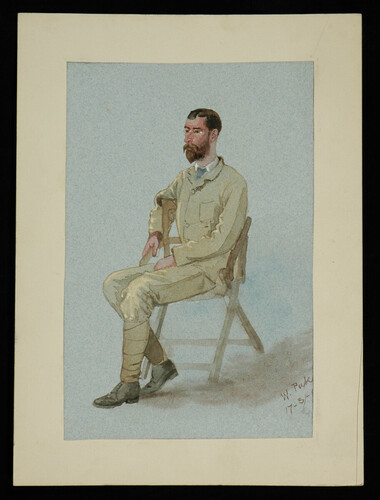 1929.87.64Watercolour portrait of a seated European man titled ' W. Pak 17-3- ' [part of caption cut off by the mount]. [El.B 16/04/2008]1929.87.64
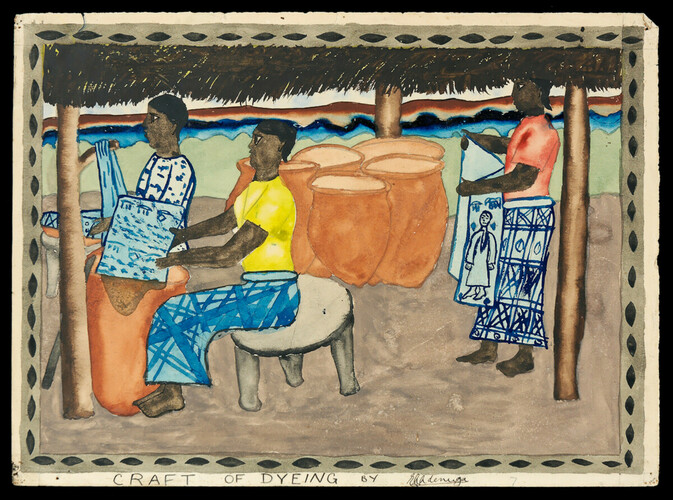 1996.5.69Polychrome watercolour entitled 'Craft of Dyeing', the textiles depicted are indigo1996.5.69
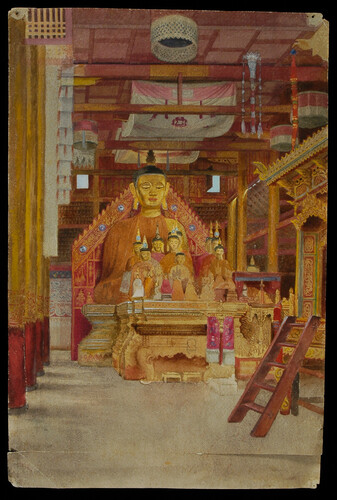 1929.87.33Watercolour of the inside of a temple, with a statue of Buddha and other smaller statues. [El.B 16/04/2008]1929.87.33
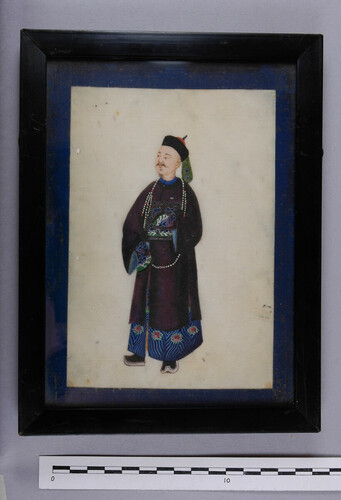 1962.9.10Framed watercolour on rice paper, showing a man in embroidered clothing. [SM 16/04/2008]1962.9.10
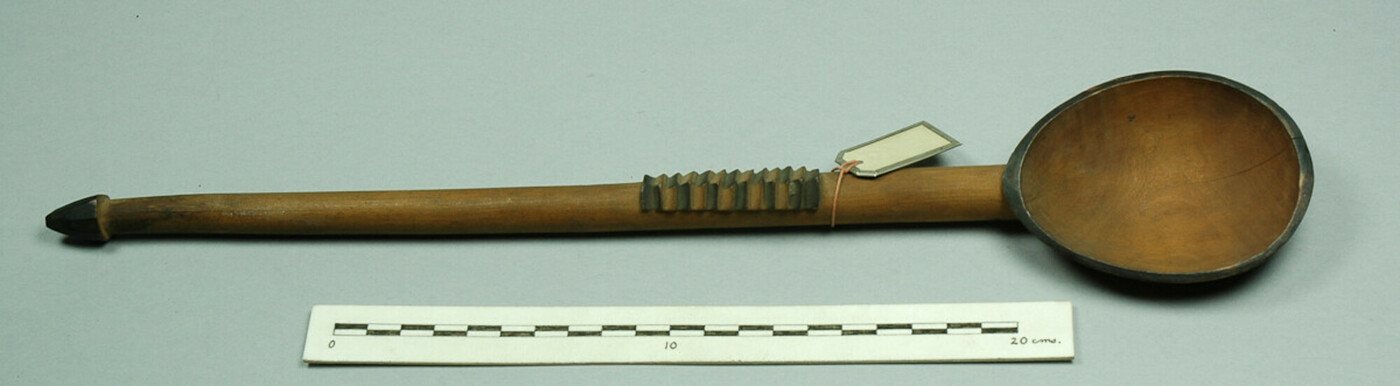 1941.12.23Wooden spoon with slightly oval bowl, with notched and burnt panel on the handle. [El.B 'DCF 2004-2006 What's Upstairs?' 31/3/2006]1941.12.23
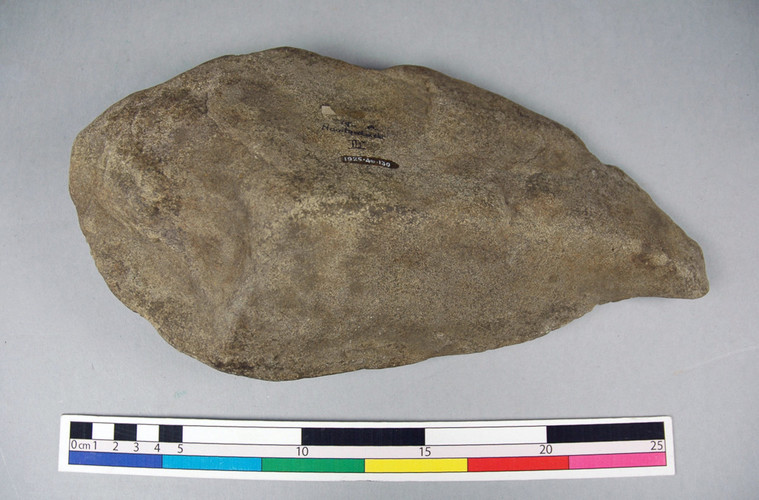 1925.46.130Stone tool, possibly a handaxe. [LKG 19/02/2010]1925.46.130
 1935.13.106.142Cream coloured stone with dark brown flecks. Converging dorsal crests and scar plain edges at the proximal edge. [LKG 24/05/2010]1935.13.106.142
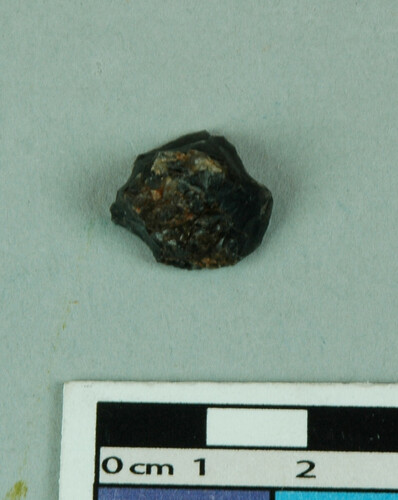 1946.6.92.8Stone tool; end-scraper, black in colour and roughly cone shaped. [MJD 16/07/2010]1946.6.92.8