
- Collection type
- Object
- Description
- Canoe stern ornament with carved seated man and long projection made from wood.
- Geographical reference
- Cultural groups
- Māori
- Person
- Field collector Mākereti Papakura (Margaret Pattison Staples-Browne)
- PRM source William Francis Dennan
- Date / Period
- Date made: Before 1930
- Date collected
- By 1930
- Acquisition information
- Purchased: 1930
- Materials and processes
- Material Wood Plant, Process Carved
- Dimensions
- Width 308 mm approx, Depth 300 mm, Height 970 mm approx
- Object numbers
- Accession number: 1930.85.8.1
- Research and responses
For general information, see The Old-Time Maori (by Makereti sometime Chieftainess of the Arawa Tribe, known in New Zealand as Maggie Papakura; collected and edited with a biography by T. K. Penniman), London: Victor Gollancz, 1938. [JC 15 5 1996]
See also ‘Makereti’, by Hélène La Rue, in Collectors: Collecting for the Pitt Rivers Museum, ed. Alison Petch (Oxford: Pitt Rivers Museum, University of Oxford, no date [1996]), pp. 31-35. [JC 11 6 1997]
In 1978, David Simmons recorded the holdings of Māori material in a number of museums in Europe and North America including, in May 1978, the Pitt Rivers Museum. (For copies of his notes and related correspondence, see RDF: Researchers: Simmons.) In 1996, Simmons put together the ‘draft catalogues’ he had prepared, depositing copies in, at least, the National Library of New Zealand / Te Puna Mātauranga o Aotearoa and the British Museum. The ‘draft catalogue’ of the Māori material in the PRM, which includes photocopies of some of the relevant catalogue index cards and annotations supplied by PRM assistant curator Lynne Williamson in 1982, was included in ‘Draft Catalogues of Maori Material in English Museums II. Prepared by David Simmons from records made in 1978… Compiled in Auckland in 1996’. It is now widely accepted that Simmons’s assertions about the provenance and history of individual Māori objects are not to be trusted without further evidence and/or documentation. Nevertheless, as the entries in this document have been referred in the literature, in July 2016 I obtained from the British Museum scans of the pages devoted to the PRM’s collections (numbered by hand as pages 43 to 62), printing out a copy for the RDF. For the probable entry for this object, see page 58 (page 14 of Simmons's original list). [JC 28 7 2016]
- Associated publications
- For a discussion of the circumstances in which some of the objects that once belonged to Makereti were acquired by the Museum, see ‘Makereti and the Pitt Rivers Museum, 1921–1930, and Beyond’, by Ngahuia te Awekotuku and Jeremy Coote, in Pacific Presences 2: Oceanic Art and European Museums (Pacific Presences series, 4b), edited by Lucie Carreau, Alison Clark, Alana Jelinek, Erna Lilje, and Nicholas Thomas (Leiden: Sidestone Press, 2018), pp. 277–95, 460–63. This object is referred to on page 288: 'In 1930, [Makereti's son Te Aonui] sold the PRM ten carvings (1930.85.1-.7) from the house Ruamano - at Parekarangi, five miles from Whakarewarewa - that had belonged to Maihi Te Kakau Paraoa and Marara Marotaua, along with three canoe carvings (1920.85.8-.9), and three further tukohu (1930.85.10.-12), used for boiling food in the hot springs at Whakarewarewa.' For a photograph (PRM0001858345165) of this object on display, see Figure 23.13 on page 290. (Printout of article in RDF: Biographies: Makereti.) [JC 4 1 2019]
Search terms: Navigation, Figure, Carving, Canoe Part
Further items to explore
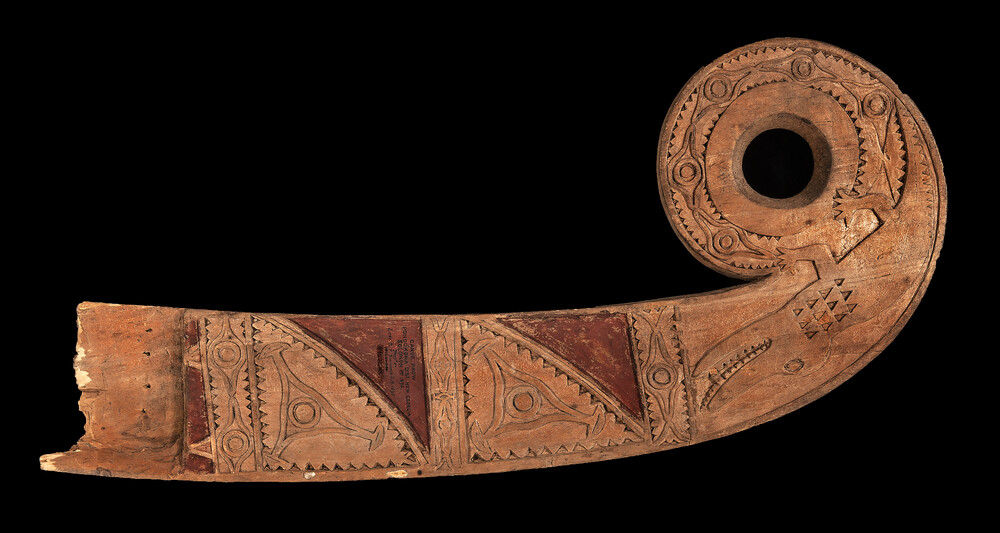 1895.22.165Canoe prow ornament in the form of a scroll with relief decoration including a crocodile carved on one side. [SM 25/11/2008]1895.22.165
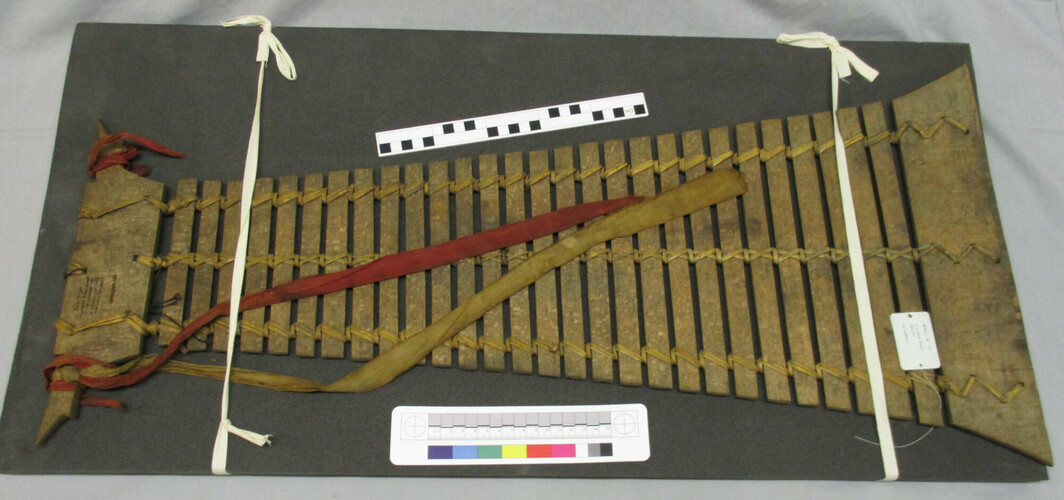 1884.81.14Boat seat made from wood with 30 slats secured together in three places with cane plant. [FC 03/06/2010]1884.81.14
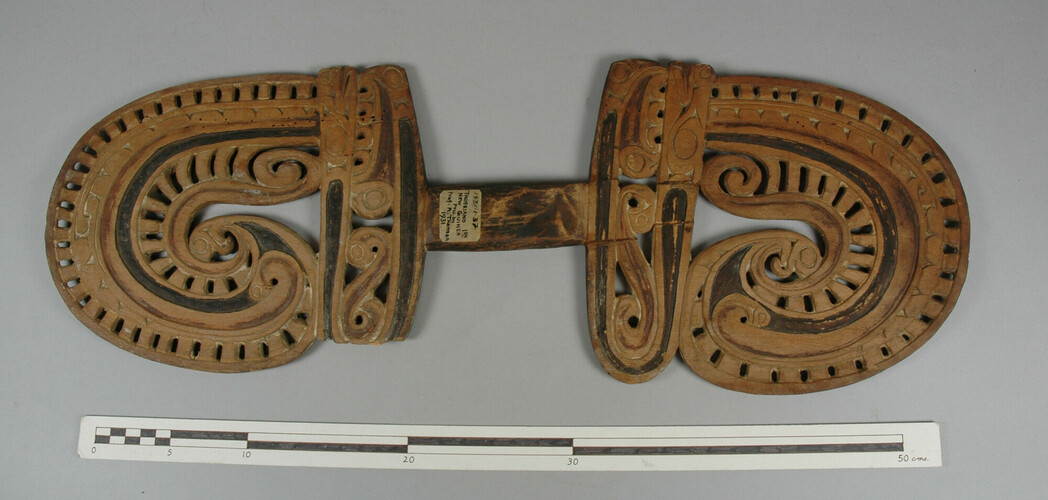 1931.1.37Dance shield. Made of wood with two ornate paddles and central grip. The paddles are incised with a scroll pattern. Parts of the paddles and the handle are painted black. [AB [OPS Move] 1/8/2016]1931.1.37
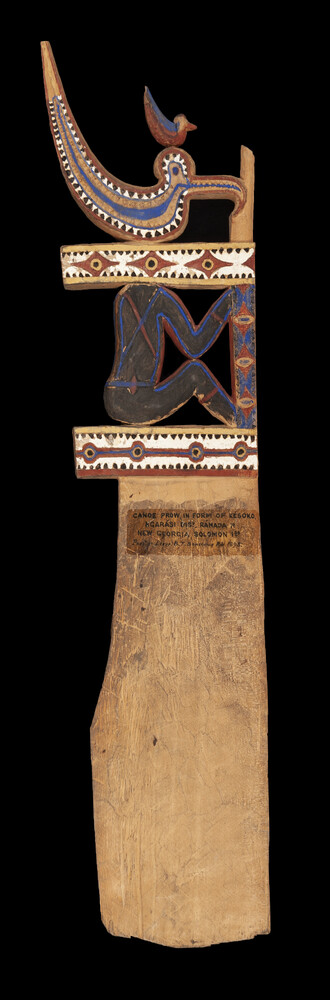 1895.22.160Canoe prow ornament, carved with frigate bird and anthropomorphic designs.1895.22.160