
- Collection type
- Object
- Description
- Barkcloth. Decorated with a pattern in blue featuring a repeated figure (possibly anthropomorphic). [JC 29/4/1996]
- Person
- Field collector Henry Boyle Townshend Somerville
- Field collector HMS Penguin
- PRM source Henry Boyle Townshend Somerville
- Date / Period
- Date made: Before 1893?, uncertain
- Date collected
- ? 1893 ? 1894
- Acquisition information
- Donated: 09/1895
- Materials and processes
- Material Bark Cloth Textile Plant, Material Pigment, Process Beaten, Process Painted
- Dimensions
- Width: max 490 mm, Length: max 1640 mm
- Object numbers
- Accession number: 1895.22.121 Other numbers: Brigham (1911) 246?
- Research and responses
The Museum's collection of barkcloth (including this piece) from the Solomon Islands (including Santa Cruz) was surveyed on 29 April 1996 by Ms Virginia Bond of the Sainsbury Research Unit at the University of East Anglia as part of her work for her MA dissertation. [JC 30 4 1996]
Sample analysed by Tamsin O'Connell and Christina Nielsen Marsh of the Research Laboratory for Art and Archaeology in June 1996. Both the UV analysis and IR analysis show the presence of indigotin. (See correspondence in RDF; spectographs held by Conservation in 'Analysis' file.) [JC 4 7 1996]
See 'A Study of Bark Cloth from the Solomon Islands with Particular Reference to the Use of Indigo in the North-Western Region' by Virginia Bond (M.A. dissertation; Norwich: Sainsbury Research Unit, University of East Anglia, 1996). Copy in Balfour Library. Details illustrated as Figures 14a and 14b on page 98. Motif (serpentine iconography) reproduced as a drawing in Fig. 42 on page 123. See also page 51. Spectographs (see above) reproduced on pages 58 and 60. [JC 3 10 1996]
For an account of Somerville's collection from the Solomon Islands, see 'The H. B. T. Somerville Collection of Artefacts from the Solomon Islands in the Pitt Rivers Museum’, by Deborah Waite, in The General’s Gift: A Celebration of the Pitt Rivers Museum Centenary, 1884–1984 (JASO Occasional Papers, no. 3), edited by B. A. L. Cranstone and Steven Seidenberg (Oxford: JASO, 1884), pp. 41–52. (Copy in RDF: Collectors: Somerville.) [JC 27 2 2003]
This is presumably the source of one of the specimens of barkcloth given by Henry Balfour to William T. Brigham, Director of the Bernice Pauahi Bishop Museum; see Ka Hana Kapa (Memoirs of the Bernice Pauahi Bishop Museum of Polynesian Ethnology and Natual History, III; with separately boxed set of color plates), by William T. Brigham (Honolulu: Museum Press, 1911). On page 231 Brigham notes that his private collection contains many specimens 'gathered in visits to many museums, and sent by correspondents who desired to make the knowledge of bark-cloth manufacture more complete'. A list of 'Specimens of Kapa in the Author's Collection' follows (pages 240-49). This includes some 14 specimens given to Brigham by Balfour, including (on page 241) Brigham's number 246: 'Dark blue lined kapa, the lining straight with loops, from NGarasi District, north coast of Rubiana, Solomon Ids. H. B. M. S. Penguin, 1894. Given by H. Balfour, Esq. To this specimen is appended this note: "juice of plant mixed with lime and water; sometimes chewed and spat upon the cloth and shaped into patterns with the finger." I have endeavored, so far without success, to learn the name of this plant of which the coloring matter is verry bright and durable.' On examination of the object it was found that a piece had been cut off one end, presumably to provide Brigham's sample. The removed piece would have measured approximately 220 mm x 150 mm. The later history and current whereabouts of this and the other samples is not known. [JC 5 9 2003; JC 23 9 2003]
For an account of Somerville's collection from the Solomon Islands, see 'The H. B. T. Somerville Collection of Artefacts from the Solomon Islands in the Pitt Rivers Museum’, by Deborah Waite, in The General’s Gift: A Celebration of the Pitt Rivers Museum Centenary, 1884–1984 (JASO Occasional Papers, no. 3), edited by B. A. L. Cranstone and Steven Seidenberg (Oxford: JASO, 1884), pp. 41–52. (Copy in RDF: Collectors: Somerville.) [JC 27 2 2003]
For an account of Somerville's collecting in the Solomon Islands, see 'Notes and Queries, Science, and “Curios”: Lieutenant Boyle Somerville’s Ethnographic Collecting in the Solomon Islands, 1893–1895’, by Deborah Waite, in JASO: Journal of the Anthropological Society of Oxford, Vol. XXXI, no. 3 (Michaelmas 2000), pp. 277-308. (Copy in RDF: Collectors: Somerville.) [JC 24 2 2007]
- Associated publications
- Discussed briefly on page 61 of Not Quite Extinct: Melanesian Bark Cloth ('Tapa') from Western Solomon Islands, by Rhys Richards and Kenneth Roga, Wellington, New Zealand: Paremata Press (2005): 'In the Pitt Rivers Museum in Oxford there are seven undecorated [sic] barkcloths collected in 1894 [sic] by Henry Boyle Townsend [sic] Somerville while on the survey expedition on HMS Penguin under Cmdr. A. F. Balfour.... A year later Somerville donated six more barkcloths.... Two cloths are from "Ngarasi District, northeast coast of Rubiana," which is now called Ramada lagoon in northeast New Georgia. The last, number 1895.22.121, is recorded as "decorated with a pattern in blue, featuring a repeated figure (possibly anthropomorphic.)" An old card [sic; label] adds "mati mati barkcloth patterned with wild indigo. Leaf is crushed with lime and water; sometimes it is spat on the cloth and smeared with fingers." In 1911 during his global survey, Brigham noted this cloth as "246: 'a dark blue lined kapa..., the lining straight with loops... Very bright and durable....'".' Richards and Roga go on to discuss potential confusions with Brigham's numbers. NB It is not clear why Richards and Roga think this, like 1895.22.120, is from "Ngarasi District, northeast coast of Rubiana," which is now called Ramada'; there is no indication of this in the Museum's records. For the other six barkcloths donated by Somerville and discussed by Richards and Roga, see 1894.26.49, 1895.22.116-.120. [JC 8 12 2005]
Search terms: Barkcloth
Further items to explore
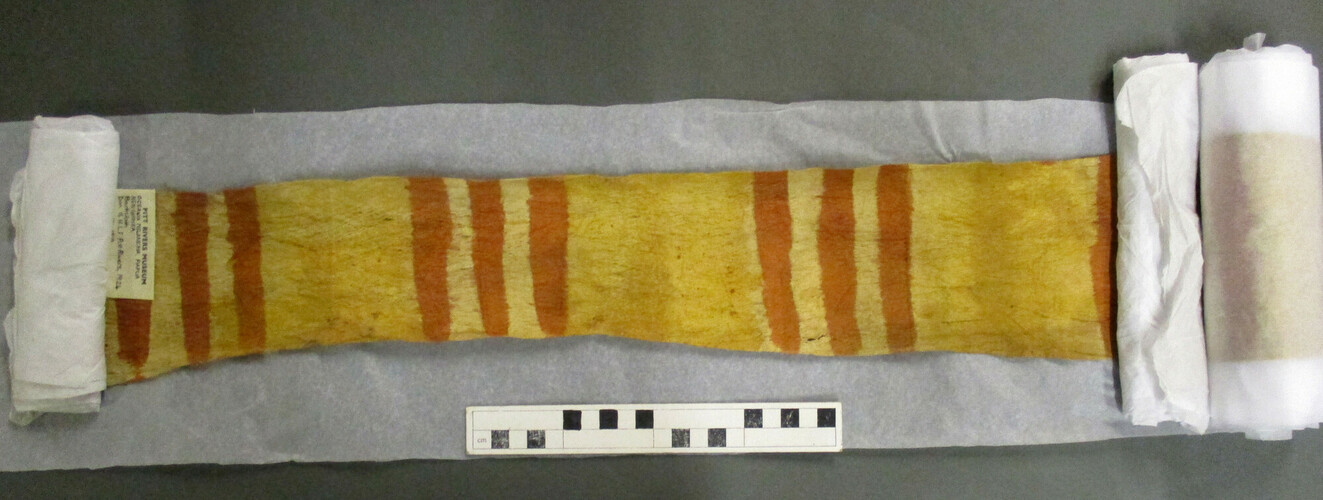 1924.51.150Barkcloth. It is light brown in colour. Painted with bands of yellow and sets of three red stripes. [AB [OPS Move] 19/7/2017]1924.51.150
 1914.56.24Barkcloth.1914.56.24
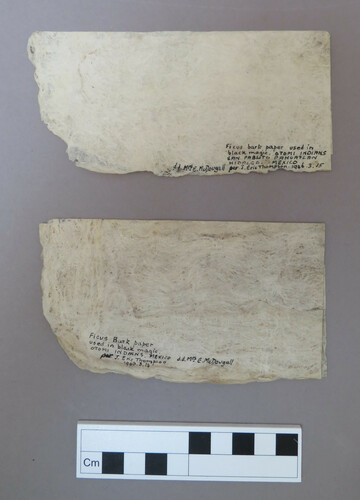 1946.3.15Bark paper specimen.1946.3.15
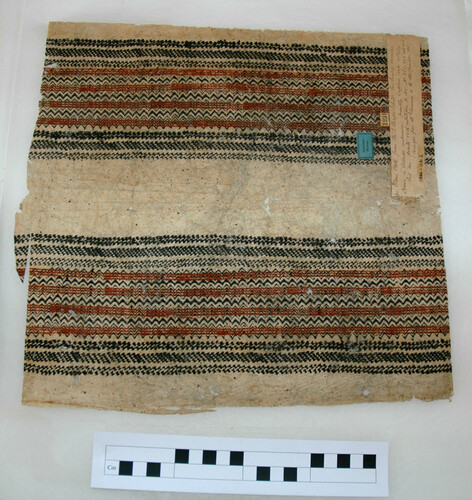 1886.1.1231.2Piece of barkcloth 'with black and red zigzag designs'.1886.1.1231.2
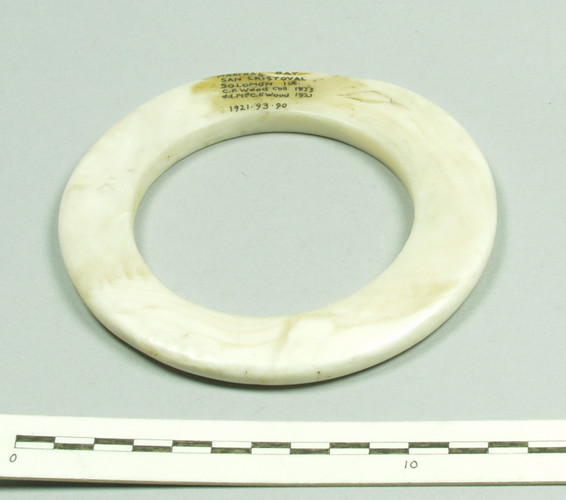 1921.93.90Arm ornament; flat ring of plain, white, undecorated Tridacna shell. [EC 'DCF 2004-2006 What's Upstairs?' 23/11/2005]1921.93.90
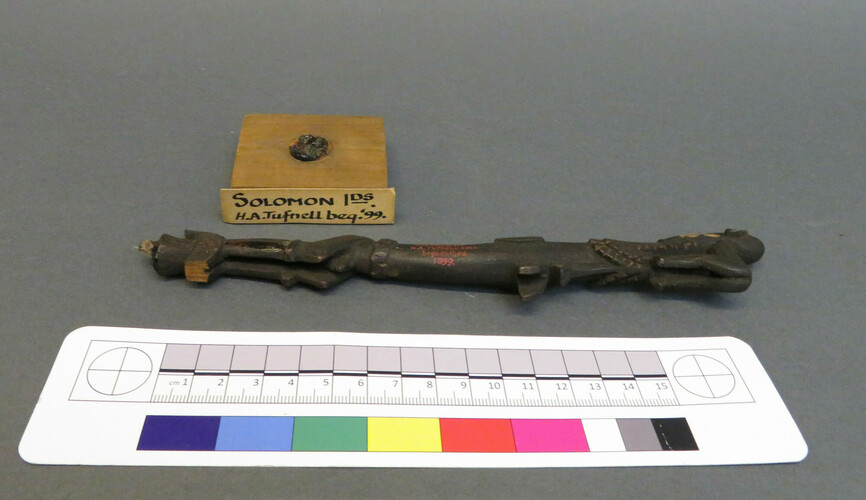 1899.62.74Carving of fish with human legs. The fish has its mouth open and is trying to eat a human, who is clinging onto the snout of the fish. It has been painted with a dark brown pigment. Attached to a square base made of a lighter wood [broken off]. [BH [OPS Move] 4/4/2017]1899.62.74
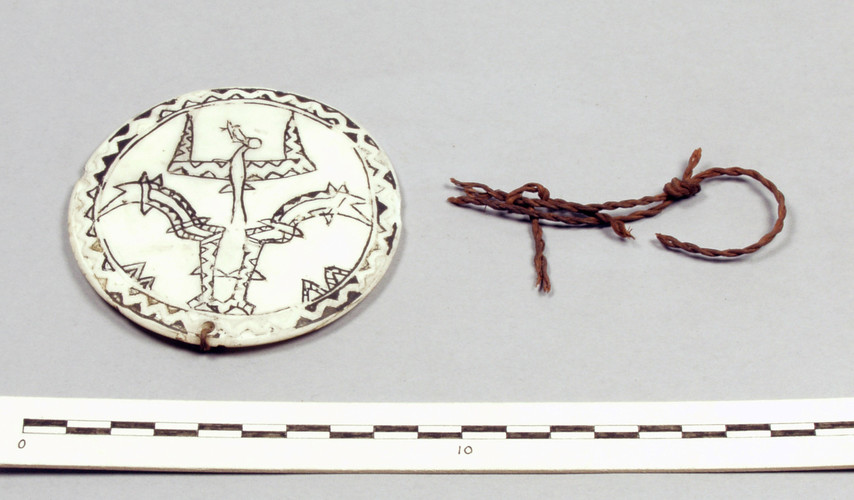 1884.68.129Round breast pendant of shell with incised fish and frigate bird design and zigzag borders, infilled in black. With fragment of plant fibre string, formerly threaded through perforation. [LM 'DCF 2004-2006 What's Upstairs?' 22/9/2005]1884.68.129
 1926.23.63Bean. [DCF Court Team 14/11/2002]1926.23.63