
- Collection type
- Object
- Description
- Cross bow with ivory inlaid stock and composite bow. [SM 21/02/2007]
- Long description
- Cross bow with ivory inlaid stock and composite bow. The bowstave has been badly damaged on one end and the other end has been cut through to show the structure of the horn strips and sinew backing. The left side has been cut twice, and the two pieces remain with the cross bow. The bow is covered and painted in a dot design. [MJD 28/11/2014]
- Geographical reference
- Cultural groups
- German
- Date / Period
- Date made: Circa 1480
- Date collected
- By 1900
- Acquisition information
- Loaned: 1900 Bequeathed: 1939, uncertain
- Materials and processes
- Material Metal, Material Animal Ivory Tooth, Material Wood Plant, Material Animal Sinew, Material Animal Horn, Material Birch Bark Wood Plant, Process Inlaid, Process Carpentered, Process Forged (Metal), Process Tied, Process Painted
- Dimensions
- Length: max 520 mm of stock, Weight 2520 g
- Object numbers
- Accession number: 1900.80.38
- Research and responses
Cross bow with ivory inlaid stock and composite bow part-covered in snake-skin. Says 'German 16th century dep'd by H. Balfour 1900' on stock. There is another cross-bow of similar description [1943.1.4ab] and a letter on page 95 of L.1 from Fenton dated Sept 2nd 1903 'Received from the Curator of the Pitt Rivers Museum in 1899 and 1900 - 1 cross bow with 'composite' bow ...' This may be a reference to this object.
See RDF for report by Jens Sensfelder, from his visit in November 2014. He comments 'there are some comparatives in different collections sharing similar decoration. He notes 'The left arm is covered with printed birchbark, decorated in black-white dot design and on the belly a decorated horizontal line' and not snakeskin. [MJD 25/02/2015]
- Associated publications
- Published with two colour illustrations (the author's own) in 'Querschnitt eines Hornbogens im Pitt Rivers Museum, Oxford', by Jens Sensfelder, in Jahrblatt der Interssengemeinschaft Historische Armbrust (2017), p. 110. (Photocopy in RDF.) Sensfelder writes: 'Im Pitt Rivers Museum (Universität Oxford) befindet sich unter der Inventarnummer 1900.80.38 (Prov. Sammlung Henry Balfour) eine Hornbogenarmbrust, deren Bogen auf der linken Seite zu Studienzwecken angeschnitten ist. Auch wenn das Schloß vor längerer Zeit modifiziert wurde, so ist die gesamte Waffe in einem guten Zustand und lässt sich in den deutschen Sprachraum verorten und in die Zeit um 1480 datieren. / Die Säule ist aus braunem Fruchtholz, oben vollständig verbeint und an den Seiten mit eingelegtem grünen Horn ver- ziert. Obwohl ein Teil der Bogendecke aus Birkenrinde beschädigt ist, kann man den ehemaligen Punktdekor noch gut er- kennen. / Die Größe des Querschnittes beträgt 52 x 41 mm, während die maximale Größe des Hornkerns cirka 42 x 20 mm misst. Der Hornkern ist in der üblichen Weise aus verzahnten Stücken zusammengesetzt. Dafür wurde Horn mit verschiedenen Far- ben verwendet (hell, schwarz, grün, braun). / Der Sehnenbelag weist sich als oliv- farbene Fläche aus, an der man gut die Orientierung der Fasern sehen kann. / Das Stück befindet sich zusammen mit anderen Armbrusten in der ständigen Aus- stellung des Museums.' [JC 23 5 2017, 1 6 2017] Published with three black and white illustrations (of the author's own photographs) in 'Cross Section of a Composite Bow in the Pitt Rivers Museum, Oxford', by Jens Sensfelder, Journal of the Society of Archer-Antiquaries, Vol. 81 (2018), pp. 97-8. The text reads: 'The Pitt Rivers Museum (University of Oxford) is in the possession of a crossbow with a composite bow, Inv. No. 1900.80.38, given by a former curator, Henry Balfour. Although the end of the left hand limb of the bow lath was cut off for study purposes, and the lock was modified a long time ago, the weapon is in generally good condition (fig. 1). It can be dated around 1480 and originates in the German language area. / The stock is made of brown fruit wood, and the upper surface is completely covered with plates of polished antler. The sides are covered with long plates of green coloured horn, inlaid with a lily design. / Traces of the birch bark, which once entirely covered the bow, show the usual black and white dotted decoration (fig. 2). The overall cross section measures 52 mm by 41 mm, whereas the horn core measures 42 mm by 20 mm (fig. 3) and consists of several horn plates of different colours (light, black, green, brown), glued together. The grooved surfaces of these laminations are clearly visible in section. Several layers of sinew around the belly are of an olive-green colour. / The crossbow is usually to be seen with other crossbows in the museum displays.' (Copy of the journal in RDF.) [JC 25 1 2019]
Search terms: Archery Weapon, Cross Bow, Composite Bow
Further items to explore
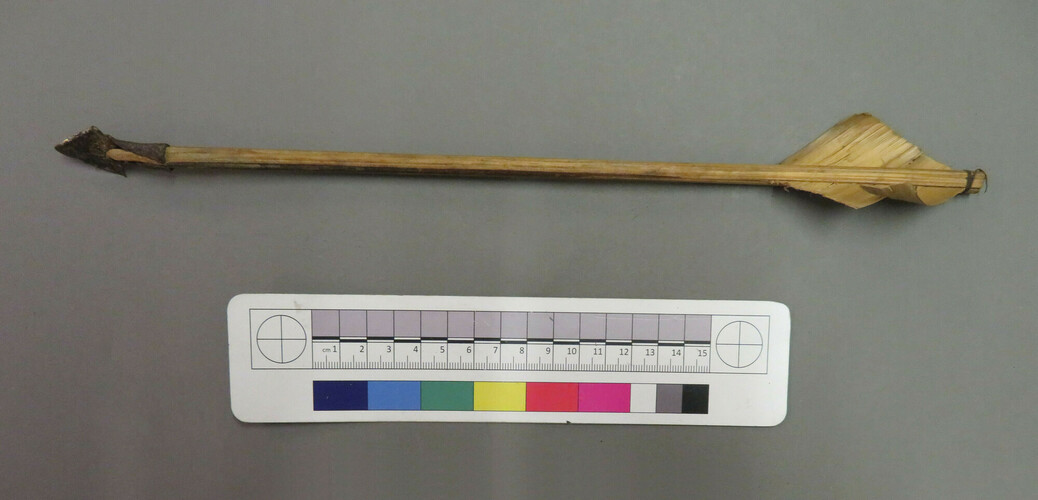 1923.85.551.4Crossbow bolt with metal head. For the associated bamboo quiver see 1923.85.551 .1. For the associated bolts/arrows and ?stones see 1923.85.551 .2 - .3, .5 - .11. [AF [OPS move] 25/9/2017]1923.85.551.4
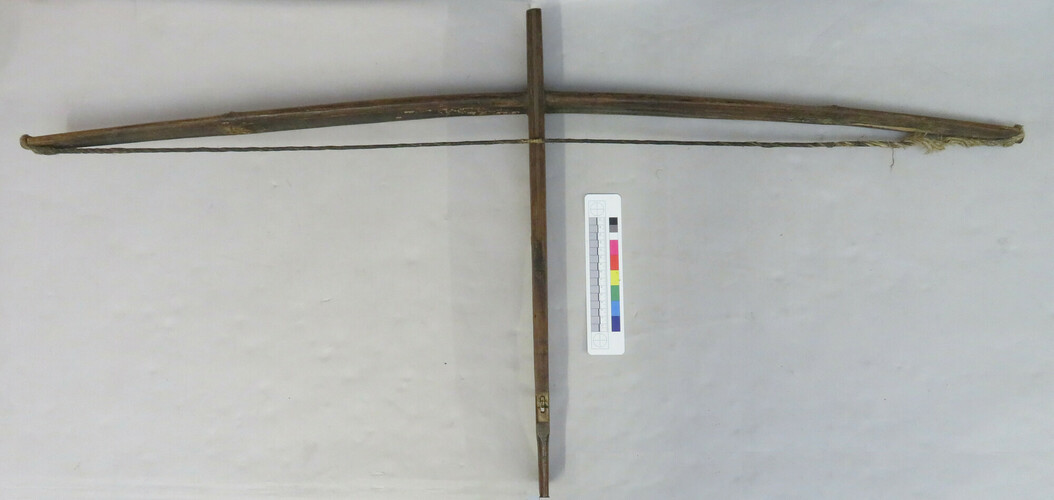 1948.7.4Wooden crossbow.1948.7.4
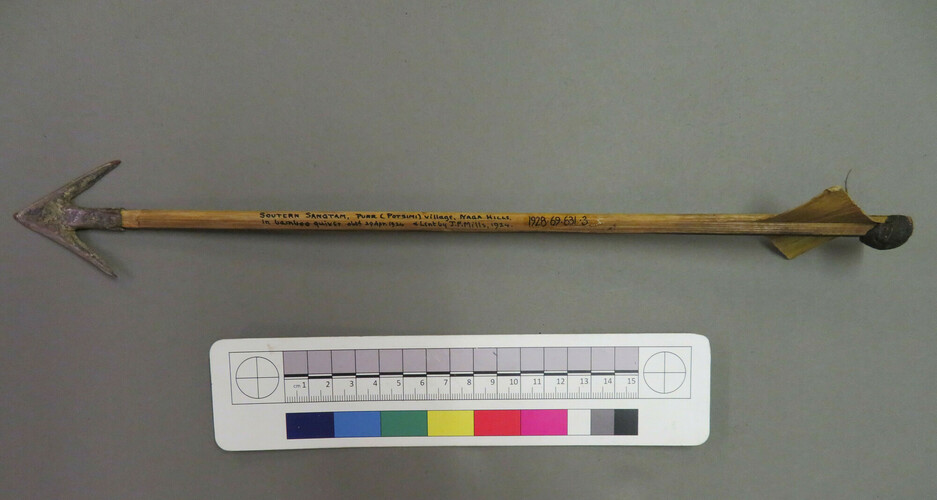 1928.69.631.3Arrow or crossbow bolt with cane shaft and metal head. For associated quiver and arrows see [1928.69.631 .1 - .4] [EH [OPS move] 25/9/2017]1928.69.631.3
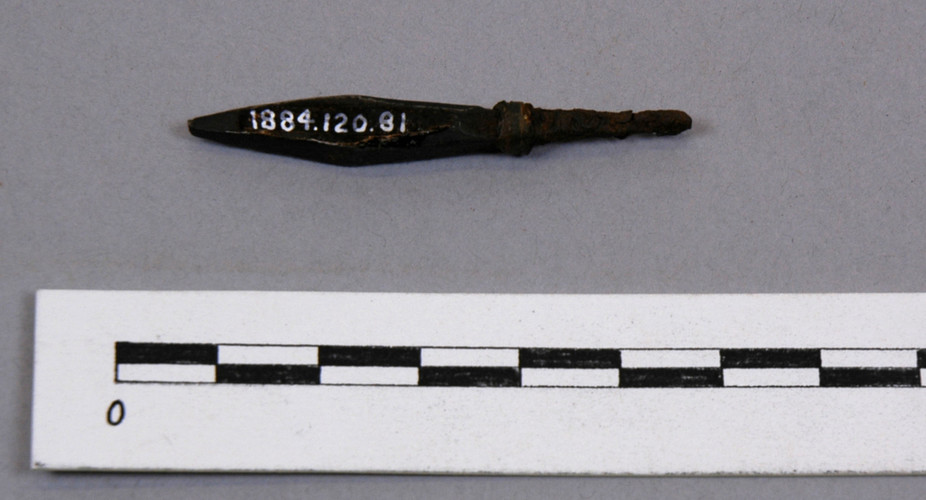 1884.120.81Iron arrow-head1884.120.81
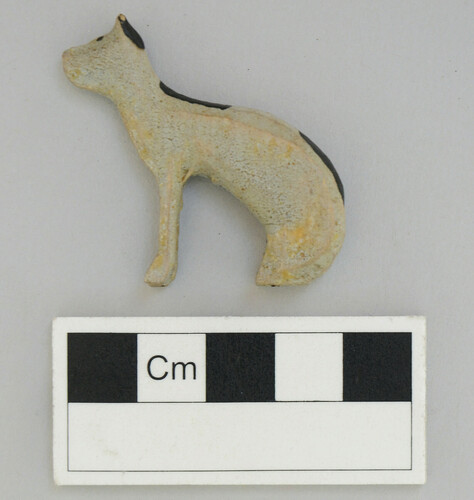 1956.9.70.195Seated grey cat figure. Part of a Noah’s Ark set. One of a pair. [See 1956.9.70.194 for other figure]. [SM (Verve) 16/04/2015]1956.9.70.195
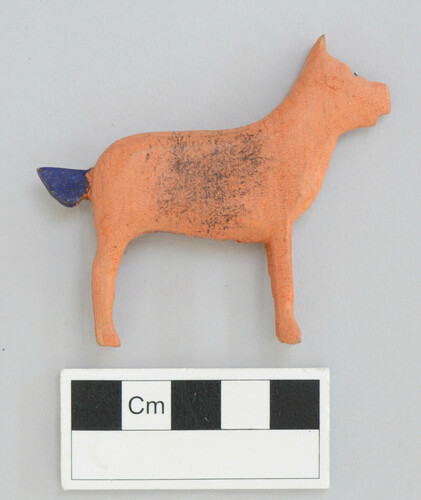 1956.9.70.149Pink dog-like animal figure with small blue tail and short pointed ears. Part of a Noah’s Ark set. One of a pair [See 1956.9.70.148 for other figure]. [SM (Verve) 16/04/2015]1956.9.70.149
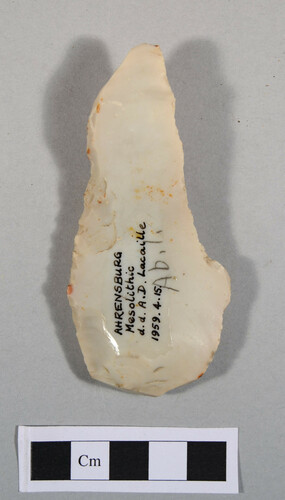 1959.4.15Stone flake, light grey colour. [MJD 03/03/2014]1959.4.15
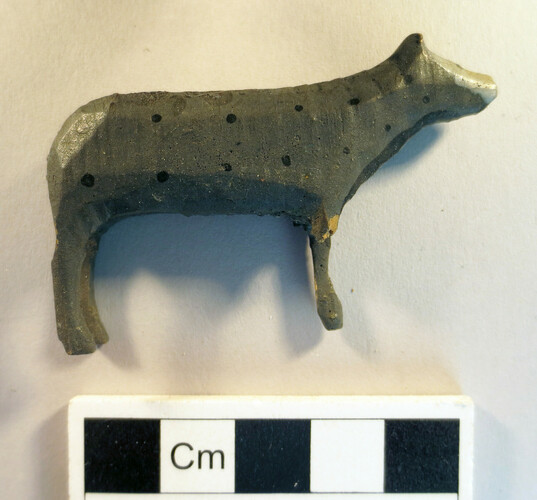 1956.9.70.72Dark grey dog-like animal figure with black spots and light grey face. Part of a Noah’s Ark set. One of a pair [See 1956.9.70.73 for other figure]. [SM (Verve) 15/04/2015]1956.9.70.72