
- Collection type
- Object
- Description
- Broken stone tool (toki) from Easter Island. [ZM 29/4/2004]]
- Person
- Field collector William Scoresby Routledge
- Field collector Katherine Maria Routledge
- PRM source William Scoresby Routledge
- Date / Period
- Date made: Before 18/08/1915
- Date collected
- Between 29 March 1914 and 18 August 1915
- Acquisition information
- Donated: 1916
- Materials and processes
- Material Stone
- Dimensions
- Width: max 70 mm, Length: max 150 mm
- Object numbers
- Accession number: 1916.36.249
- Research and responses
Please note that the Routledge's published account of their journey includes many specific object references, drawings, maps and photographs. Please refer to: Routledge, Mrs. [Katherine] Scoresby Routledge (1919) The Mystery of Easter Island: The Story of an Expedition. London: Sifton, Praed & Co. Ltd. [L.Ph 29/4/2004]
Please note that the unpublished field notes relating to this expedition are at the Royal Geographical Society. This information was found on p. 334 of the biography of Katherine Routledge (Pease): van Tilburg, Jo Anne (2003) Among Stone Giants: The Life of Katherine Routledge and her Remarkable Expedition to Easter Island. London: Scribner. [L.Ph 29/4/2004]
- Associated publications
- One of twenty objects from the Pitt Rivers Museum included in the exhibition catalogue Making Monuments on Rapa Nui: The Statues from Easter Island, by Colin Richards and Bryan Sitch (Manchester: The University of Manchester, Manchester Museum, 2015). On page 38 in the section 'Making the Monuments' this particular object is one of a group described as follows: 'Group of fourteen stone tools used to make moai including adzes or toki and pebble hammers. Some of the toki have an oblique cutting edge. Thor Heyerdahl in Aku Aku describes how, in an attempt to carve a moai during his 1950s expedition, the islanders stopped regularly to resharpen their toki. However, they were working an old, weathered rock face. Newly exposed stone is softer and easier to carve. Unknown date. Lent by the British Museum (Oc1898,1010.11, Oc1920,0506.56), National Museums Liverpool (54.160.200-206, 209) and the Pitt Rivers Museum, University of Oxford, 1916.36.167, 1916.36.175, 1916.36.191 and 1916.36.249'. [ZM 9/9/2015]
Search terms: Tool
Further items to explore
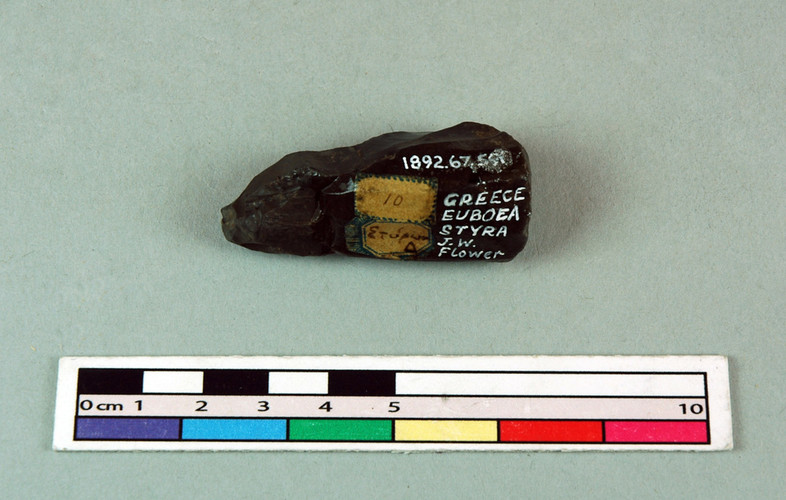 1892.67.591Stone tool, rough 'point' of dull grey/black ?obsidian. [SM 26/06/2008]1892.67.591
 1992.22.37.21One of nine loose needles. For the other component parts in this set of tools see [1992.22.37 .1 - 20] and [1992.22.37 .22 - 36]. [CW [OPS Move] 27/4/2017]1992.22.37.21
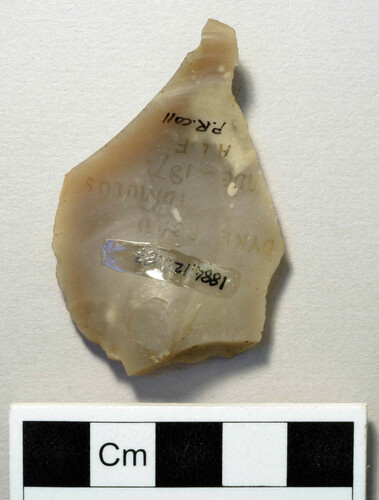 1884.123.87Stone flake1884.123.87
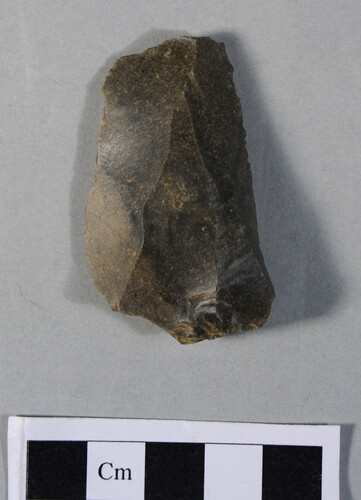 1911.28.34Stone tool; implement1911.28.34
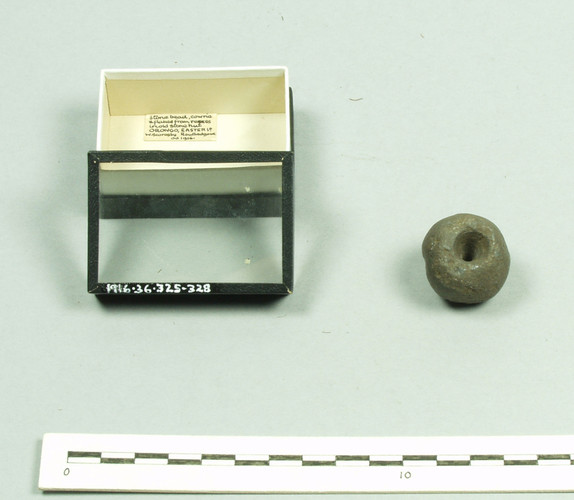 1916.36.325Perforated dark grey stone bead [EC 'DCF 2004-2006 What's Upstairs?' 21/7/2005]1916.36.325
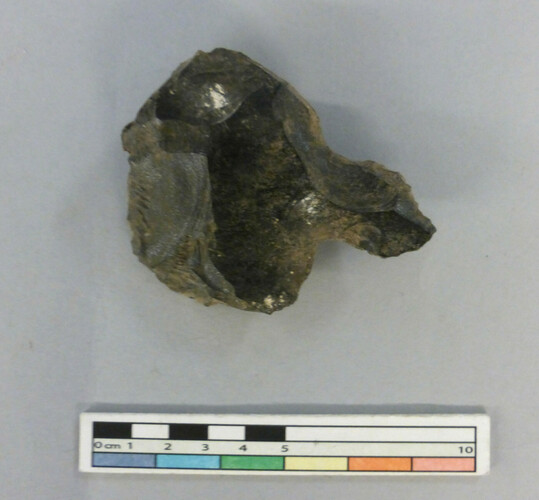 1916.36.340.82Obsidian stone tool (mata'a ).1916.36.340.82
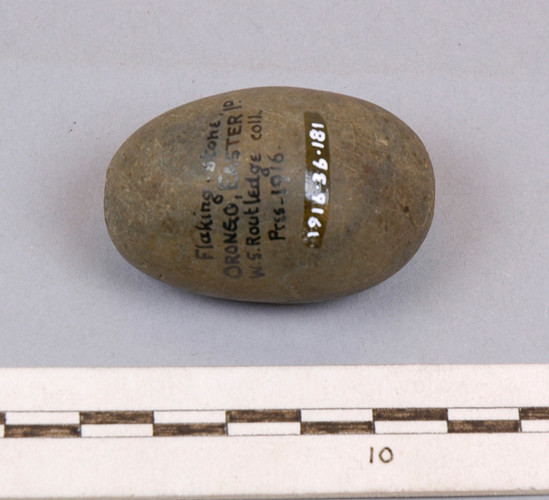 1916.36.181Smooth pebble used for flaking. [El.B 15/02/2008]1916.36.181
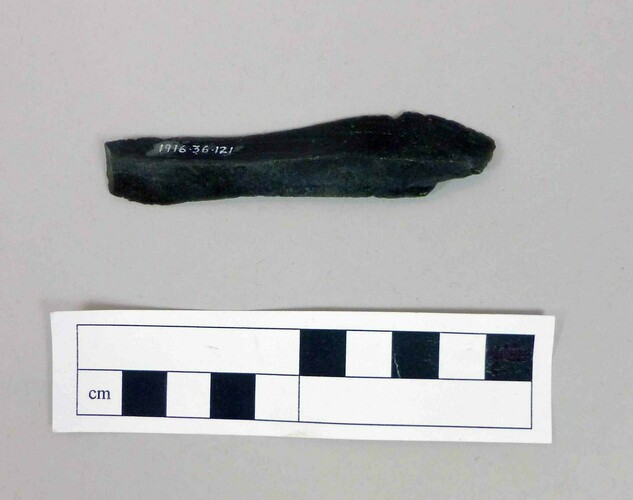 1916.36.121Stone tool, mata'a, made of obsidian.1916.36.121