
- Collection type
- Object
- Description
- Hide thong. For related bells, see 1884.108.7 .1 and 1884.108.7 .2. [LC 29/1/2020]
- Long description
- A pair of iron bells [.1 - .2] linked across the top by a hide thong [.3]. The bells have been made in a similar way, with bodies formed from a rectangular sheet of iron that has been folded over double, with the long sides heated and hammered together. The top and sides have been flattened, but the central part of the body forced open, creating a hollow, almost cylindrical interior that is lentoid in section and that widens as the bell body splays out towards the mouth. The top edge of each bell has been pierced twice for a suspension loop; these holes have jagged edges and were punched through from the bell interior. A narrow iron bar, roughly square in section, has been fitted through these holes and bent into an elongated oval loop, with the ends overlapping near the top. A second, smaller oval loop hangs down from this, inside the body, to which the clapper has been attached. The clappers are each made from a slightly thicker iron rod, with a rectangular section that becomes almost round for part of its body, then tapers towards the top, where it has been bent over the small loop and turned down and in towards the clapper body to hold it in place. The clappers both extend beyond the lip of the bell mouth, and are of uneven lengths. At the top, 2 hide thongs have been used to tie the two bells together [.3], both made from the same yellowish brown material (Pantone 7507C). A short rectangular strip has been attached to the top of the suspension loop of 1884.108.7.1, by wrapping one end over the loop, pushing the other end through a long slit cut down the centre of the thong, and then pulling this tight to secure it. A second, longer hide thong has been tied to the iron loop for the other bell, 1884.108.7.2; this has only a small slit cut in the lower end, which was wrapped around the iron ring with the body of the thong pushed through the hole on the other side and pulled tight in its turn. The other end was then tied to the first thong with a simple knot. The object is compete and intact, with some surface rust on the iron elements, now a reddish brown colour (Pantone 7533C), and a flaw or cut in the iron of [.2] that has left a small hole in the body wall. The group has a total weight of 160.1 grams. 1884.108.7.1 has a total length of 125 mm, including its suspension ring; the bell body is 52.2 mm long, 39.5 mm wide across the top and 45.8 mm wide and 29 mm deep across the mouth opening, while the metal is 1 mm thick; its suspension loop measures 17.5 mm across its maximum width, and is made from a bar 2.4 mm wide and 1.8 mm thick; the clapper is 80 mm long, 4.8 mm wide and 4.5 mm thick. 1884.108.7.2 has a total length of 94 mm, including its suspension ring; the bell body is 53 mm long, 39 mm wide across the top and 44.8 mm wide and 30 mm deep across the mouth opening, while the metal is 1 mm thick; its suspension loop measures 14.4 mm across its maximum width, and is made from a bar 2 mm wide and 1.7 mm thick; the clapper is 52 mm long, 4.7 mm wide and 4.3 mm thick. 1884.108.7.3, the thong, has a width of 5.5 mm and is 0.4 mm thick. The 2 parts, stretched out, have a combined length of 145 mm [RTS 21/2/2005].
- Geographical reference
- Cultural groups
- Nuer
- Person
- Maker Unknown Maker
- Field collector John Petherick
- PRM source Augustus Henry Lane Fox Pitt Rivers founding collection
- Date / Period
- Date made: Before 1858?, uncertain
- Date collected
- 1858?
- Acquisition information
- Donated: 1884
- Materials and processes
- Material Iron Metal, Material Animal Hide Skin, Process Forged (Metal), Process Hammered, Process Bent, Process Perforated, Process Knotted, Process Welded
- Dimensions
- Length: max 135 mm, Weight 160.1 g
- Object numbers
- Accession number: 1884.108.7.3
- Research and responses
Evans-Pritchard, writing in 1940, commented on the scarcity of iron amongst the Nuer and the high value consequently placed on objects made from it: 'Nuer have always been poor in iron objects. Till recently they possessed very few iron spears, cherished as heirlooms ... Iron bells ... are rare and highly prized even at the present time, and in the old days iron rings and bracelets were important pieces of property' (E.E. Evans-Pritchard, 1940, The Nuer, p. 86). The cultural attribution of this object to the Nuer did not come from the collector's information, but was done on the basis of a parallel type collected by Evans-Pritchard; it is equally likely to be a Dinka object. Larger versions of this type of bell seem to have been used to adorn cattle (see 1934.8.14 from the Dinka, or 1979.20.103, from the Dinka Tuich). This item does not appear in Petherick's unpublished sketchbook, now in the Wellcome Library (MS 5789). He talks only generically about bells in his publications, with a reference to Arabs trading cattle-bells to the Shilluk (Egypt, The Sudan and Central Africa, 1861, p. 351) [RTS 21/2/2005].
- Associated publications
- 1884.108.7.2 is probably the bell illustrated in J.G. Wood, 1868, The Natural History of Man, p. 513 figure 2. This matches our bell in shape and details such as some surface flaws in the iron, but the hide thong on the suspension loop has been drawn incorrectly. Wood does not give a cultural attribution, and simply states that this is one of the bells in 'Colonel Lane Fox's collection' [RTS 21/2/2005].
Search terms: Music, Animal Gear, Musical Instrument, Cattle Accessory, Bell
Further items to explore
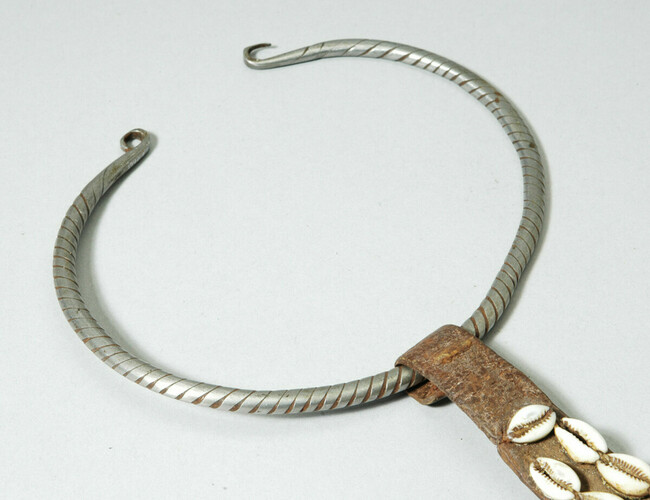 1940.7.016.1Circular neck ornament of twisted iron [.1], with a leather strap [.2] decorated with cowrie shells and a brass pendant hung from the base, worn by women [RTS 2/3/2005].1940.7.016.1
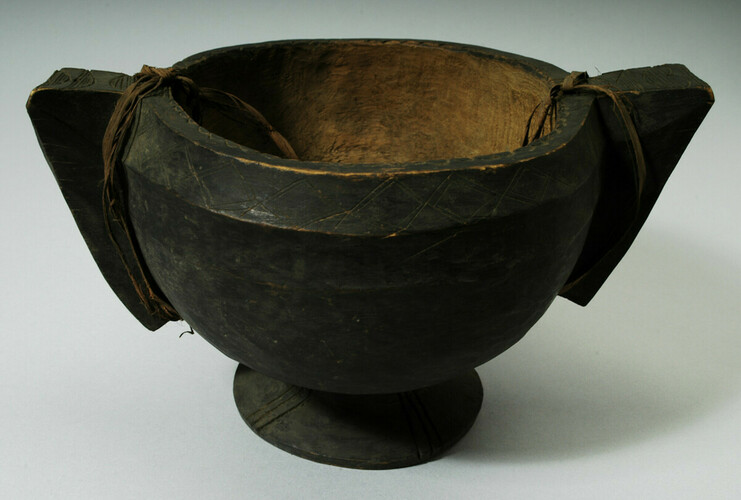 1948.2.136Deep wooden bowl with 2 lug handles and a hemispherical body on a short splaying foot, with bark carrying loop [RTS 13/5/2005].1948.2.136
 1979.20.197Light yellow wooden spoon with long pierced handle and shallow bowl, tied to 1979.20.195-6 by hide thongs [RTS 21/6/2004].1979.20.197
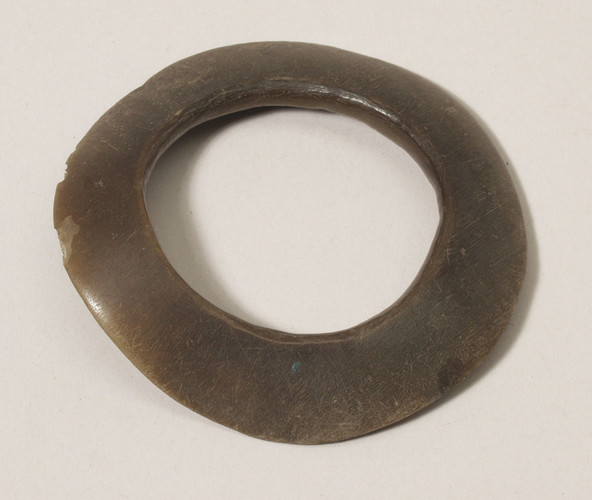 1917.25.84Annular armlet made from elephant hoof [RTS 25/3/2004].1917.25.84