
- Collection type
- Object
- Description
- Sword-belt of plaited rattan, partly covered with red textile and with two bead tassels. See also sword [1943.6.111 .1], sheath [1943.6.111 .2] and knife [1943.6.111 .4]. [El.B 16/11/2007]
- Cultural groups
- Kenyah
- Date / Period
- Date made: Before 1943
- Date collected
- By 1943
- Acquisition information
- Donated: 1943
- Materials and processes
- Material Bead, Material Textile, Material Metal Wire, Material Silver Metal, Material Bark Wood Plant, Material Wood Plant, Material Rattan Fibre Plant, Process Carved, Process Incised, Process Beadwork, Process Plaited, Process Repoussé, Process Beaten
- Object numbers
- Accession number: 1943.6.111.3
- Research and responses
Parang is a term used among the Malay and Iban to indicate any sword, although these weapons were used (like the kukri and Naga dao) for agricultural and arboricultural purposes as well. Parang ilang is an Iban term for these swords, which have other names among other peoples. The parang is worn blade-upwards on the left hip, in the Japanese fashion, and offers considerable artistic interest. In use, the distinctive blade is quite unique. It has a curvature across the width of the blade, as well as the length, which is found by the Borneans to permit a deeper cut. These swords are the counterpart to the beautiful Kayan and Kenyah shields, and the baju empurau war-jackets. One begins to get a true sense of the rich self-presentation of the Kayan and Kenyah warrior when one puts these items together into the appropriate complex of objects. The back of the blade is often fretted and hooked, or decorated with incised motifs, somewhat after the fashion of the keris. These designs allude to various serpent or dragon forms, again, much like the keris. Research Conducted for DCF Cutting Edge 2006/2007 [AM].
Baieng is the Kenyah name for the parang ilang. [El.B 16/11/2007]
Further items to explore
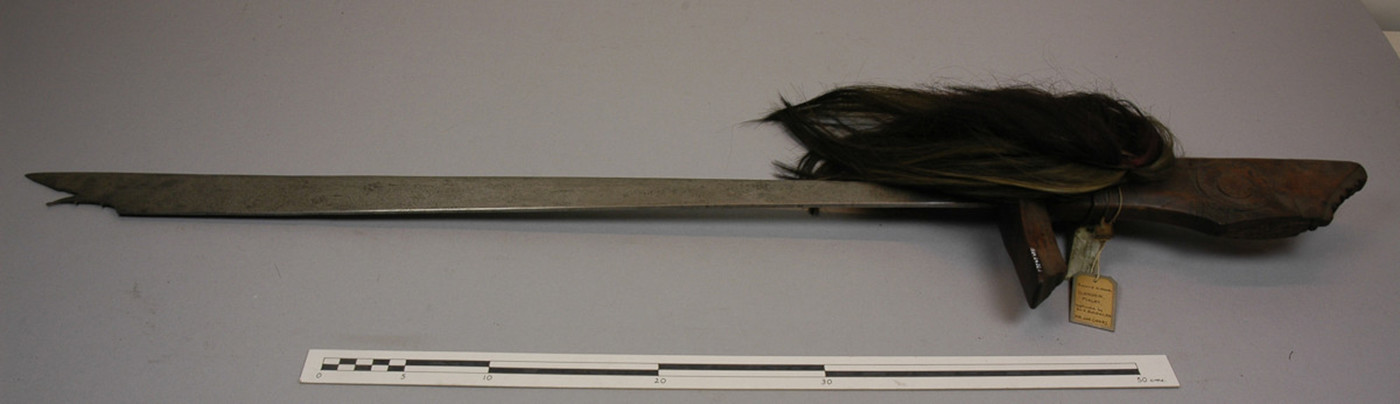 1884.24.32.1Sword [.1] with expanded single edged blade and decorated wooden hilt. For sheath and belt see 1884.24.32 .2-.3 [SM 02/03/2007]1884.24.32.1
 1946.12.68.2Sheath of wood covered in black lacquer, for sword [1946.12.68 .1], See also knife [1946.12.68 .3]. [El.B 27/02/2008]1946.12.68.2
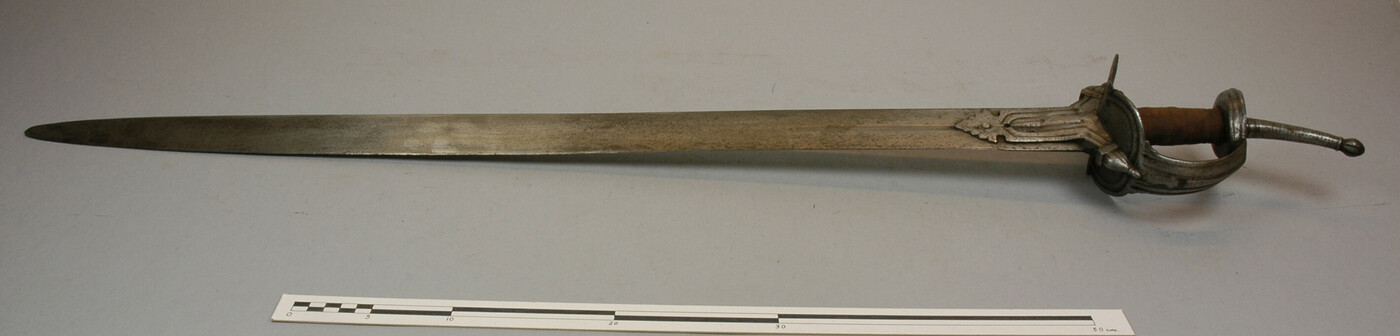 1909.78.18Sword with straight, tapering, double-edged pointed blade (probably European), decorative langets, 'Hindu Basket' hilt and cloth-bound grip. [LM 07/11/2007]1909.78.18
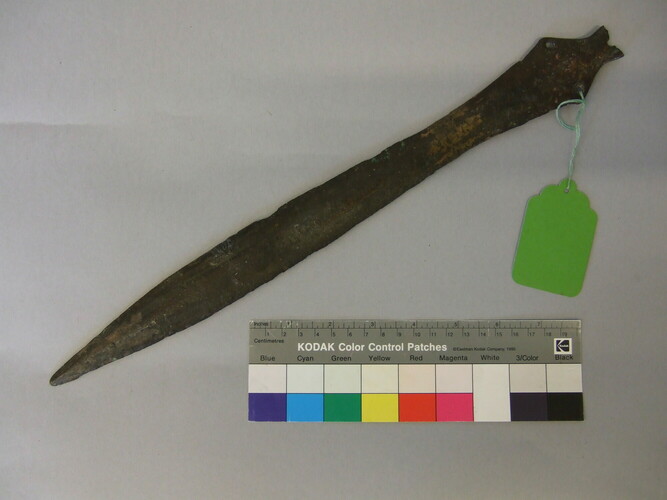 1884.119.298Bronze sword blade.1884.119.298
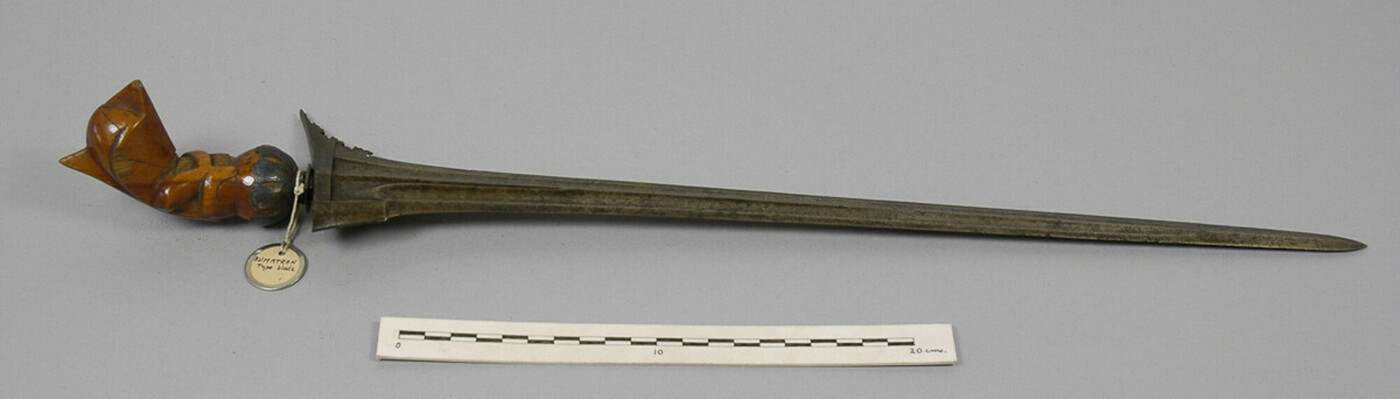 1944.6.96Kris with straight blade and carved wooden handle in jawa demam form, connected to the hilt with an incised silver cup. [El.B 8/3/2007]1944.6.96
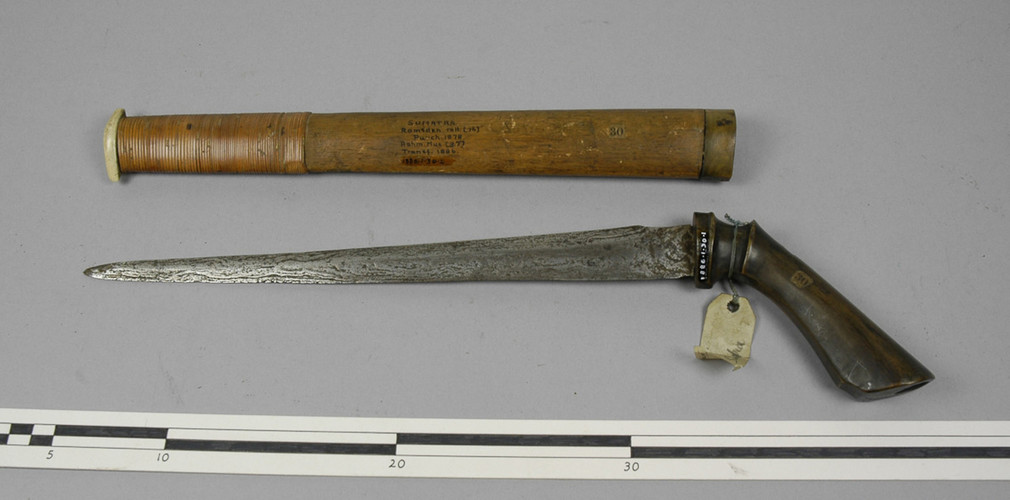 1886.1.30.1Kris [.1] with straight blade and horn handle in the shape of a pistol grip. With wooden sheath [.2] with horn at the top and ivory at the tip, bound with cane on the lower part. [El.B 31/5/2007]1886.1.30.1
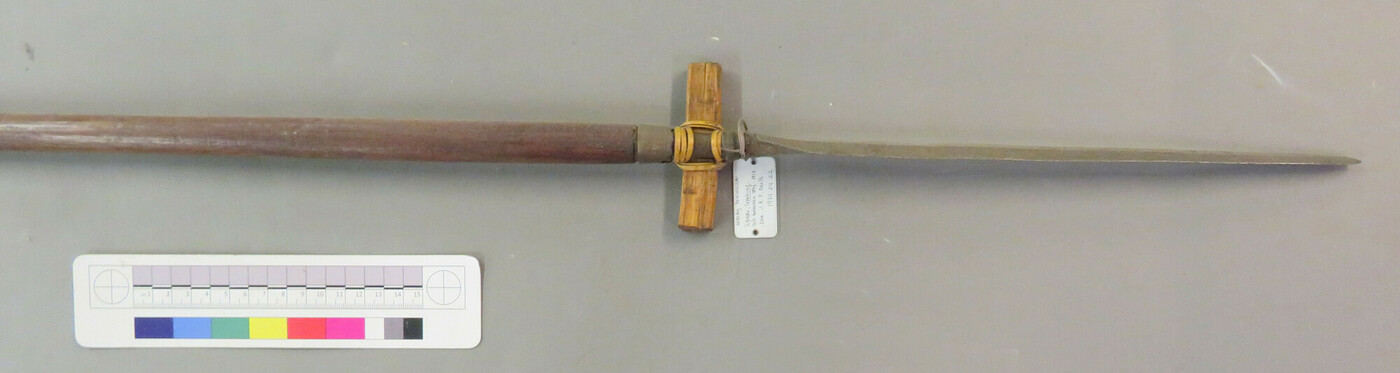 1974.24.22Spear, with a leaf shaped metal blade socketed onto a wooden shaft. There is a rectangular block of wood bound beneath the blade with rattan. [AB [OPS move] 23/8/2018]1974.24.22
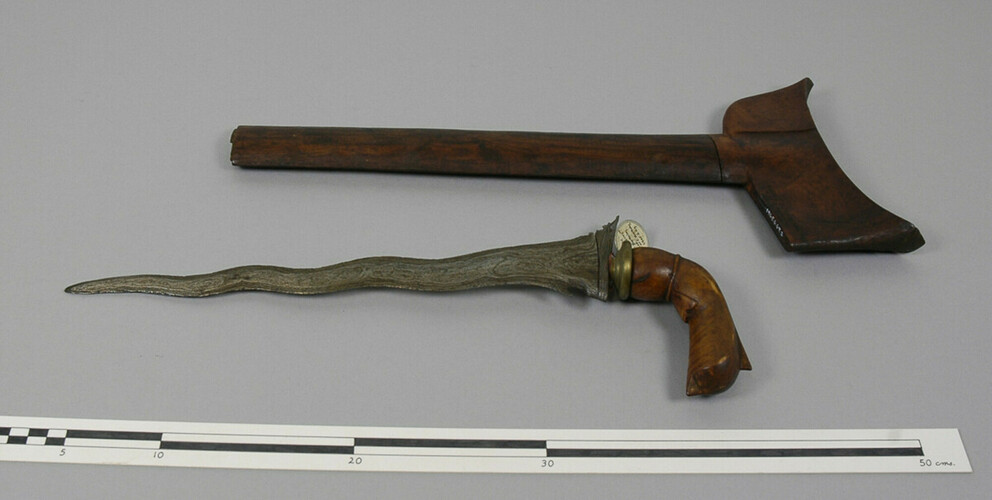 1945.6.69.1Wavy-bladed damascened dagger [.1]; carved wooden hilt of jawa demam type [also called garuda] with brass cup. With wooden sheath [.2], chape missing. [LM 6/3/2007]1945.6.69.1