
- Collection type
- Object
- Description
- Iya beji carved wooden figure of a mother with twins. The mother is seated and is nursing one child while the other is on her back. [JMC 24/9/2019]
- Long description
- Iya beji carved wooden figure of a mother with twins. The female figure is seated on a three-legged stool and is nursing one child, laid across her knees and suckling at her left breast while holding her right, while another is held in a baby carrier at her back and is looking right. The baby carrier has a carved triangular decoration with tassels at the corners. The mother is wearing a long necklace of tubular beads, four bracelets on each wrist, a large disc in each ear and has her hair arranged in a high, peaked, crested hairstyle. The whole figure is set onto a hollow cuboid plinth, comprising a square platform at the top and bottom, each with a chip-carved border along the edge, separated by four raised arches. [JMC 24/9/2019]
- Cultural groups
- Yoruba
- Date / Period
- Date made: 1970
- Date collected
- 1970
- Acquisition information
- Donated: 22/07/2019
- Materials and processes
- Material Wood Plant, Process Carved
- Dimensions
- Height: max 465 mm, Depth: max 120 mm, Width: max 137 mm
- Object numbers
- Accession number: 2019.23.9
- Research and responses
The artist's name is given by the donors as 'Bamgboye', probably Bamgboye of Odo-Owa (c.1895 - 1978), meaning he would have carved this sculpture at the age of approximately 75. Bamgboye was considered one of the greatest Yoruba master carvers of the 20th Century and was Chief Alaga of Odo-Owa, Ekitit. [JMC 24/9/2019]
This sculpture is an 'Iya beji', a mother of twins, a common subject of Yoruba sculpture. Twins and mothers of twins are highly revered in Yoruba culture. [JMC 24/9/2019]
Search terms: Figure
Further items to explore
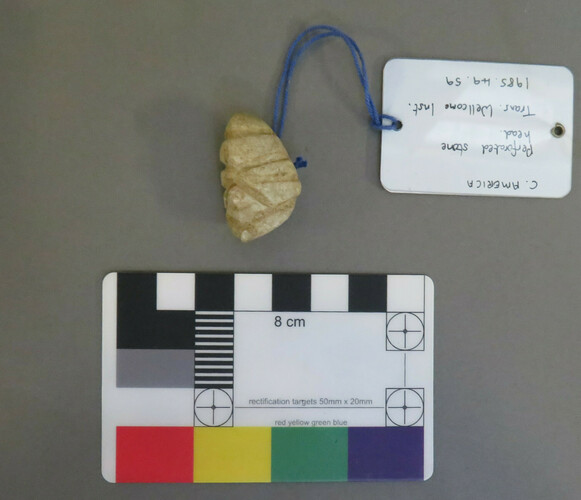 1985.49.59Pendant of white stone carved in the shape of a stylised geometric human head. It is perforated at the back for suspension. [BA [OPS move] 30/10/2017]1985.49.59
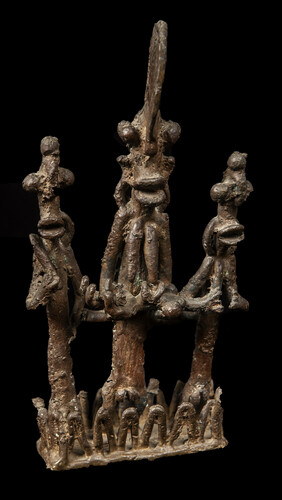 2019.23.10Lost wax cast bronze sculpture depicting a woman nursing a baby, with a young female figure on her left and a young male figure on her right. [JMC 24/9/2019]2019.23.10
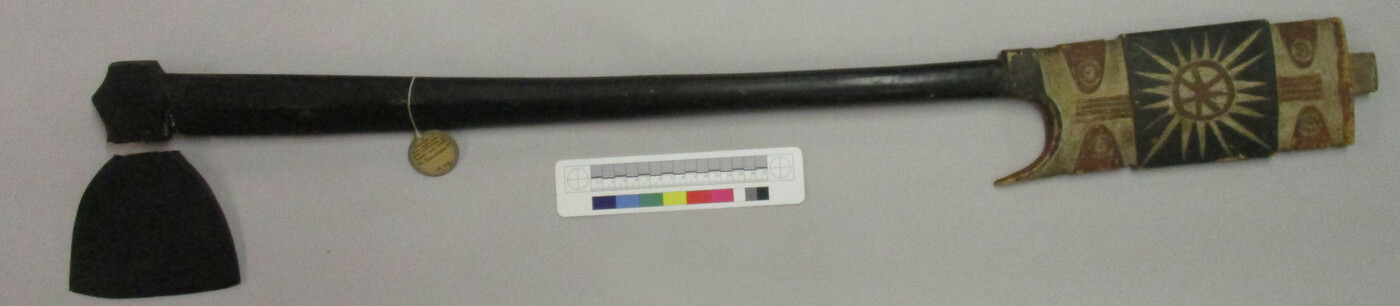 1884.13.41Ceremonial wooden axe with a carved axehead imitating an iron blade and a 'hatchet head' plate at the butt. [JC [OPS Move] 29/07/2016]1884.13.41
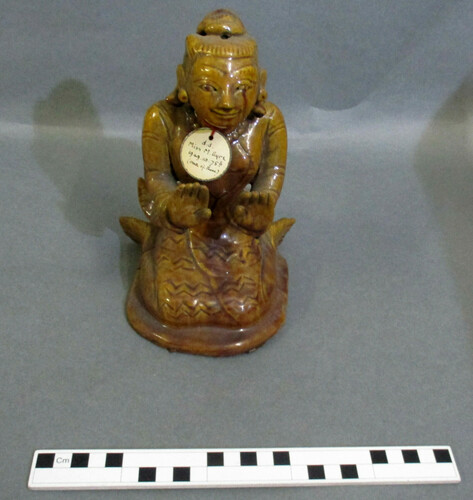 1949.10.75.2Female figure of wife in the act of pushing the Prince over the cliff. One of two pottery figures finished with a yellowish-brown glaze, illustrating a folk tale. Please see [.1] for ceramic representation of a cliff, and [.3] for the figure of the Prince in the act of falling. [IL [OPS Move] 10/7/2017].1949.10.75.2
 1999.28.1Ceremonial Loin cloth made of stitched strips of yellowish and blackish [or possibly faded dark blue] cotton textile. The loin cloth is roughly triagular in shape. At the longest side of the triangle there are two ties of the yellowish cotton textile stitched at to the triangle at both ends of the longest side. Two sides of the triangle are edged with a coloured wool fringe. The fringe is predominantly blue, green, orange and bright pink in colour. Towards the pointed end of the triangle the textile has been embroidered in a geometric pattern. [MdeA 25/11/99]1999.28.1
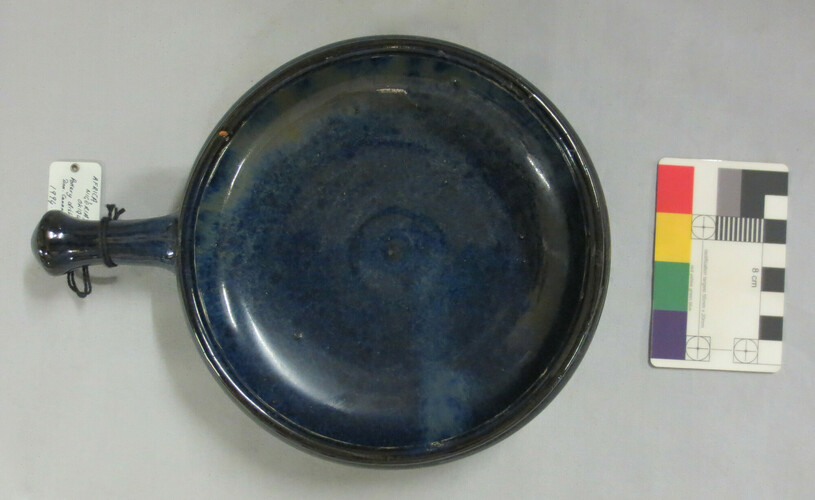 1994.14.58Pottery bowl with a handle. The lip on the rim curves outwards. The bowl has been glazed with an uneven dark blue glaze. [ASh [OPS move] 26/02/2016]1994.14.58
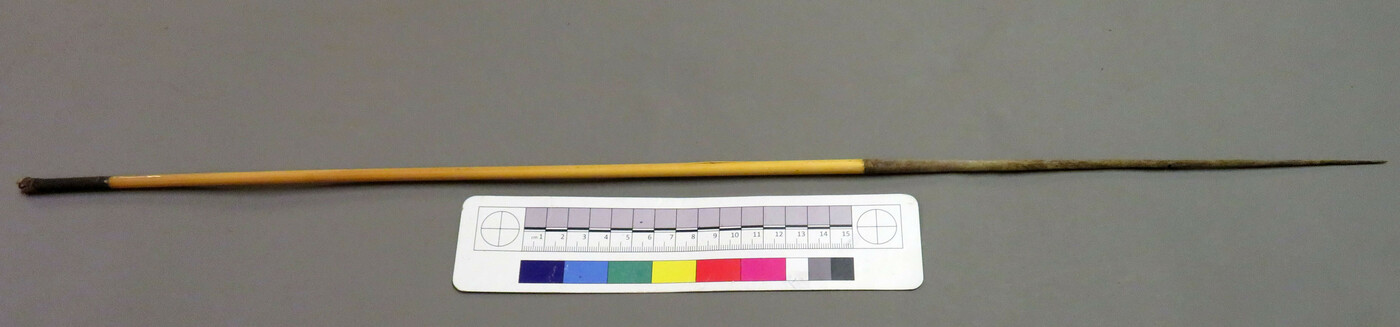 1911.45.3.15Arrow with cane shaft and pointed metal head bound with sinew. The end of the arrow is notched and painted black. See [1911.45.3 .1] for the quiver and [1911.45.3 .2 - .19] for the arrows. [FB 24/10/2017]1911.45.3.15
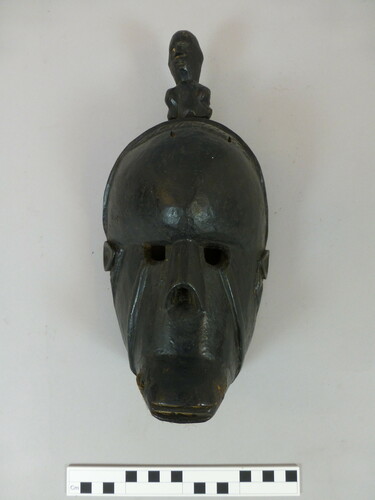 1938.15.85Face mask representing an old man 'agadi' worn during Okorosia plays. [ZM 09/04/2013]1938.15.85