
- Collection type
- Object
- Description
- Embroidered dress. The dress is made from black cotton and embroidered with coloured threads predominantly coral and red. [FB 6/3/2018]
- Long description
- Embroidered dress. The dress is made from black cotton and embroidered with red designs. The embroidery extends mainly in a v-shape over front and back neck and shoulders like a cape, on the skirt sides in asymmetric form and on the sleeves. Designs are predominantly geometric. The embroidery is mostly very fine cross stitch. All of the embroidery is in red with the exception of one line of white embroidery on the design on the top right hand shoulder at the front of the dress and on the opposite shoulder some . The blue and pink cross stitch. The panels of the dress are hand stitched together with blue thread. [FB 6/3/2018]
- Date / Period
- Date made: Before 1985
- Date collected
- 1985
- Acquisition information
- Donated: 03/03/2016
- Materials and processes
- Material Cotton Seed Fibre Textile Plant, Material Cotton Seed Fibre Yarn Plant, Material Pigment, Material Silk Yarn Animal, Process Stitched, Process Woven, Process Dyed, Process Embroidered
- Dimensions
- Width: max 1407 mm, Length: max 1308 mm
- Object numbers
- Accession number: 2018.37.6 Other numbers: S3
- Research and responses
The designs on Syrian dress is discussed in detail in Chapter 36 'Embroidery from Syria' in 'Encyclopaedia of the Arab World' edited by Gillian Vogelsang-Eastwood published by Bloomsbury Academic in 2016. [FB 14/3/2018]
[Multaka-Oxford Project Notes] - During collections workshop, volunteer Khalil noted how this embroidery would all be done by hand, and we looked at the reverse to show how neat and precise all the stitching is. He mentioned that the weave of the cotton helps with counting stitches. [AF [EFCF project] 13/8/2018]
[Multaka-Oxford Project Notes] - Volunteer Abdullah said that traditionally the colours in Syrian embroidery change with the age of the woman. Younger women tend to have deep reds prominently featured, then moving to pinks and corals and later more orange and yellows. [AF [EFCF project] 5/11/2018]
- Associated publications
- Balfour-Paul, Jenny, Indigo in the Arab World, Routledge, 1997 [AF [EFCF project] 23/8/2019] Balfour-Paul, Jenny, Indigo: Egyptian Mummies to Blue Jeans by , British Museum Press, 1998 [AF [EFCF project] 23/8/2019]
Further items to explore
 1968.23.8Pink silk robe with gold-coloured metal buttons, embroidered in various colours with dragons, birds and flowers.1968.23.8
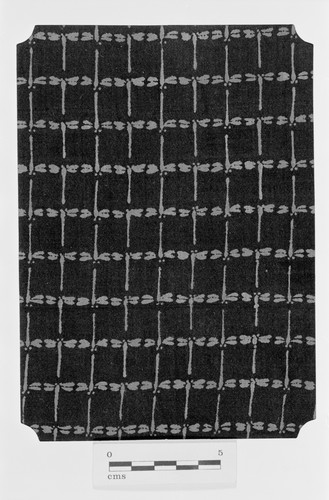 1996.17.109Kimono fragment, brown squared pattern.1996.17.109
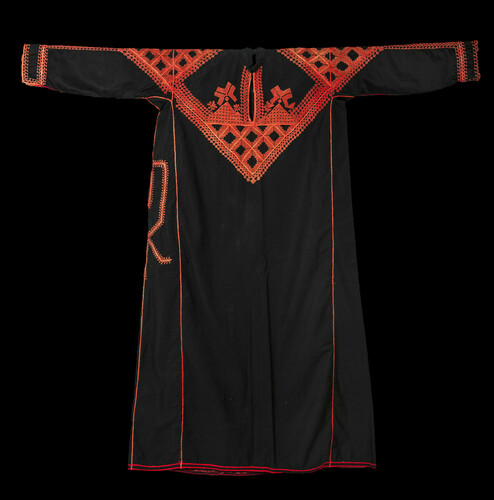 2018.37.15Embroidered women's dress. The dress is made from black cotton and embroidered with coral and red silk cross stitch embroidery. [FB 6/3/2018]2018.37.15
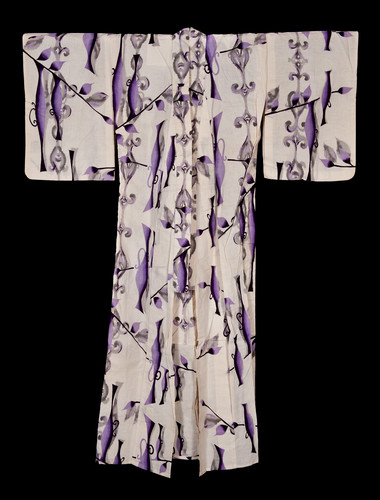 2009.33.1Summer kimono "yukata". [FC 16/04/2010]2009.33.1