
- Collection type
- Object
- Description
- Shin guard from samurai armour. [BH [OPS move] 17/8/2017]
- Long description
- Shin guard from samurai armour. Piece of green and blue fabric with 7 pieces of horizontal plate mail attached. In between in plate are small bands of chain mail. A square of leather in one corner. Hexagonal stitched pattern along the fabric. For associated objects please refer to [1922.37.2 .1 .1-.11] [BH [OPS move] 17/8/2017]
- Geographical reference
- Cultural groups
- Samurai
- Date / Period
- Date made: Before 1887
- Date collected
- By 1887
- Acquisition information
- Donated: 1922
- Materials and processes
- Material Metal, Material Textile, Material Pigment, Material Lacquer Varnish, Material Silk Textile Animal, Material Animal Leather Skin, Material Plant Fibre, Process Woven, Process Stitched, Process Glazed, Process Embroidered, Process Gilded, Process Padded
- Dimensions
- Depth: max 20 mm, Width: max 370 mm, Length: max 297 mm
- Object numbers
- Accession number: 1922.37.2.1.5
- Research and responses
Japanese iron armours were initially of lamellar construction, but armour became increasingly plate-oriented over time. The Sengoku Jidai (‘Age of Battles’, 1550-1600) was a period of intense and nationwide conflict in Japan, and this promoted a rapid acceleration of armoury innovations in this time. All of the armours on display in Case U6A are of the tosei-gusoku (‘modern armour’, post-1500) type, with a fully fitted cuirass, smaller shoulder guards and a lighter form than the box-like hanging lamellar plates of o-yoroi (‘great armours’), which characterised the preceding centuries. Following Tokugawa Ieyasu’s 1615 reunification of the country under the Shogunate, Japan enjoyed over a century of unprecedented peace (the Edo or Tokugawa period). During this time, daimyo and the samurai class as a whole underwent a significant change from practical to symbolic warriorhood – becoming administrators and diplomats rather than warlords. This – and particularly the Sankin Kotai obligation for daimyo to attend the court at Edo, with the extensive annual parading to and fro – promoted major changes in armour, which became richer and more ornate than it had ever been. Various components of the armours also became associated with religious and mythical figures during the early Edo period – overlaying them with layers of symbolic reference. Between 1709-22, the master armourer Arai Hakuseki wrote The Armour Book in Honcho-Gunkiko (1964) – in which he deplored the decline of the ancient o-yoroi (‘great armours’). He also argued that the sight of a general (Taisho) in imposing and grand antique-style armour was of tactical morale-boosting value to an army. This book caused an archaistic shift in armour-making, throughout the 18th century. In 1799, Sakikibara Kozan wrote an armoury manual criticising Japanese armour as showy and impractical, which caused a return to the more functional armour styles of the Sengoku Jidai. After 1868, and the overthrow of the Shogunate during the Boshin War, the Imperial party suppressed the cultural status of the samurai class. It became a legal offence to wear the paired katana and wakizashi swords (the de facto insignia of samurai status), and armour suffered similarly. Japan was undergoing radical social, economic and technological change during this period, under the influence of external Western powers, and the Japanese army was progressively Westernised on the most modern German model of the day. Relevant Reading: Norman, F.J. (1905) The Fighting Man of Japan: The Training & Exercises of the Samurai. London: Archibald Constable & Co. Swann, P.C. (1958) An Introduction to the Arts of Japan. Oxford: Bruno Cassirer. Ryukasu, T., de Bary, W.T. & Keene, D. (1962) Sources of Japanese Tradition. New York: Columbia University Press. Arai, H. (1964 (1709-22) The Armour Book in Honcho-Gunkiko. London: The Holland Press. Robinson, H.R. (1965) A Short History of Japanese Armour. London: HMSO. Moad, M.I. (1982) An Exhibition of Japanese Armour from the L.J. Anderson Collection. Rochester-upon-Medway: City Council Guildhall Museum. Bottomley, I. & Hopson, A.P. (nd) The Samurai Armour at Snowshill Manor. London: The National Trust. Carey, J. (1995) Samurai Undressed. Torquay: The Devonshire Press. Research Conducted for DCF Cutting Edge Project 2006/2007 [AM]
Search terms: Armour Weapon, Armour
Further items to explore
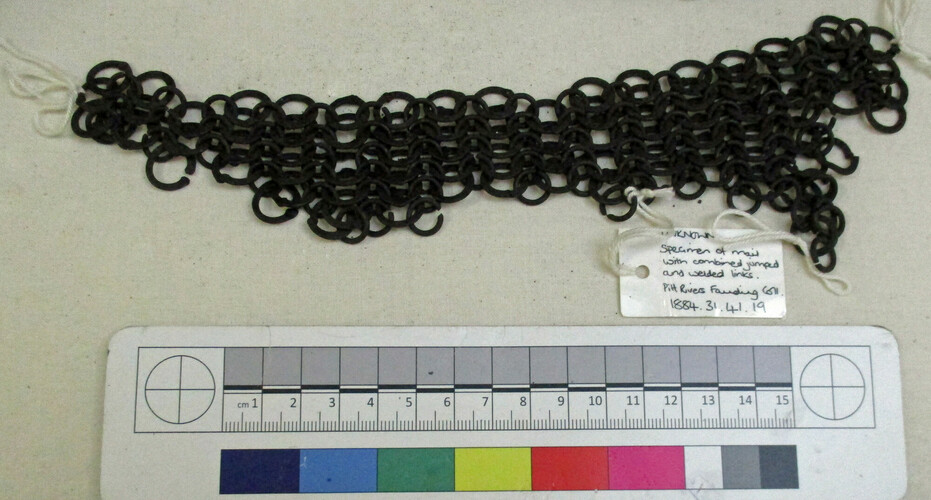 1884.31.41.19Specimen of mail with jumped and welded links. [SM (Verve) 23/10/2014]1884.31.41.19
 1901.46.1.5Face mask [.5], part of complete suit of Japanese armour. [El.B 4/4/2007]1901.46.1.5
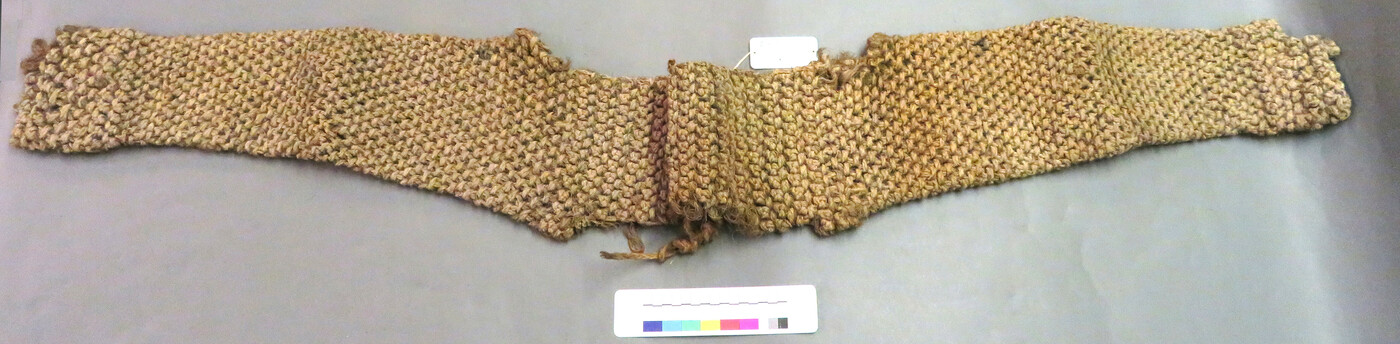 1899.62.472Fibrework sleeves, made of coconut fibres. Armour. [MOBB [OPS move] 4/9/2017]1899.62.472
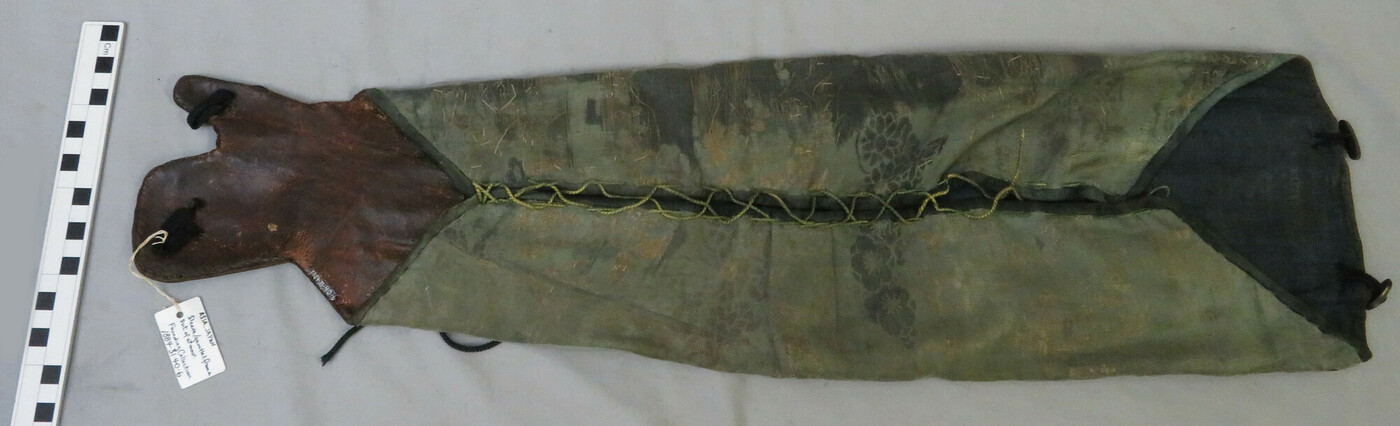 1884.31.40.6One of two sleeves/gauntlets [Kote]. Green floral textile with iron plate mail stitched into the hands and upper arm. Iron chain mail has been stitched into the upper arm, elbow and wrist areas. Iron fluted mail has been stitched into the forearm section. Cords of yarn with toggles attached are bound to the top of the upper arm, supposedly to attached the shoulder guards to the sleeves. The underside is bound together by a cord of green string. [BH [OPS Move] 29/6/2017]1884.31.40.6
 2024.22.46.1Paper envelope (2024.22.46.1) containing nine printed paper slips (2024.22.46.2-10).2024.22.46.1
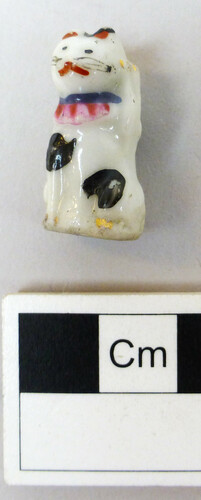 1985.53.707Small porcelain figure of beckoning cat, painted with black spots, red nose and ears, blue and pink collar and gold claws. [El.B 20/11/2013]1985.53.707
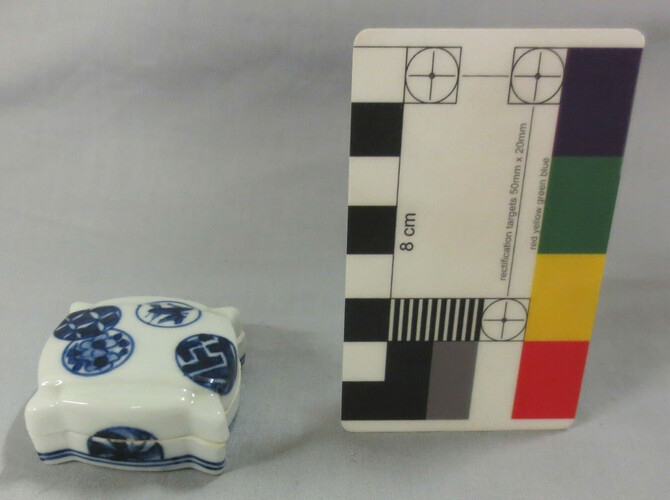 1996.17.50Incense box, blue and white procelain in form of a zabaton (cushion for sitting). There is a double band of blue above the base. The interior is glazed white with the exception of the rim. With lid 1996.17.50 .2.1996.17.50
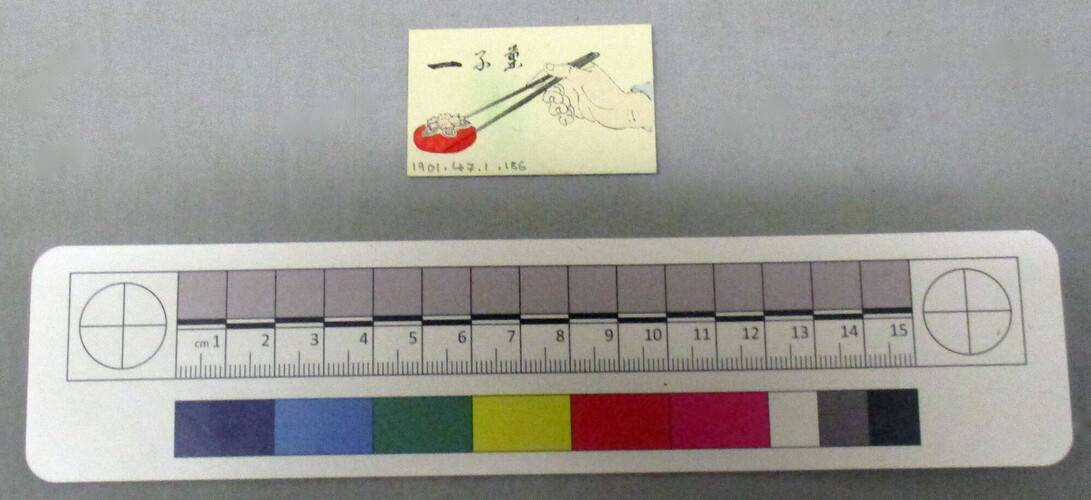 1901.47.1.186Gaming card. The front of the card depicts text in Japanese characters and floral design. The card is rectangular and made from paper. The reverse of the card has an illustration depicting a hand holding chopsticks. The card is one of sixty-two cards in a game set. [CW [OPS Move] 21/7/2016]1901.47.1.186