
- Collection type
- Object
- Description
- Wooden roof strut for model nomadic tent. For the other wooden roof struts see [2009.150.9 .1 - 29] and [2009.150.9 .31 - 45] and for the other constituent parts of the tent see [2009.150 .1 - 31]. [CW [OPS Move] 26/6/2017]
- Long description
- Wooden roof struts for model nomadic tent. There are 45 lengths of wood in total. The wood has been stained with a red paint and varnished. Two pieces are mostly unpainted. The lengths of wood are round and pointed at one end with one flat side. All struts have a small round perforated hole through the top, forty of which have been threaded with white cotton yarn and tied, forming a loop. Five of the struts have perforations but no cotton threaded through. These five struts are for above the door. [See 2009.150 .1-.31 for all parts of tent]. [FC 12/11/2009]
- Geographical reference
- Date / Period
- Date made: By 1948
- Date collected
- 1948
- Acquisition information
- Donated: 28/10/2009
- Materials and processes
- Material Cotton Seed Fibre Yarn Plant, Material Wood Plant, Process Perforated, Process Painted, Process Varnished, Process Knotted
- Dimensions
- Depth: max 7 mm, Width: max 9 mm, Length: max 365 mm
- Object numbers
- Accession number: 2009.150.9.30
- Research and responses
Clare Harris [Reader in visual Anthropology, Pitt Rivers Musem]: Although the object has been described by the donor as a yurt, technically speaking this is not correct as this is a Turkic term used in Central Asia and then exported to the West (hence commonly used). (See the Wikipedia entry for Yurt for more information on this.) Mongolians call the tent a gyer or ger and Tibetans call a white tent a gur. In fact there are many different terms for these portable dwellings in Tibetan - depending on their shape and colour. I suspect that the same will be true for Mongolia. The problem with the model we have been donated is that it was given to Arthur Hopkinson by a Mongolian-Tibetan trader and so could be either Mongolian or Tibetan. I don't know enough about the designs of these tents to be able to say which it is without doing some research. The other issue is that (if I remember correctly) it was presented to Hopkinson in India (probably Darjeeling or Kalimpong) and might have been made there. I am pretty sure that there was a Tibetan handicraft establishment in Kalimpong in the 1930s... The fabric used to make the internal fittings (eg bed covers) suggested to me that it might have been made in India. Monisha Ahmed has a lengthy discussion about the type of tents used by nomads in Ladakh and Western Tibet in her book "Living Fabric" (should be in the Balfour library). However, our model is not of this variety. [FC 12/11/2009]
Further items to explore
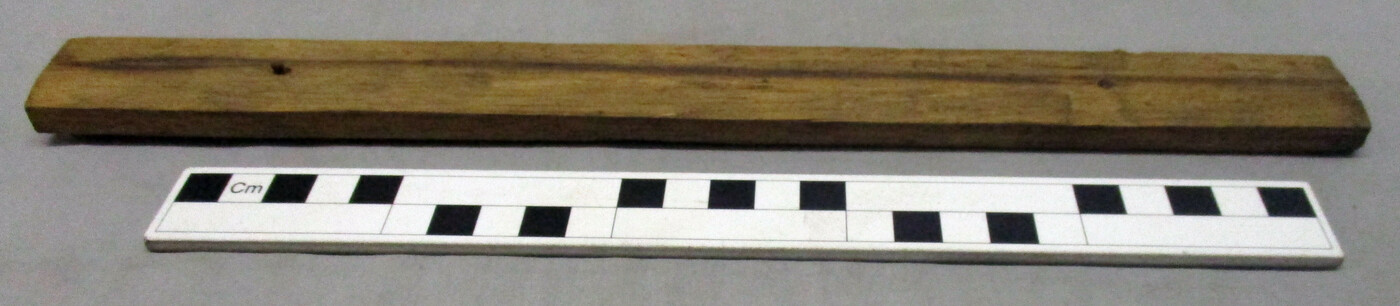 1946.2.38.5Seat for model river boat 1946.2.38 .1. See records 1946.2.38 .1 - .11 for the full river boat. [ASh [OPS move] 04/10/2016]1946.2.38.5
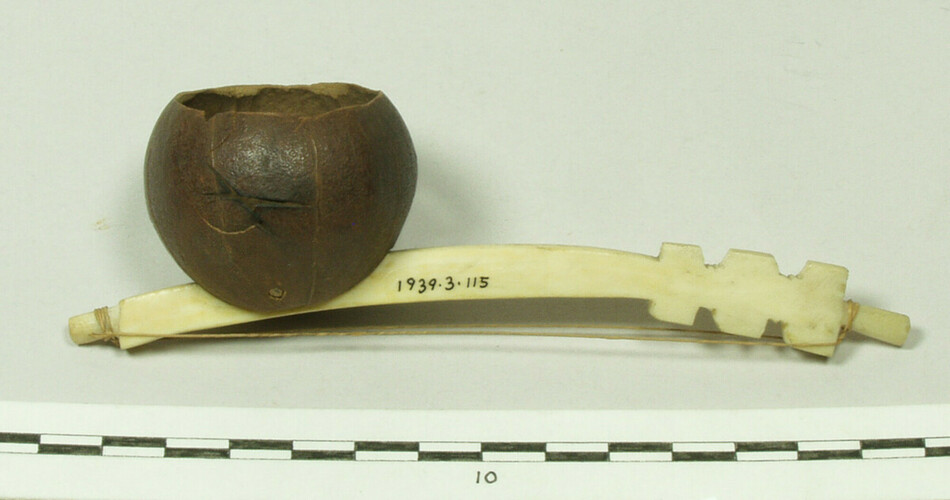 1939.3.115Ivory model of zeze, a string instrument, with gourd resonator and string. [El.B 'DCF 2004-2006 What's Upstairs?' 15/3/2005]1939.3.115
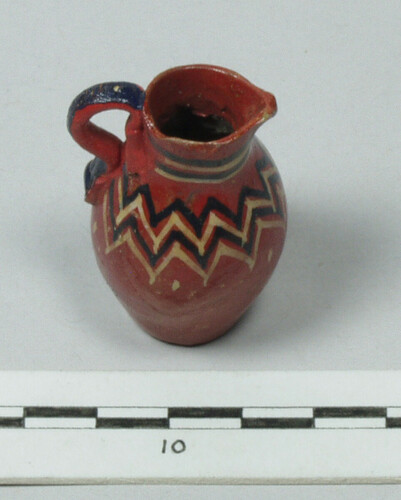 1938.36.1875Miniature water jar with handle, glazed red with geometric motifs in black and white. [N.B. 'DCF 2004-2006 What's Upstairs?' 16/3/2005]1938.36.1875
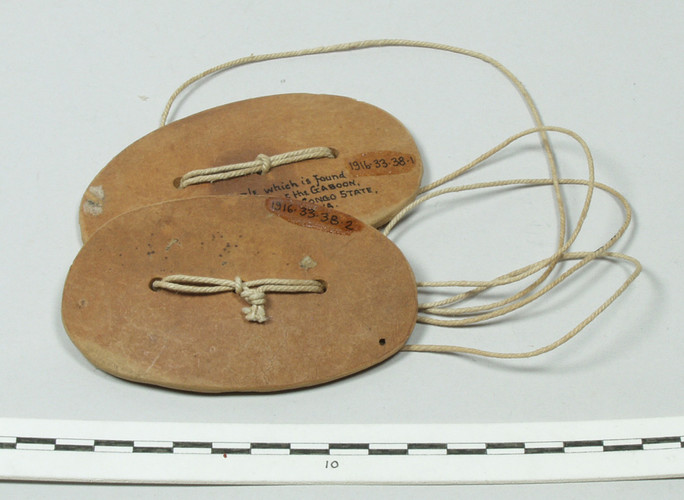 1916.33.38.1Model of a game, two pieces of gourd [.1 - .2] tied together with string [L.Ph 'DCF 2004-2006 What's Upstairs?' 14/3/2005]1916.33.38.1
 2008.88.11Unused postage stamp from Tibet. Stamped with green ink. In the centre of the stamp is the image of a lion. Down one side is the word 'Tibet'. The other three sides have Tibetan script. The value of the stamp is 4 trangkas. [FC 02/09/2009]2008.88.11
 1954.6.190Ornamental brass pin with a square-pyramidal top, pierced near the top. [EC 'DCF 2004-2006 What's Upstairs?' 1/2/2006]1954.6.190
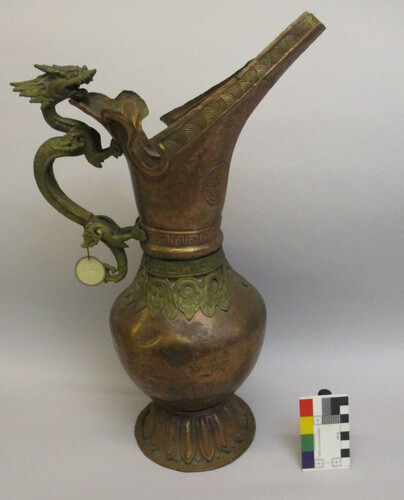 1950.5.29Large copper jug. 'A dragon-handle, and ornamental neck-collar, both of brass. Stands on fluted pedestal.' [ZM 24/11/2004]1950.5.29
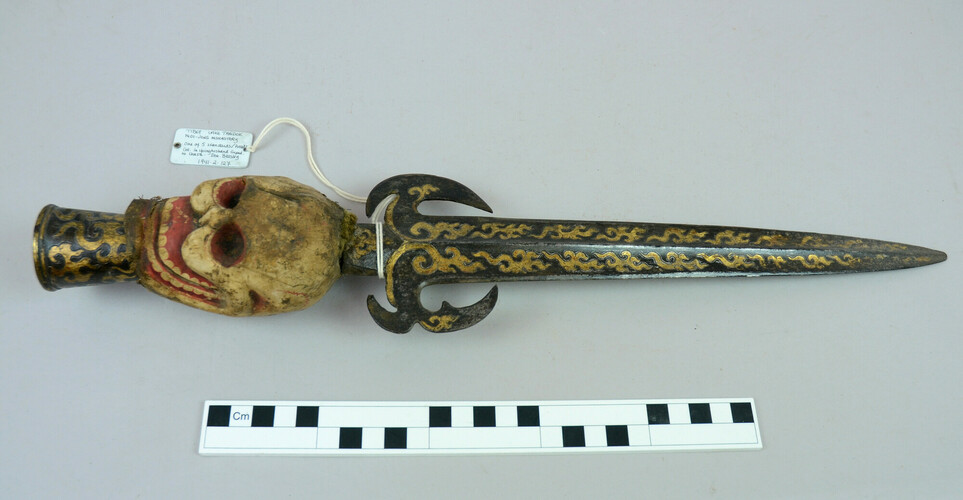 1941.2.127Silk standard, comprising head [.1] and pole [.2], now separate. [BS [OPS move] 26/7/2017]1941.2.127