
- Collection type
- Object
- Description
- Bow, backed with moulded sinew covered with snake skin. [ZM 19/7/2005]
- Long description
- Bow, backed with moulded sinew covered with snake skin. Leather band twisted at grip. Ends bound with hide. On each arm 100 mm band with centre part of quillwork (red, white and faded blue) and ends of blue, black and white beads on red flannel. String of twisted sinew.
- Geographical reference
- Date
- Date collected
- 1842
- Acquisition information
- Purchased: 1893
- Materials and processes
- Material Wood Plant, Material Animal Sinew, Material Snake Skin Reptile, Material Quill, Material Animal Leather Skin, Material Animal Hide Skin, Material Bead, Process Quillwork, Process Bound, Process Woven
- Dimensions
- Length: max 1200 mm
- Object numbers
- Accession number: 1893.67.24
- Research and responses
Collected when Hopkins was accompanying Sir George Simpson on his voyage around the world. [CW 14 5 99]
In March 2004 Roland Bohr, a PhD student from University of Manitoba, Canada, examined and sketched this object in detail, a photocopy is in the related documents file. [ZM 19/7/2005] In June 2007 Bohr examined similar bows in the collections of the Montana Historical Society in Helena. [ZM 20/07/2007]
The following notes are drawn from research compiled by Andy Mills as part of the DCF Cutting Edge Project in 2006-2007. This is a takintazipa, or sinew-backed Lakota Sioux bow (takan = ‘sinew’, itazipa= ‘bow’) (‘Cultural Signatures: Lakota Bows’ K. Koppedrayer 2005, www.sfmission.org/museum/exhibits/bows0.andarrows/signatures.html). Such bows, although not possessing the same performance qualities of many other bows from the Old and New Worlds, represent a triumph of ingenuity over highly limited materials. One of the major obstacles to the Lakota Sioux bowyer was the lack of wood on the Great Plains of North and South Dakota, what woods were available were often less flexible than those available to their neighbours on the southern Plains. As a consequence of this, the Lakota added to the bow’s flexibility by the addition of a layer of sinew along the back.
The bow also overcomes many of the material’s limitations through the use of its distinctive ‘reflex-deflex’ or double-curved form. In this form – as can be seen in several of the Asiatic composite bows – the ‘ears’ of the bow turn forwards for the terminal 10-15cm. The angle of this turn is quite sharp, and the wood is carved narrower and thinner at this point – making this section of the bow more flexible than other parts. Consequently, as the bow is drawn to its greatest draw, the ‘ears’ bend backwards towards the archer, effectively lengthening the string. As the bow is released, these snap back in advance of the rest of the bow, and give the arrow added acceleration. The result is a bow much more powerful than its size and apparent Draw Weight would indicate – increased efficiency.
Although used in warfare, the principal function of the bow was in the hunting of buffalo (tatanka). The bow was considered a sacred object by the Lakota, as it ensured the continuation of life itself. In terms of its provenance, this bow is both interesting and puzzling. It was collected in 1842 by Edward M. Hopkins, on Sir George Simpson’s round-the-world journey. Simpson was Governor-in-Chief of the Hudson Bay Company’s territories in North America from 1820 until his death in 1860. The ghost-written account of his journey Narrative of a Journey Round the World, during the Years 1841 & 1842 (Simpson, 1847), is very informative, but mentions no contact with the Sioux nation whatsoever. It seems he spent most of the North American leg of his journey travelling through present-day Canada, and did not approach the Lakota. This said, he came into considerable contact with the Cree and Blackfoot, who had both military encounters and alliances with the Sioux. It may be that Hopkins acquired these Sioux weapons by this means.[SM 28/02/2008]
Search terms: Archery Weapon, Hunting, Composite Bow, Hunting accessory
Further items to explore
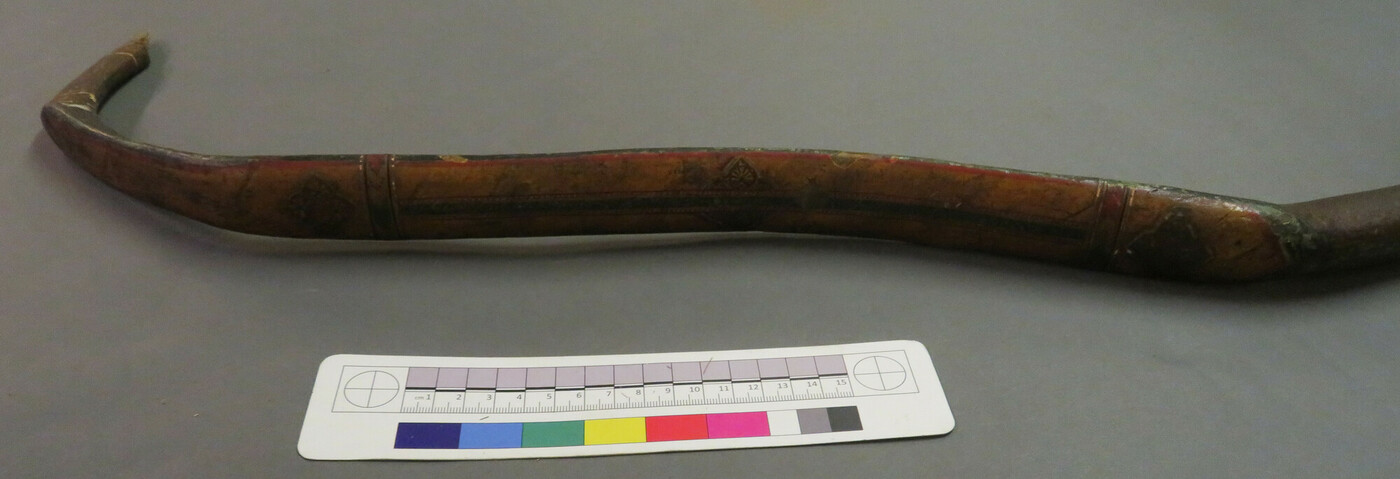 1945.10.211Bow, made from wood which has been lacquered yellow with bands of red, green and gilt scroll and floral designs. The tips of the bow are pointed and notched and the grip in the centre of the bow is narrowed slightly and is darker in colour. [SB [OPS Move] 4/7/2017]1945.10.211
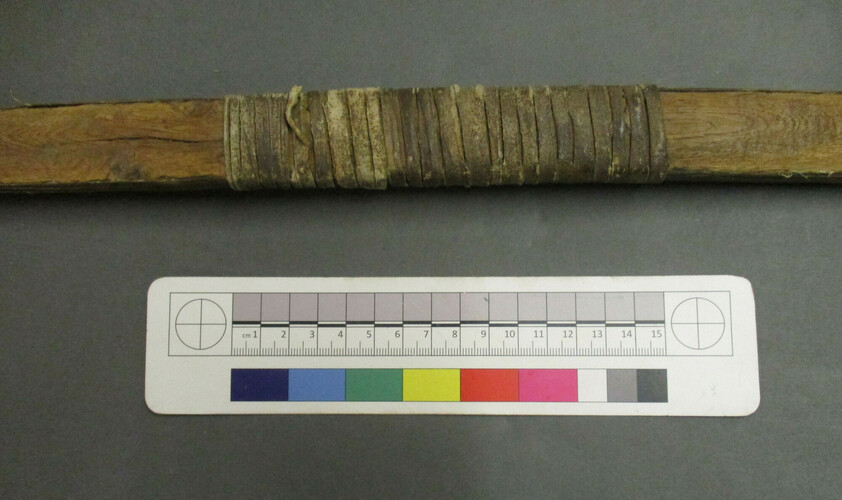 1936.45.1Sinew-backed bow. [ASh [OPS move] 25/7/2017]1936.45.1
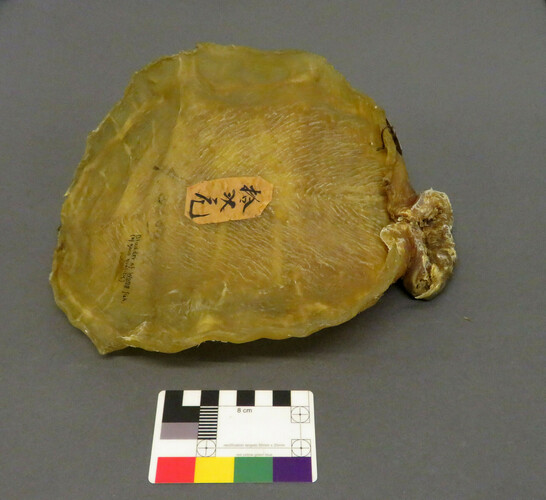 1914.27.8Fish-bladder, from the yellow-bellied 'Wong' fish. The bladder is yellow in colour and roughly oval in shape with curled over edges. SB [OPS move] 26/9/2017]1914.27.8
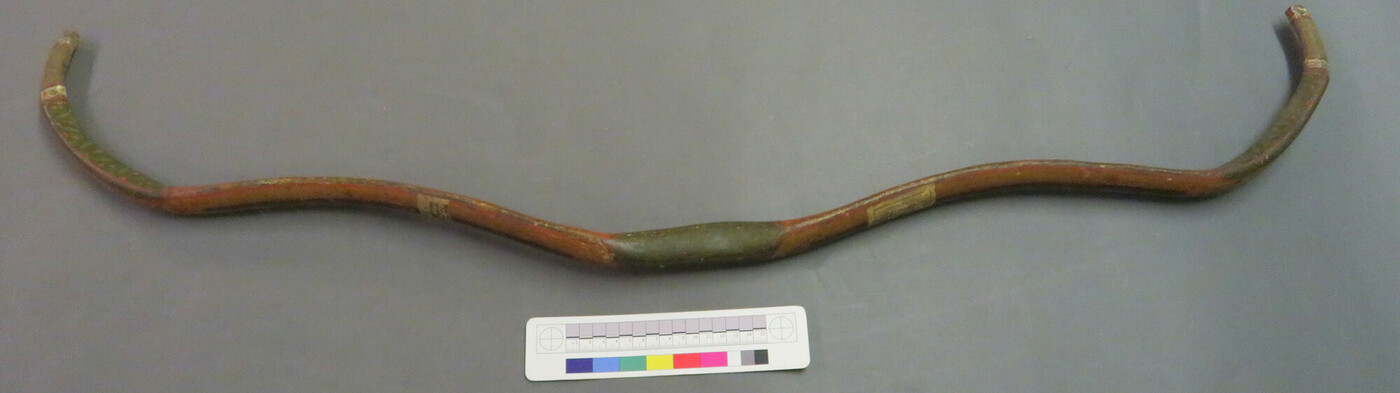 1932.89.85Composite bow, painted and lacquered. The tips at each end of the bow are decorated with sections of foliate design. The main body of the bow is decorated on the inner edge with a strip of stars and circles and the outer edge is decorated with a design of crosses. [SB [OPS Move] 4/7/2017]1932.89.85
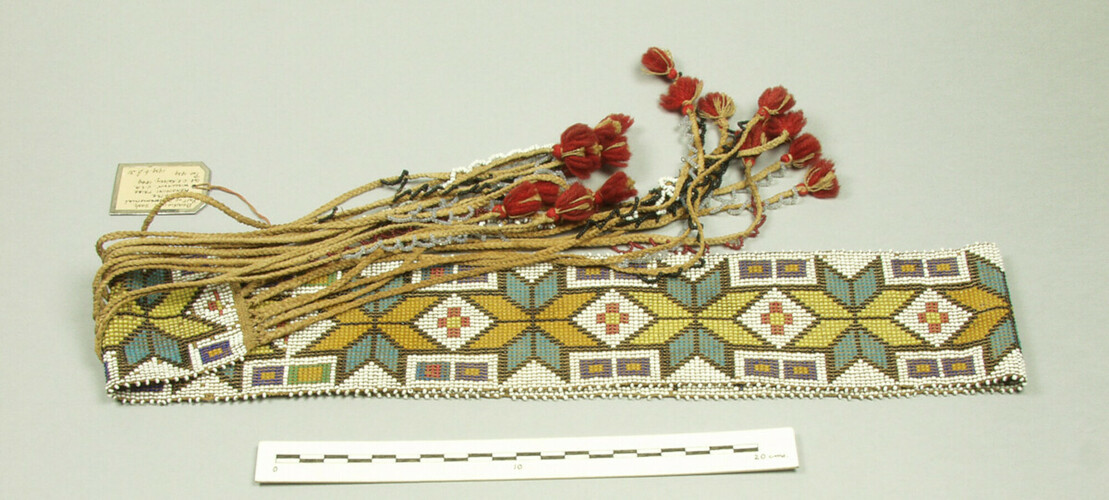 1939.6.31BSash, beadwork, with woollen tassels. The beads' design form blue pairs of rectangles with orange centres, running along the edges, with an arrangement of blue and yellow and blue and orange pairs of eight pointed stars, between which are small red crosses with yellow centres. All of this is set on a white 'ground'. The sash is part of ceremonial regalia. Last worn at a 'Ghost dance' in 1889, at Kesheenah. Collector father of Vendor.1939.6.31B
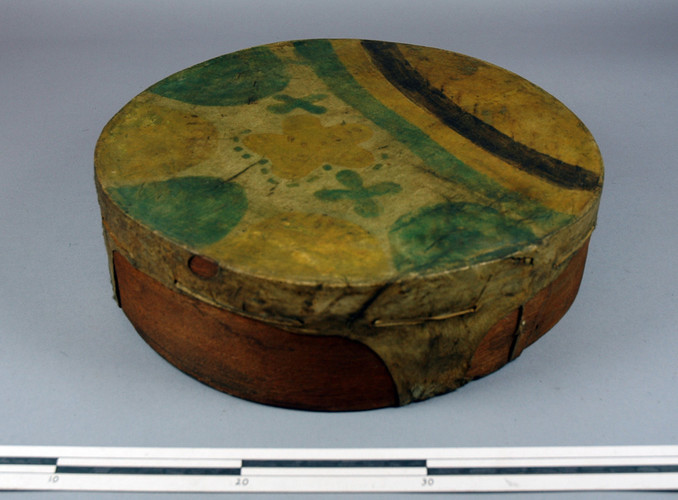 1903.129.23Single membrane frame drum with green, yellow and black conventional design. [MJD 29/9/2008]1903.129.23
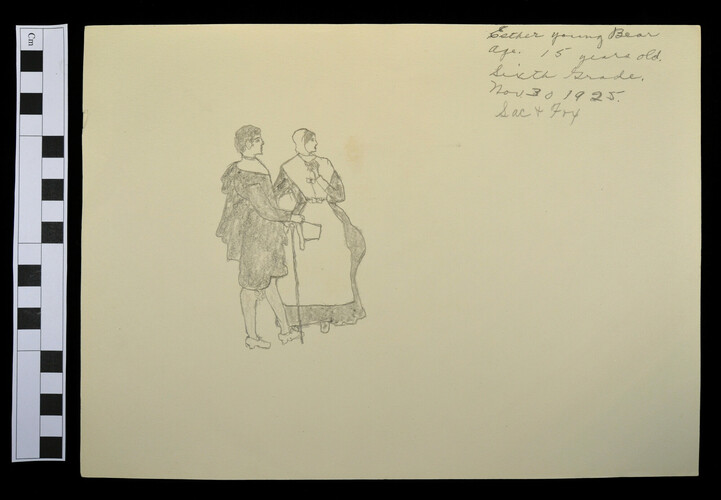 1994.15.306Drawing by child of two figures in pencil. [MJD 14/01/2015]1994.15.306
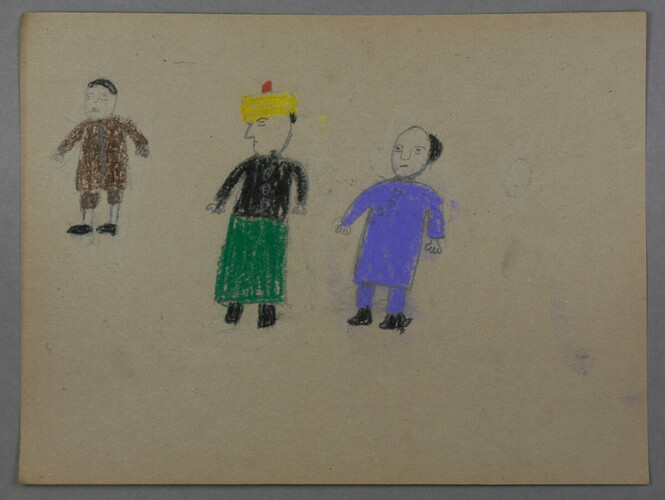 1994.15.2261Drawing in pencil and wax crayon of three people in Chinese clothes. [El.B 07/05/2008]1994.15.2261