
- Collection type
- Object
- Description
- Amulet, circular tablet made of white clay, with a figure of a nursing woman on one side, and a geometric motif on the other, in a box. The other identical amulet is 1985.52.938 .2 [ASh [OPS move] 18/1/2017]
- Long description
- Amulet, two circular tablets made of white clay, with a figure of a nursing woman on one side, and a geometric motif on the other, in a box. These stones are in a cardboard box and are from the Milk Grotto. [.2] has a chip in it. [RB 19/04/2012]
- Person
- Field collector Unknown Collector
- PRM source Wellcome Institute
- PRM source Wellcome Historical Medical Museum
- Date / Period
- Date made: Before 1931
- Date collected
- By 1931
- Acquisition information
- Transferred: 1985
- Dimensions
- Diameter: max 28 mm
- Object numbers
- Accession number: 1985.52.938.2 Other numbers: 1850
- Research and responses
Please note that the Milk Grotto, also known as Magharet Sitti Mariam or Grotto of the Lady Mary is in Bethlehem. Tradition has it that the Virgin Mary, Joseph and Jesus took refuge here during the Slaughter of the Innocents, before their flight into Egypt and whilst Mary was nursing Jesus, a drop of milk fell on the ground and turned it white. Both Christians and Muslims believe that dust scraped from the stones in the grotto improve a mother's milk and can enhance fertility. [MdeA 24/02/2012]
- Associated publications
- This amulet was selected for the Small Blessings project website [http://web.prm.ox.ac.uk/amulets], online text as follows: 'These two circular tablets are made of white clay from the milk grotto in Bethlehem. One side of the tablets is impressed with a geometric motif, and the other side shows a feint figure of the Virgin Mary holding the baby Jesus. According to legend, Mary was nursing Jesus in the grotto when a drop of milk spilled onto the ground and turned it white. This miracle led to the belief that dust and clay from the grotto, which is made of limestone, can enhance fertility and improve a motherʼs milk. Although tablets of clay like these ones are no longer sold, the Franciscans who oversee the shrine still prepare small packets of limestone powder to give in return for a small donation. They instruct that both husband and wife should drink the powder mixed with milk or water for nine days, and recite the prayer for the Third Joyful Mystery of the Rosary which recalls the birth of Jesus, known as the Nativity.' [CB 29/08/2012] Both 1985.52.938.1 and 1985.52.938.2 are illustrated in colour (front and back) as Figure 10 on page 97 of 'Marie la Chétienne, Marie la Musulmane', by Isabelle Marquette et Manöel Pénicaud', in Lieux Saints Partagés (Marseille: MuCEM / Actes Sud, 2015). Caption (same page): 'Amulettes de la grotte du Lait, Bethléem (Palestine), 1931, argile blanche, diam. 2,8 cm, Pitt Rivers Museum, Oxford. Sur les deux figures de bas, on devine les silhouettes à demi effacées de la sainte Famille.' [JC 29 7 2015]
Search terms: Religion, Pottery, Amulet, Religious Object
Further items to explore
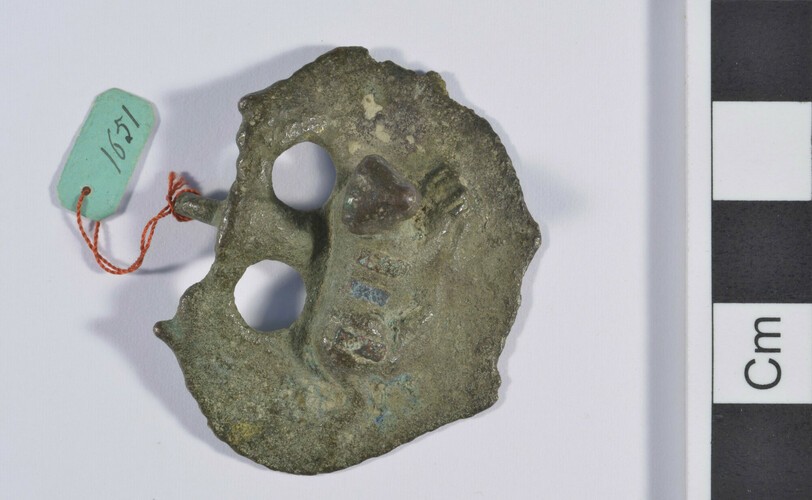 1985.52.848Amulet, bronze pendant with the figure of a lion in relief, with two perforations and a loop for suspension. [RB 12/04/2012]1985.52.848
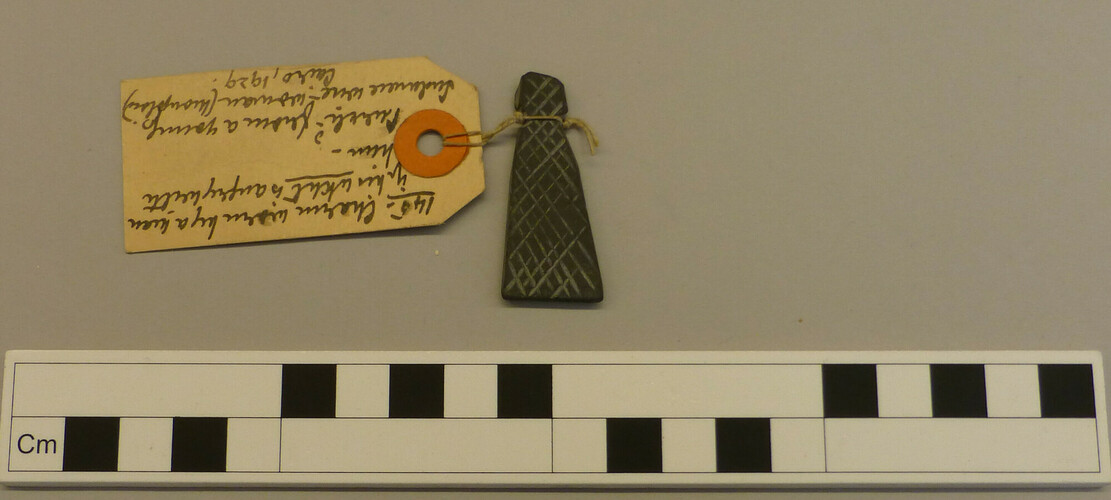 1985.54.847Amulet, shaped, incised piece of slate for a man who is afraid of his ukht because he is angry with his wife. The slate is roughly triangular in shape with pinched sides near the top, and incised with cross-hatching. [CW [OPS Move] 07/03/2017]1985.54.847
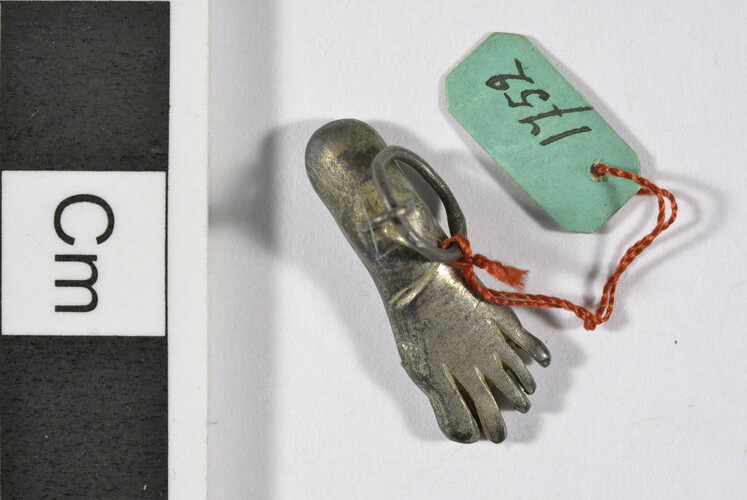 1985.52.896Amulet, silver ex-voto in the shape of a foot, perforated and with a loop for suspension. [RB 18/04/2012]1985.52.896
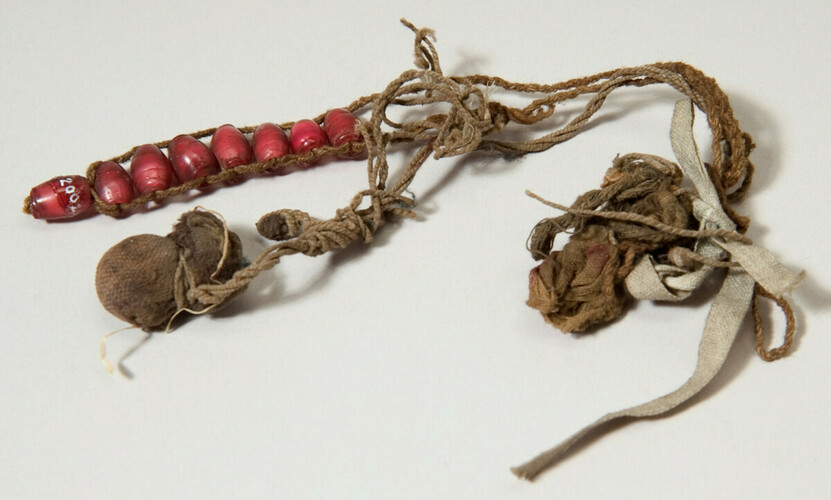 2002.91.19Piece of knotted and tanged string with a piece of cotton textile and a small bundle of something wrapped in cotton attached to it. Also attached is a row of 8 red glass beads. [JP 3/11/2003]2002.91.19
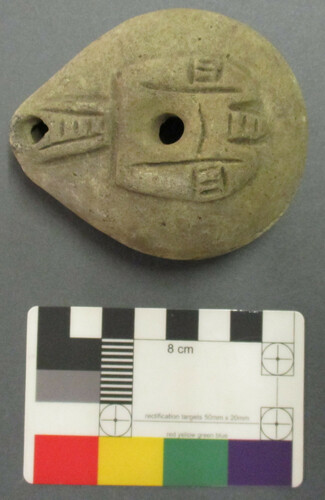 1932.88.393Pottery lamp of unglazed, unslipped buff ware. Pear shaped with slightly rounded body and seam running around the hemisphere. There is a small filling hole in the centre of the top, around which a body has been moulded and then detailed with incised lines. A small banded tail is behind the hole. Extending from this rear section are two legs and feet. At the front of the hole the front of the body or shoulders are indicated with a straight line. Between this line and the wick hole are several diagonal lines between which run five horizontal lines. There is a maker's mark on the base. [MOBB [OPS move] 31/08/2016]1932.88.393
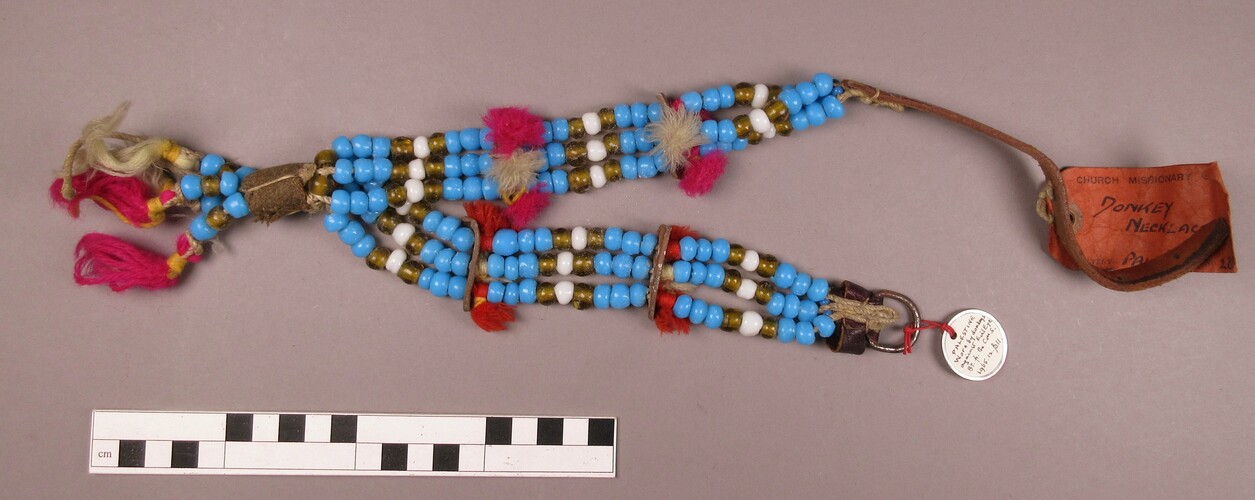 1965.12.11BAmulet of leather, textile and blue, brown and white glass beads to protect for camels and donkeys from the Evil Eye.1965.12.11B
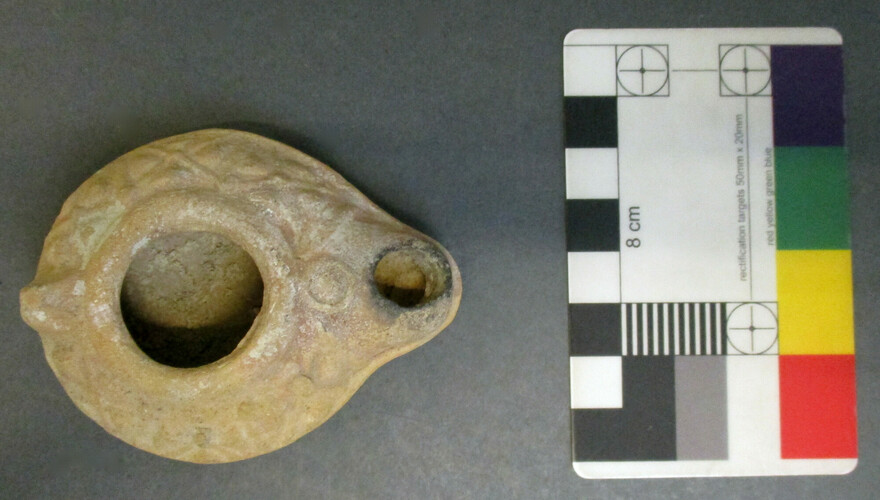 1952.1.6Pottery lamp of pink or yellow ware. Pear shaped lamp with circular body and rounded wick nozzle/ wick hole. [MOBB [OPS move] 18/10/2016]1952.1.6
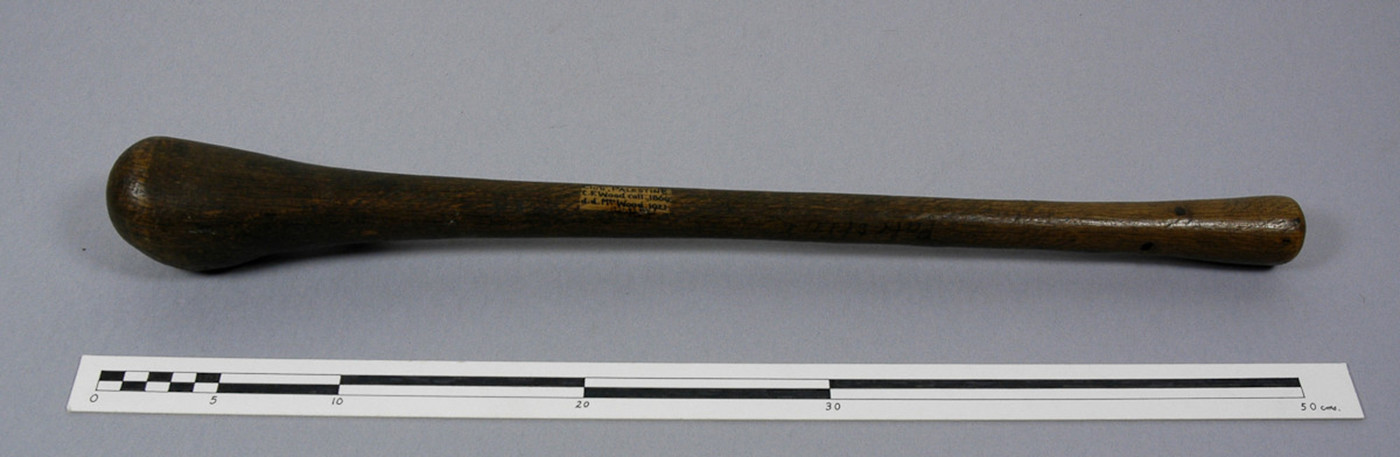 1921.93.397Wooden club with knob head [SM 28/03/2007]1921.93.397