
- Collection type
- Object
- Description
- Model sledge consisting of a strip of wood with a bark strip bound to it with plant fibre. For the associated objects see 1884.54.8 .1 - .17 [ASh [OPS move] 23/09/2016]
- Long description
- Model sledge consisting of a strip of wood with a bark strip bound to it with plant fibre. The bark has then been bent over at one end and is supported with two wooden struts. The exterior is painted with red scallop shapes and bands. There is a strip of textile looped and attached to the front of the sledge to create reigns. This has been decorated with sewn on glass beads. [ASh [OPS move] 23/09/2016] Model of bark canoe [.1], with two figures [female .2], [male .3], sledge [.4], snow shoes [.5-.6], gun [.7], two paddles [.8-.9], sail [.10], stick [.11], keg of alcohol [.12], drinking vessel [.13], powder horn [.14], axe [.15] and model wampum belt made from glass beads [.16], textile hat [.17]. [ZM 13/12/2007]
- Person
- Maker Unknown Maker
- Field collector Unknown Collector
- PRM source Augustus Henry Lane Fox Pitt Rivers founding collection
- Date / Period
- Date made: Circa 1780
- Date collected
- ?Prior to 1876
- Acquisition information
- Donated: 1884
- Materials and processes
- Material Bark Wood Plant, Material Cedar Wood Plant, Material Cotton Seed Fibre Textile Plant, Material Plant Fibre, Material Glass, Material Pigment, Process Painted, Process Carved, Process Woven, Process Bent, Process Stitched
- Dimensions
- Height: max 30 mm, Width: max 39 mm, Length: max 215 mm
- Object numbers
- Accession number: 1884.54.8.4
- Research and responses
NB there is no primary documentation linking this object to the Maniwaki community specifically. GES Turner appears to have made the provisional attribution 'probably River Desert Band,' but I do not know how this attribution came to be made. [L Peers, 28/04/2009]
Letter from Daniel Clement at the Canadian Museum of Civilization points out that the River Desert Band did not come into existence before 1851 (see RDF). [LM]
It is not stated in any of the primary sources which object [and where it was] the canoe was modelled on. It was presumably used as example of a missing link in one of the series [AP Leverhulme project on founding collection 1995-1998]
Related Documents File - Notes by G. E. S. Turner:- 'Canoe: birchbark with cedar thwarts sheathing and headboards, mast stepped through second thwart from bow carrying square cotton sail. Exterior painted in red black green and white double-curve and dot designs, spruce root gunwale lashings interwoven with white moosehair. Figures: stuffed bodies and legs well-modelled beeswax heads and arms, no hair facial painting in red and black. ... [male and female, clothing described] ... Accessories: two paddles painted splint toboggan with beaded cloth breast-band for pulling, pair of snowshoes, keg, bottle, powder-horn, rifle and ?axe (blade broken off) of wood painted. (A bracelet of woven black and white glass beads simulating wampum found in the canoe seems from the similarity of the cotton warp to be contemporary but was probably not part of the original set). These models correspond very closely with specimens in the Speyer collection (details given) as to suggest a common maker'. Date comes from dating of similar object in the Speyer collection Offenbach. Details of the objects G. E. S. Turner believed were very similar also attached.
Ag ?5594 - Beatrice Blackwood explains in the 'Classification...' book 1970 that objects with numbers starting Ag. were objects listed in the Black, red and blue books as being sent to the South Kensington by Pitt Rivers after the main collection was sent, Ag. stands for Aggregation. [AP Leverhulme project on founding collection 1995-1998]
Examined by the GRASAC research team on 13 December 2007 as part of a research project to create a digital database. This will incorporate information about collections of indigenous material culture from the Great Lakes region of North America that are housed in a number of museums on several continents; see https://icslac.carleton.ca/grasac/ [see researchers file GRASAC]. The team noted a black and white 4-pointed cross motif on the edging of hood on one of dolls. Date of manufacture identified as 1750-1790 probably made by an Abenaki or Maliseet convents in Quebec City, with the nuns dressing the dolls and indigenous community making the canoe, which appears Ojibway style.. [ZM 15/05/2008]
Final GRASAC entry: 'Materials: Canoe: birtch bark, unidentified wood for spars and ribs, seams waterproofed with pitch mixed with charcoal, red paint or ochre, spruceroot for strapping, wooden centremass with a sail rolled up. Contents of Canoe: a miniature wampum belt made of black and white imitation wampum beads-- a miniature wooden tobaggon with two wooden panels pained and a silk binding strap with beads two wooden panels painted-- a wooden long gun-- a furled sail-- two miniature snowshoes made of bent wood, thread, with grey tufts or grey wool-- a miniature wood-carved keg, bottle, powder horn and axe (bits of pieces of which are broken off, kept in plastic bags). Two Dolls Doll A (female): Her body is made of wax doll, commercially-produced in Europe, now badly deformed to sun damage. She is wearing a wrap around linen skirt that imitates broad cloth or stroud bound wth white silk ribbon near its bottom edge, and a very long linen shirt with a cuffed short gown over it. The short gown is made with striped silk, belted with linen thread. Her red leggings are made of linen and imitate broad cloth or stroud. Her high cuffed moccasins are made of untanned hide and are painted to suggest a centre seam quill or moose hair design. For jewellry, she is wearing a silver crescent-shaped gorget on a string of multi-colour pony and seed beads in various sizes, a multiple strand beaded bracelet on one arm, a silver bracelet on the other arm. A decorative brooch may have been on the centre front of her chest. There are various beads stuck into her head, and her cheeks are painted with large red circles. Doll B: Like Doll A, it is made of wax. One cheek painted is red, the other black. There is also black paint on its forehead. He or she is is dressed in a long linen shirt with a blanket tied at waist and folded over, with a blue silk and wide ribbon band. Its blue legging flaps are bound with blue and white ribbon, and is wearing untanned deer hide moccasins with a painted-on centre seam, tied around the ankle and flipped up. Its hood is of an East Coast Algonkian or Micmac style, made out of red woolen cloth, edged with silk, with blue linen tape running up centre seam, decorted with size 20 multicoloured tubular beads. For jewellry, he or she is wearing earrings, a circular brooch which holds its shirt closed, multi-coloured beaded bracelets, a silver arm band. He or she also wears a knife sheath of untanned hide on woven thread, with a strap painted down the back to imitate quill work.
Format/Techniques:
Motifs and Images: The hood of Doll B is decorated with a black and white four-pointed cross motif on its edging.
Symbolism and Interpretation:
Condition: Very poor - the dolls are extremely fragile and slightly melted.' [L Peers, 28/04/2009]
It is presumably this object that is referred to as one of a number of ‘virtually complete models’ in note 20 on page 290 of Trading Identities: The Souvenir in Native North American Art from the Northeast, 1700-1900, by Ruth B. Phillips (Seattle and London: University of Washington / Montreal and Kingston: McGill-Queen's University Press, 1998). In note 24 on page 291, Phillips notes that the PRM is one of the museums that identifies the model in its collection as ‘Native’. [JC 8 3 2013]
This object was examined on a research visit by Nikolaus Stolle, Goethe University, Frankfurt am Main, Germany, on 19 June 2013. He noted the hat was on the wrong figure. The male figure [.1] should not be wearing the hat. The male figure is wearing a red breech coat - originally worn around the shoulders. The female figure [.2] is wearing a skirt. The canoe has almost all it's parts. There may have been a child in the cradle. The glass beads on the model wampum belt [.16] date to 1770-1800. They imitate black wampum beads. The long wooden stick [.11] doesn't belong to the object. The small striped stick [not numbered] used to have a scalp attached - now missing. Nikolaus bases his opinion on comparison with other surviving examples. [MJD 19/06/2013]
- Associated publications
- It is presumably this object that is referred to, as a comparable example to that illustrated, on page 25 and in note 19 on page 33 of '"A Casket of Savage Curiosities": Eighteenth-Century Objects from North-Eastern North America in the Farquharson Collection', by Ruth B. Phillips and Dale Idiens, Journal of the History of Collections, Vol. VI, no. 1 (1994), pp. 21-33. [JC 21 11 2003] Included in a list of 'virtually complete models' of canoes in note 20 on page 290 of Trading Identities: The Souvenir in Native North American Art from the Northeast, 1700-1900, by Ruth B. Phillips (Seattle and London: University of Washington / Montreal and Kingston: McGill-Queen's University Press, 1998). [JC 5 1 2009]
Search terms: Navigation, Figure, Transport and Travel, Clothing Footgear, Weapon, Model, Firearm, Canoe, Sledge, Snow Shoe, Canoe Part
Further items to explore
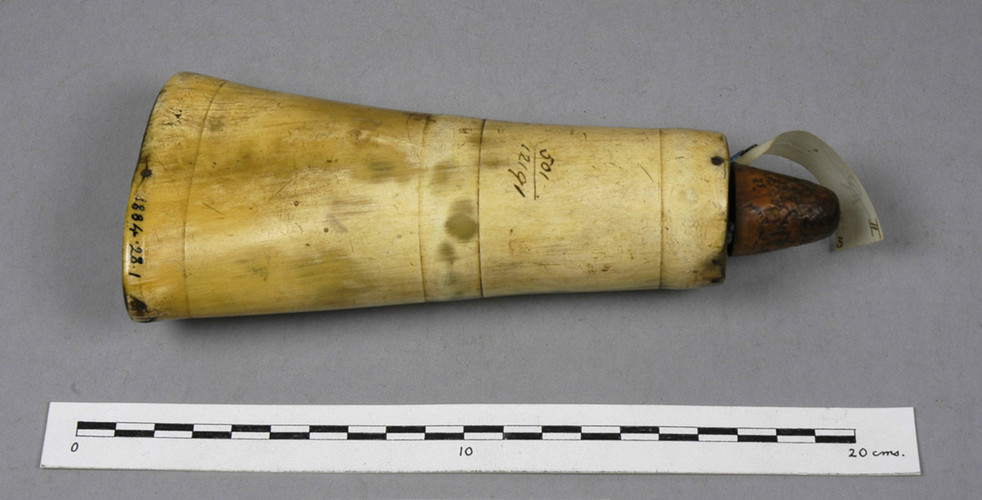 1884.28.1Powder container: a cow's horn, flattened at the bottom and with an oval wooden base attached with wooden pegs. Wooden screw nozzle at the top. [LM 17/10/2007]1884.28.1
 2006.81.4Gun-flint2006.81.4
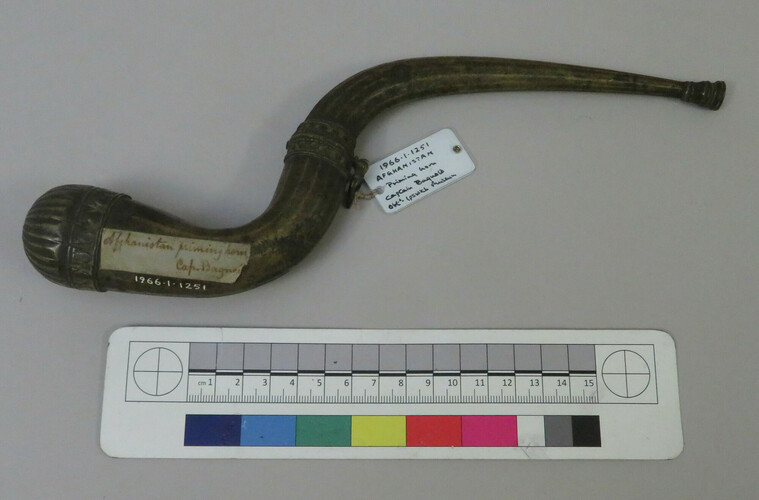 1966.1.1251Priming horn. Made from metal that is round in section, tapering to one end and bent in the middle to form an elongated 'Z' shape. [AF [OPS Move] 10/7/2017]1966.1.1251
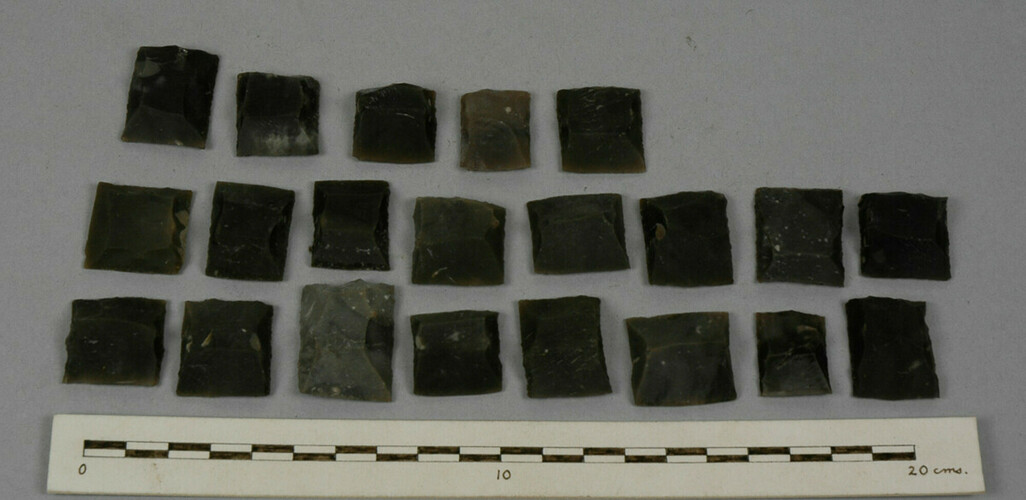 1937.54.1.20921 medium sized gun-flints, possibly for a carbine. [El.B 05/12/2007]1937.54.1.209
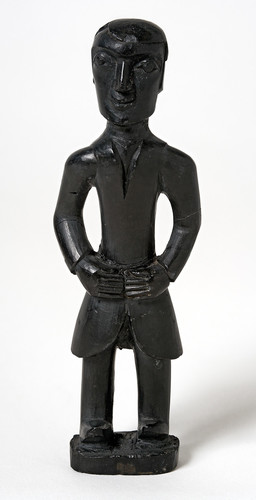 1884.65.3Small figure of man dressed in frock coat and trousers carved in argillite. [CAK 29/04/2009]1884.65.3
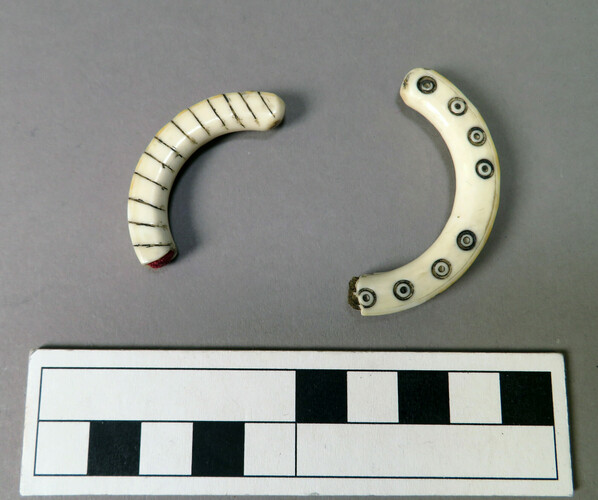 1884.100.17.1Pair of carved beaver teeth used as dice.1884.100.17.1
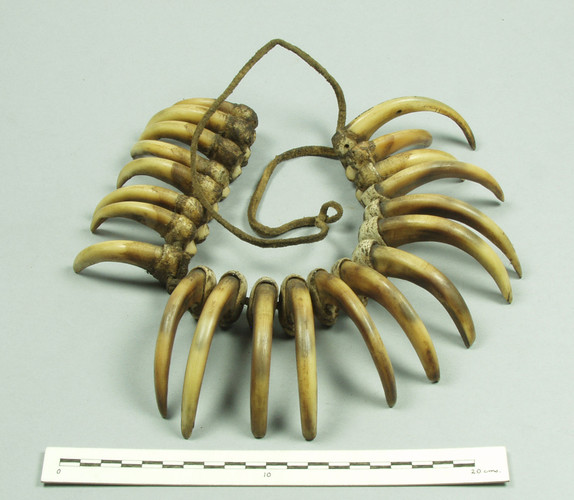 1893.67.15Bear claw neck ornament. 21 claws on leather thong. Thong has been broken and knotted together between two claws.1893.67.15
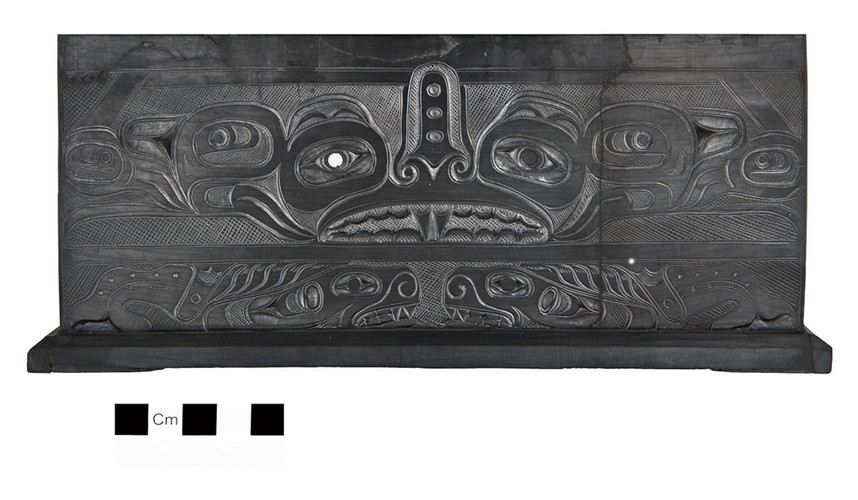 1920.8.1.1Rectangular box of argillite [.1] with lid [.2].1920.8.1.1