
- Collection type
- Object
- Description
- Pair of sandals
- Cultural groups
- Macusi
- Date / Period
- Date made: Before 1941
- Date collected
- By 1941
- Acquisition information
- Donated: 1941
- Materials and processes
- Material Palm Leaf Plant
- Object numbers
- Accession number: 1941.8.230.1 Accession number: 1941.8.230.2
- Research and responses
W. C. Farabee (in The Central Caribs (1924); Philadelphia, Pennsylvania: Philadelphia University Museum and University Of Pennsylvania Museum, Anthropological Publications volume 10) states that the Macusi wear sandals of the leaf stock of the aeta palm (Mauritia flexuosa) when travelling in the savannah on stony trails. Such sandals are roughly cut with a square toe and heel, and are wide enough to protect the sides of the foot. They are fastened with thongs which pass through slits at the sides of the foot, around the heel, and between the big and second toes. Interior tribes do not use such sandals, as their trails are shaded and covered with leaves. They are not used in the wet season, as they are useless on slippery ground. They are of greater value as protection from the heat of a sun-baked trail than on stony soil, especially where there are many streams to ford, as the soles are cooled and softened by water. The leaf stock sandal is esily made but quickly worn out. Such sandals are widely used in South America, outside the Amazon Valley. Sandals are known as pucaza in Macusi (the plural being pucazayamu?). [CW 11 9 1997]
Search terms: Clothing Footgear, Sandal
Further items to explore
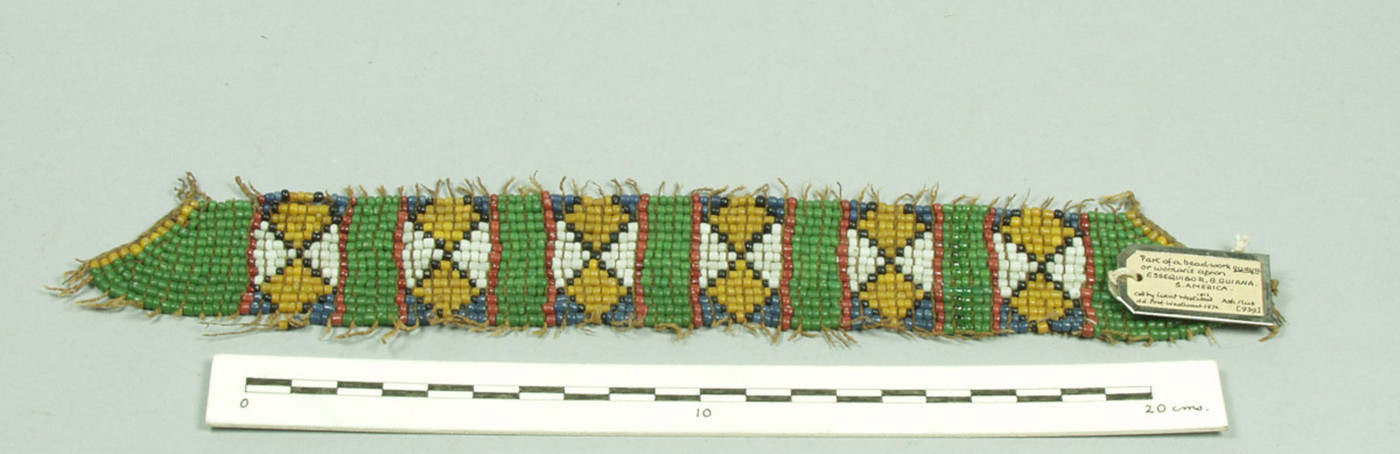 1886.1.939Part of a woman's apron of green, yellow, red, violet, white and black beadwork in lozenge patterns. [N.B. 'DCF 2004-2006 What's Upstairs?' 2/6/2005]1886.1.939
 1972.14.24Bow, made from wood. [ASh [OPS move] 7/8/2017]1972.14.24
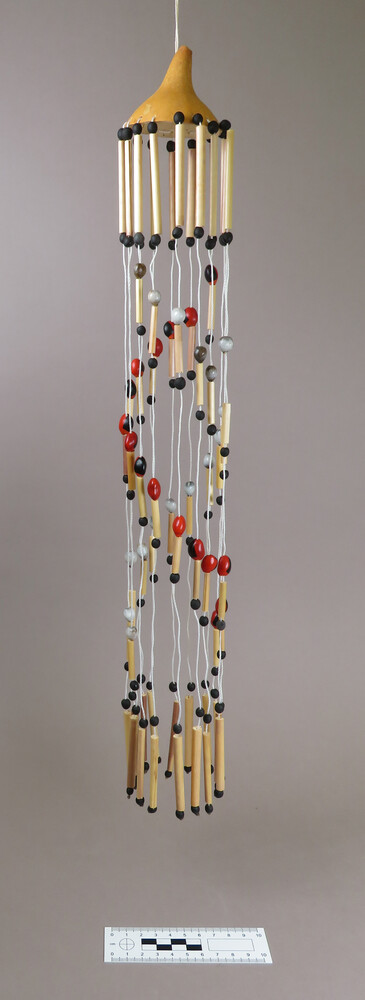 2023.47.25.17Decorative hanging.2023.47.25.17
 1884.140.1831Bow, made from wood. [FB 1/8/2017]1884.140.1831