
- Collection type
- Object
- Description
- Wooden lid for "go counters" box. Rounded lid which has been turned and polished. For the wooden "go counters' box see 1996.17.371 .1 . [CW [OPS Move] 20/7/2016]
- Long description
- Go counters pot and an unknown number of shaped lenticular white stones [see 1996.17.370 for related board and 1996.17.371 for black counters]. The pot is carved from wood and contains ? counters, known as stones, and made from ?stone, all coloured white.
- Geographical reference
- Cultural groups
- Japanese
- Date / Period
- Date made: Before 1996
- Date collected
- By 1996
- Acquisition information
- Donated: 1998
- Materials and processes
- Material Wood Plant, Process Carved
- Dimensions
- Diameter: max 110 mm, Height: max 23 mm
- Object numbers
- Accession number: 1996.17.372.2
- Research and responses
History of the game
It's not clear where the game Go originally came from or when it was invented. It is widely accepted that Go stems from the ancient Chinese game Weiqi (meaning encircling game) which was first referenced in 4th century BCE in Zuo Zhuan (The First Chronological History Book in China). Go reached Japan through Korea, where the game is known as Baduk, no later than the 7th century. Go has been mentioned in classical Japanese literature such as "The Tale of Genji", in which Genji (the emperor’s son), while pursuing his love interest Utsusemi, sneaks into her rooms and spies on her playing a game of Go. One famous historical Go set in Japan is the set once owned by Emperor Shomu (701-756), which is held at The Shoso-in (built in the 8th century as the treasure house of Todai-ji temple in Nara).
From the end of 15th century to the end of the 16th century, Go became popular in Japan among warlords as a form of entertainment, but also to simulate the battles and military strategy. During the Edo period (1603-1867), the first shogun (military ruler) Tokugawa Ieyasu promoted Go, and four major schools of Go were established. They enjoyed patronage from the Tokugawa shogunate (Japanese military government). These schools were officially funded, and they trained the professional Go players. Kisei (棋聖) meaning “Go Sage” is an honorary title given to a handful of highly skilled Go players.
After the Tokugawa shogunate ended in 1867, Go masters lost the shogun patronage, but in their place powerful politicians and businessmen began to support and promote the game. From 1878, newspapers and magazines began reporting the results of Go matches with detailed commentary and diagrams. This helped increase the numbers of players, as well as public interest and support towards the game. It was during the late 1800s, at the height of the game’s popularity in Japan, that the game spread to Europe, when German scientist Oskar Korschelt wrote a journal article titled “Das japanisch-chinesische Spiel Go, ein Konkurrent des Schach” (The Japanese-Chinese game of Go, a competitor to chess). In the 1920s, a parlour game involving a wooden board and pegs was produced in England known as Spoil Five, which board games author R. C. Bell believed was an anglicised version of the game Go.
Go is still popular and widely played by both amateurs and professionals, not only in Japan, but worldwide. In 1979 the Japan Go Association organised the first World Go Amateur Championship in Japan, and in 1982 the International Go Federation was founded.
Etymology of Go
The Chinese character used by Japanese for go is 碁, which is a combination of 其 (square farming equipment) and石 (stone), and means putting the stones in squares.
In Japanese, there is another word 囲碁 (igo) to refer the same game.
Rules of the game and board layout
Go is a two player game - one player with white stones, and the other with black stones. Starting with black, the players take turns placing stones of their own colours on the vacant intersections of a board, and try to enclose their territories by stones. They cannot move the stones again once placed, apart from captured stones, which are removed from the board immediately once captured. A stone is considered captured when all the points at right-angles to it are occupied by enemy stones. The player with larger territory than the other is the winner. Go is not an easy game to play. However there is a much easier and quicker game by using the same board and stones of Go. This game is called "Gomokunarabe" (Five in a row).
The spaces for counters on a Go board (19 by 19) are known as go ban no me meaning “eyes of the chess board”. In a game of go, one player has 180 black counters and the other has 180 white counters totalling 360, corresponding with a 360-day year. Some go boards are marked with nine star points (hoshi) where handicap stones can be placed if there is a large difference in strength between players. The nine star points refer to the “nine lights of heaven”: the sun, the moon, and the seven stars of the constellation Ursa Major.
Material properties
The quality of the materials for boards and stones vary widely- most boards are made of wood but there are lighter, more portable versions of Go boards made from paper, plastic and fabric. Historically, Go counters have been made from materials such as wood and pebbles, with more luxurious options available like ivory, clam shells, jade and quartz. Today, the most expensive black stones are made of a particular stone called "Nachiguro" from Wakayama prefecture. The most expensive white ones are, however, not made of stones but clamshells. The white stones are much more expensive and highly valued than black ones because of the limited supply of the shells and craftsmanship required.
Sources:
Korean games, with notes on the corresponding games of China and Japan by Stewart Culin (1895).
Japanese chess, shō-ngi; the science and art of war or struggle philosophically tested, Chinese chess, chong-kie, and i-go by Chō-Yō (1905).
Oriental Board Games by David Pritchard (1977).
Tale of Genji by Murasaki Shikibu
Getting the Go-ahead, Taiwan Review PAT GAO Publication (2007)
Go in Ancient China by John Fairbairn (1995)
History of Go in Japan by Nihon Kiin (2007)
Board and Table Games from Many Civilizations by R. C. Bell (1960)
Video on manufacturing Go counters: https://www.youtube.com/watch?v=JghjOqvV0_o
Search terms: Toy and Game, Vessel, Board Game, Game, Lid
Further items to explore
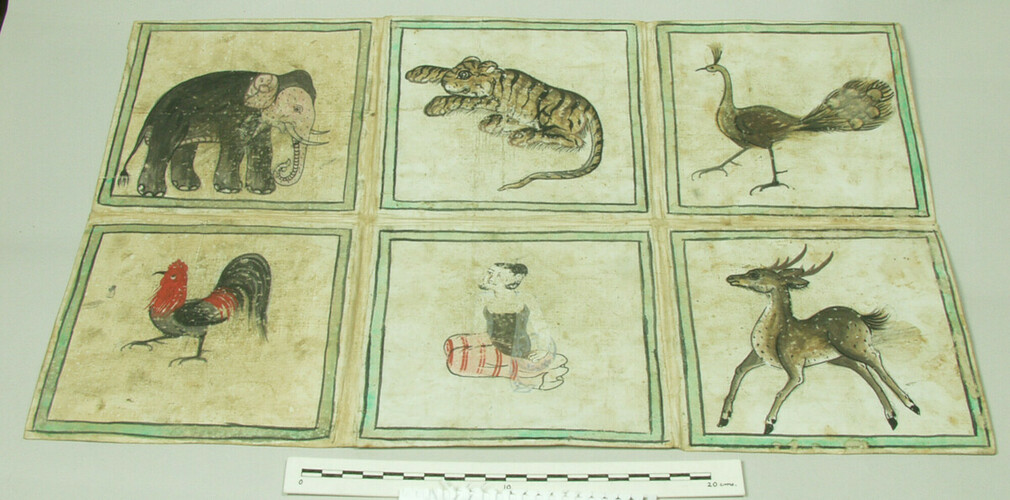 1894.27.70Folding board used in ti gambling [1 of 8], made of thin pieces of metal stuck together with fabric tape and printed on one side images of animals and people. [E.S-R 'DCF 2004-2006 What's Upstairs?' 25/1/2005]1894.27.70
 1911.29.69.3One of twelve stones used in the game of 'merry-peg'. [El.B 'DCF 2004-2006 What's Upstairs?' 7/3/2005]1911.29.69.3
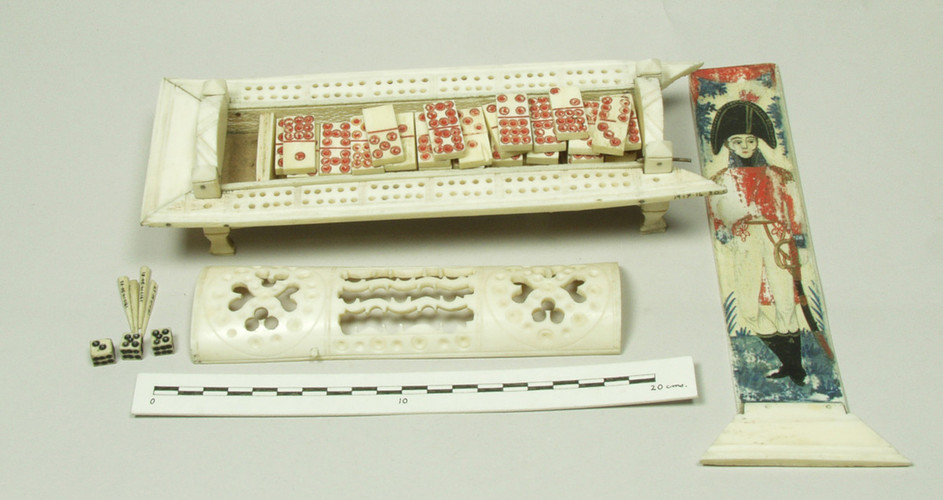 1917.14.30.1Cribbage-board [.1] with openwork lid [.2] and sliding lid [.3] painted with the picture of a soldier. Contains 54 domino pieces [.4-.57], three dice [.58-.60] and four pegs [.61-.64]. [El.B 'DCF 2004-2006 What's Upstairs?' 7/3/2005]1917.14.30.1
 1917.53.489.37Wooden chess piece with Japanese characters on both sides. For paper chess board see [1917.53.489 .1] and for the other chess pieces see [1917.53.489 .2 - .36] and [1917.53.489 .38 - .42]. [JMC 13/12/2018]1917.53.489.37
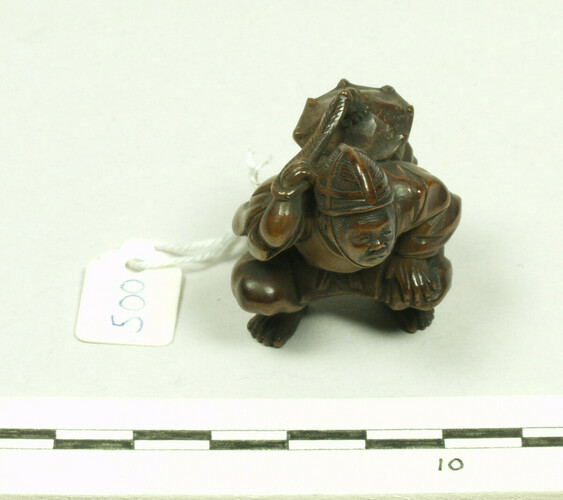 1980.34.500Balancing toggle of wood, in form of a male figure with bent knees carrying a huge lantern on a pole slung over his shoulder. [El.B 'DCF 2004-2006 What's Upstairs?' 13/4/2005]1980.34.500
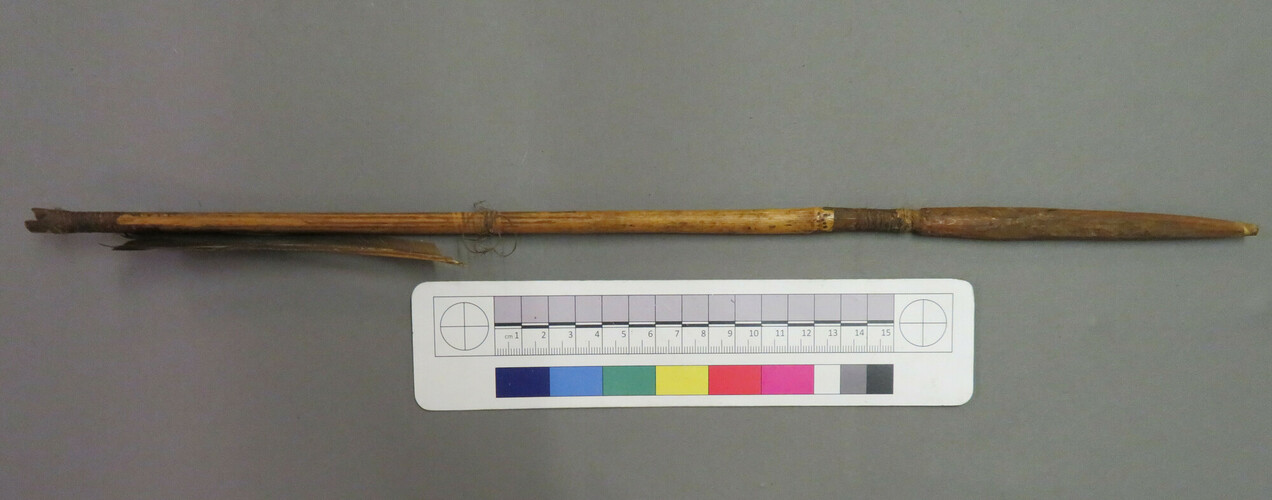 1935.74.4Arrow with missing tip. For associated quiver see [1935.74.3], and for other arrows in set see [1935.74.5 - .9] [EH [OPS move] 11/9/2017]1935.74.4
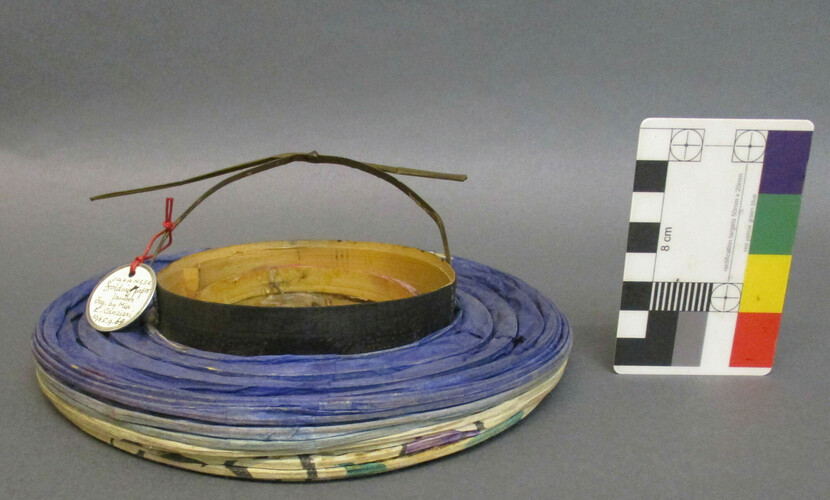 1965.9.69Folding paper lantern for use with candle. [MOBB [OPS move] 3/1/2017]1965.9.69
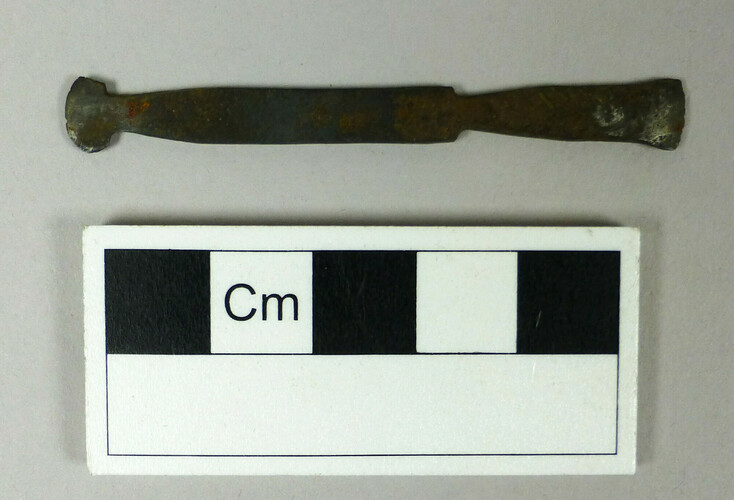 1985.53.762Tool of iron, thin strip with two flattened ends, perhaps a spatula. [El.B 26/11/2013]1985.53.762