
- Collection type
- Object
- Description
- Moccasin, one of a pair, with embroidered decoration.
- Long description
- Moccasin, one of a pair. Black dyed hide, stand-up cuff. The cuff and vamp are covered with floral, curvilinear embroidery in quillwork (most probably) or moosehair. This is tightly tucked around the vamp. The upper leading edge of the cuff is cut away to form a decorative pattern. The edge of the cuff is bound in red ?silk ribbon, some of which remains. Viewed from the back, the moccasin appears to have lower cuffs; these are faux cuffs and are delineated by the embroidery. Laura Peers 28/3/2001.
- Geographical reference
- Person
- Maker Unknown Maker
- Field collector Unknown Collector
- PRM source Augustus Henry Lane Fox Pitt Rivers founding collection
- Date / Period
- Date made: 1810-1830
- Date collected
- ?Prior to 1880
- Acquisition information
- Donated: 1884
- Materials and processes
- Material Deer Skin Animal, Material Animal Hair, Material Moose Hair Animal, Material Silk Textile Animal, Material Ribbon Textile, Material Pigment, Material Porcupine Quill Animal, Process Quillwork, Process Dyed, Process Embroidered, Process Woven
- Dimensions
- Height: max 125 mm, Length: max 235 mm
- Object numbers
- Accession number: 1884.92.16.2 Other numbers: Moc 20 PR no.: 20/ 10513
- Research and responses
Observations made by delegates during the ‘Object Lives’ research visit to the PRM on the 13-15th April 2015. The delegation consisted of Beverly Lemire, Anne Whitelaw, Sara Komarnisky, Judy Half, Cynthia Cooper, Sarah Nesbitt, Sarah Carter, Jonathan Lainey, Laurie Bertram, Susan Berry, Katie Pollock and Julie-Ann Mercer. This is a University of Alberta-based group; see: http://objectlives.com/
Moccasins. No signs of wear. Compare to Wendat saddle bag. Stand up collar with scoop, distinctive and unusual vamp. [FB 31/10/2016]
Very fine quillwork. Identified as Iroquois by Sherry & Calvin Racette, 1989. [LM]
'Moc 20' Skin embroidery with moosehair dyed blue, orange, white; ankle flaps meet over instep like European boot. [G.E.S.Turner series? --L Peers, 29/04/2009]
Examined by the GRASAC research team on 10 December 2007 as part of a research project to create a digital database. This will incorporate information about collections of indigenous material culture from the Great Lakes region of North America that are housed in a number of museums on several continents; see https://icslac.carleton.ca/grasac/. The group described the style of these moccasins as inset vamp, puckered toe with a separate stand-up cuff without holes for lacing. They noted the moccasins are made from hand-tanned blackened hide with red silk binding, which is disintegrating, and are decorated with moose hair dyed white, blue and orange (through fading originally red). The moccasins are stitched with commercial thread, there is a seam at the back of the cuffs, which is unusual as they are usually made in one piece. The motifs are flower, curve and linear designs and include a decorative area that creates the appearance of a flap. One of the moccasins is more faded [this is from exposure to light when one was on display]. This style of design would have laced across the front but there are no holes for this purpose indicating that the moccasins have not been worn. Ruth Phillips identified the style of the moccasins as c.1820 to 1835, they are a similar to a documented collection from this period housed in the Historical Museum, Berne, Switzerland. The stitching is very fine, which was a feature of moccasins made in this period for the European commercial market where European embroidery also had to be a high standard to ensure it would sell. [for information on the Project see researchers file GRASAC]. [ZM 14/12/2007] [L Peers 16/01/2008]
Final GRASAC entry: 'Materials: hand-tanned blackened hide, moose hair embroidery in white and blue and an original deep/bright orange (now faded to light orange), red-silk ribbon, commercial cotton/linen thread. Format/Techniques: The moccasin is tightly puckered around the toe vamp, with separate cuffs in a stand up cuff design. This design of cuff usually laced across the front of the ankles, but on this pair there are no holes, indicating that this pair was never worn. The moccasins are constructed with a Y-shaped heel seam. The foot is turned up and gathered to the vamp with ca. 58 puckers. CW and LP note that the puckering comes up unusually high on the vamps. The vamp is long and narrow, extending to form the tongue. The ankle flaps are made in two parts, joined at the back by the continuation of the heel seams. They are shaped to meet edge to edge over the instep as in a European boot. Motifs and Images: There is extensive embroidery on the vamp, on the outside of ankle flaps and on the foot piece around the ankle. CW and RP suggest that the scalloped line that runs around the outside border of the vamp possibly resembles the sky dome motif. On the cuff are double curves, parallelograms, and floral designs with curvilinear lines between the flowers. Rectangular embroidered panels along the upper edge of the body of the moccasin could stylistically represent a flap.
Symbolism and Interpretation: RP suggests a link with Dorothy Burnham's book about painted hide coats, including triangles which implied the mountains where the Lord of the Caribou dwelt. Possibly the triangles on this pair refer to mountains. A four dimension motif is also possible. SL suggests a play of symmetry and balance across the design, grouping some items. Interlocking colour balances the arrangement of elements. See Cory's thesis, chapter on "Clothing of a New Kind". RP notes that this pair of moccasins is an example of the kinds of items made in the eighteenth century by Aboriginal women in convents, to be either sent to patrons in France who were collectors of curiosities or sold to tourists. Condition: The moccasins are in very good condition, with faded colour, disintegrated red ribbon edging, and some holes on the soles from what appears to be insect damage. One of the moccasins is more faded than the other, as they had been on display for thirty years. CW and RP believe they haven't been worn. Other Notes: The seam at the back of the cuff is very peculiar (CW) and the stand-up cuff with no holes for lacing were also unusual. AD asked if there a is a relation between fineness of stitching and exchange context. CW suggests that these made for the European, commercial market, which in this period sought fineness of women's handiwork. This example of fine needlework relates to English embroidery of the same period. RP notes that the sort of puckering found around the vamps is characteristic of eastern Cree and eastern Algonkian moccasins.' [L Peers, 29/04/2009]
Search terms: Clothing Footgear, Shoe
Further items to explore
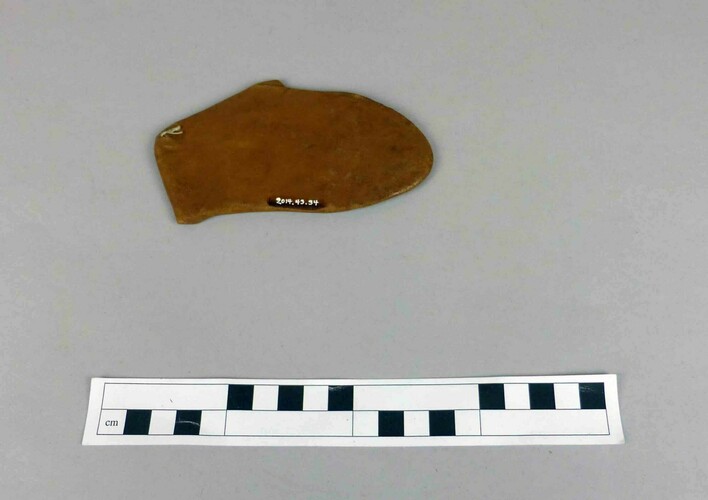 2014.43.34Slipper made from brown leather. [FB 07/11/2014]2014.43.34
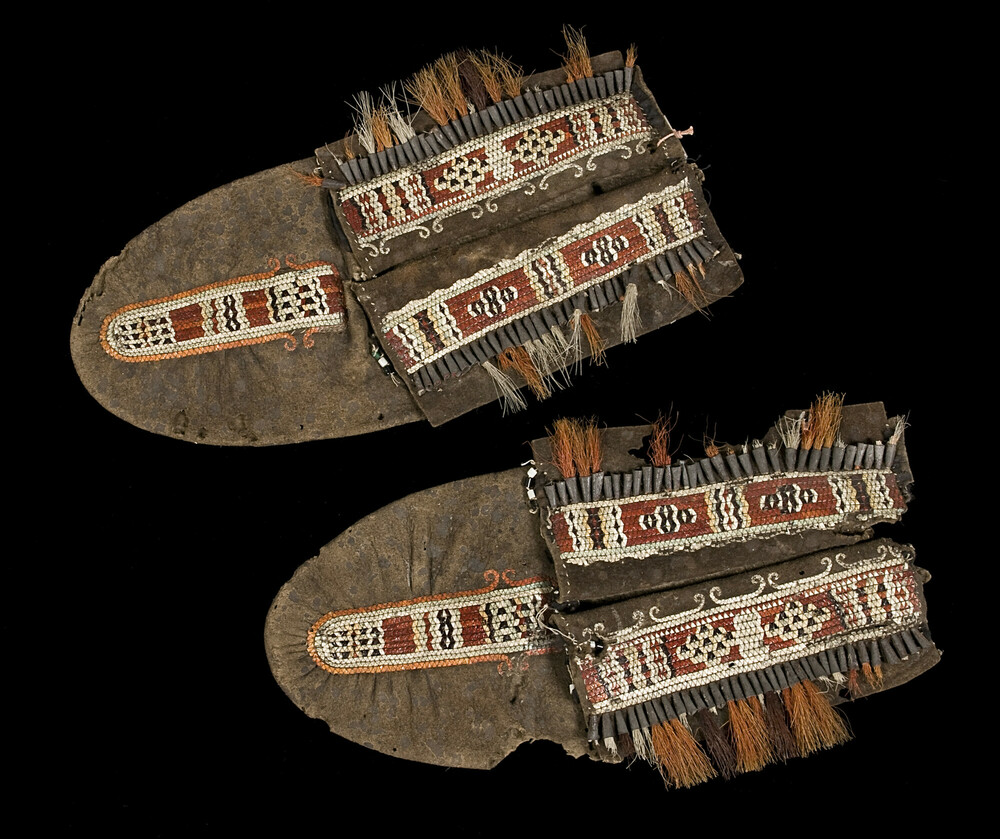 1952.5.03.1Animal skin moccasins with porcupine-quill decoration and edging of metal cones. [ZM 2/11/2005]1952.5.03.1
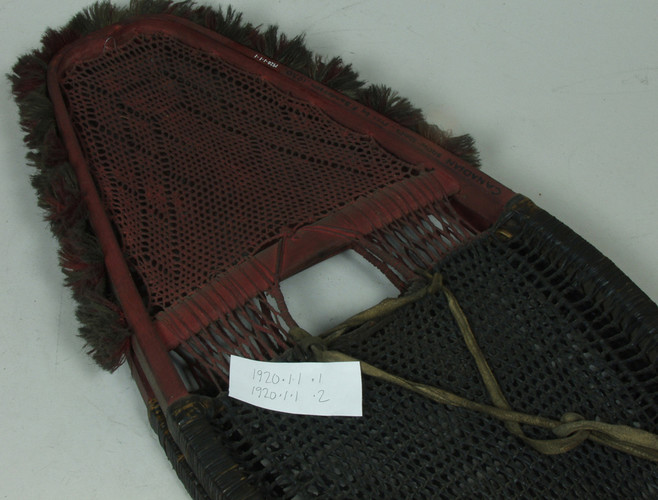 1920.1.1.1Pair of painted snow-shoes1920.1.1.1
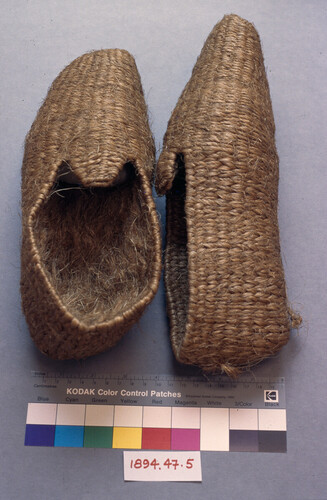 1894.47.5.1Fibre shoes plaited over a wooden shape by a coastguard. The toe is plaited differently to the heel and sides the change starting at the beginning of the opening where there is a small tongue. The ends of fibre line the inside1894.47.5.1
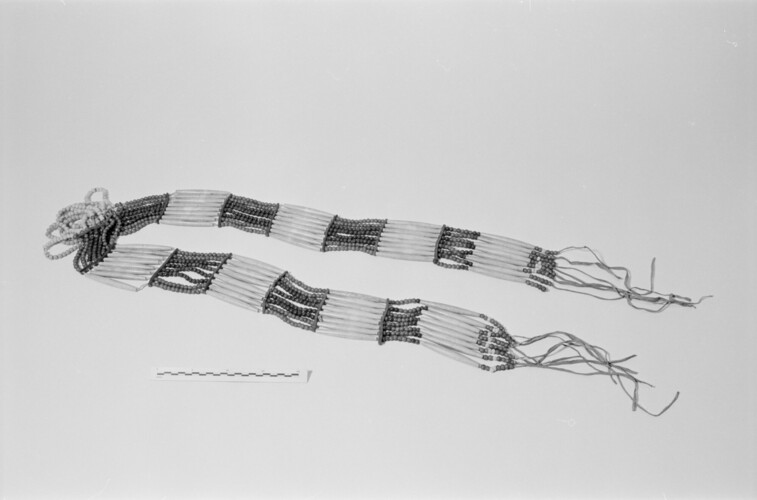 1994.4.43Neck ornament; tapering cylindrical sections of bone and strings of red, blue and yellow beads separated by strips of skin [EC 'DCF 2004-2006 What's Upstairs?' 28/9/2005]1994.4.43
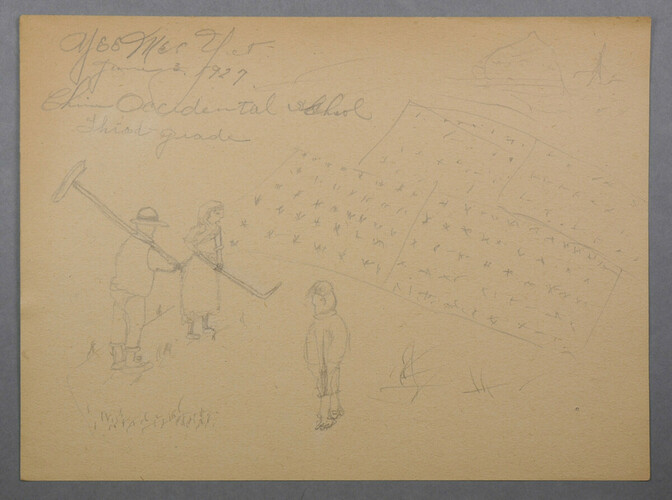 1994.15.2401Pencil drawing of a man, a woman and a boy. The man and woman are carrying agricultural tools. They are standing in front of fields or vegetable patches. [El.B 15/05/2008]1994.15.2401
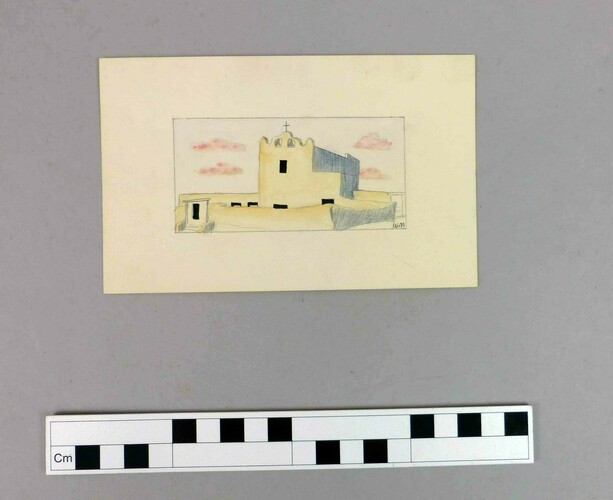 1953.12.14.5Watercolour painting of church in desert landscape with pink clouds in the sky. Drawn and painted on postcard sized card with plain boarder. [FB 12/05/2015]1953.12.14.5
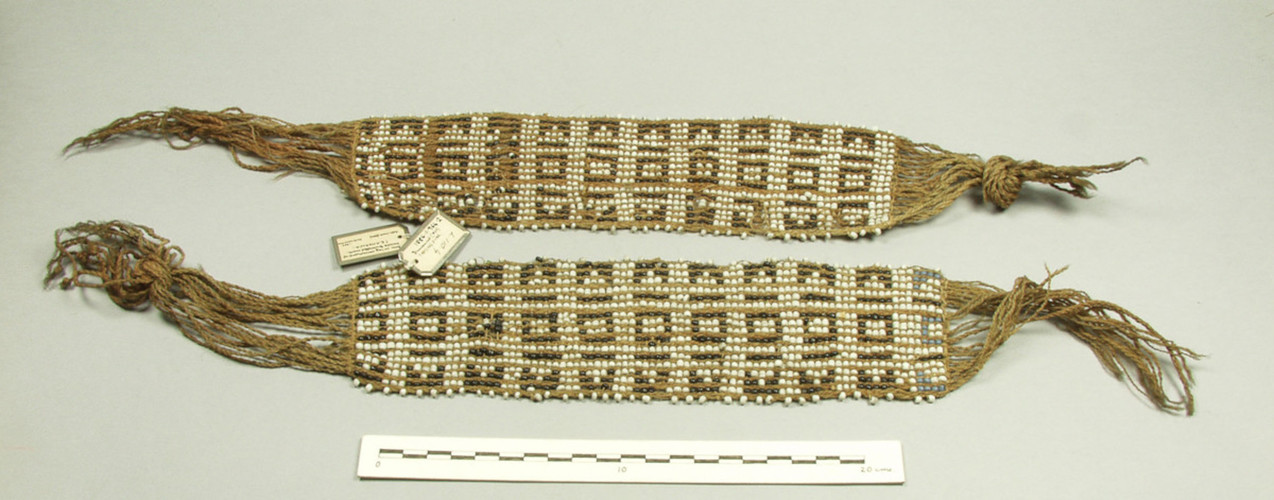 1886.1.964.1A pair of leg bands [.1 & .2] of wool interwoven with glass beads, in square shaped patterns [SM 15/09/2008]1886.1.964.1