
- Collection type
- Object
- Description
- Ceramic sherd
- Long description
- Medium grained ceramic sherd with mineral (shell ?) temper. [CG [Excav. PR] 10/12/2013]
- Geographical reference
- England Kent Shepway Folkestone Castle Hill [Caesar's Camp]
- Person
- Maker Unknown Maker
- Field collector Augustus Henry Lane Fox Pitt-Rivers
- PRM source Augustus Henry Lane Fox Pitt Rivers founding collection
- Date / Period
- Archaeological period: Medieval
- Date collected
- By 1878
- Acquisition information
- Donated: 1884
- Dimensions
- Thick: max 7 mm, Width: max 39 mm, Length: max 42 mm, Weight 14 g
- Object numbers
- Accession number: 1884.140.1637.6
- Research and responses
The excavation at 'Caesar's Camp ran more or less concurrently with the second season at Mt Caburn [June/ July 1878], the actual digging took just over two weeks with a workforce of between 8 and 10 labourers. Relic tables [qv] were kept and published for this excavation [Bowden, 1991: 86, Thompson, 1977: 56] [AP Leverhulme project on founding collection 1995-1998]
Further information and research notes on this site compiled in the 1970s by Revd. AH Gibson are held at Folkestone Library (see correspondence and copies of Gibson's notes in RDF) [JC 7.11.96]
The full reference for the article mentioned in Primary Documentation, in which Pitt Rivers published the results of his excavation at Castle Hill is: Pitt Rivers, AHLF. 1883. Excavations at Caesar's camp, near Folkstone, conducted in 1878. Archaeologia 47: 429 - 465. [MN 19/06/2009]
Castle Hill [TR 2140 3795] is a large oval ringwork and bailey in use between 1095 and 1137. The site and Pitt Rivers excavation there is recorded on the English Heritage maintained National Monuments Record under monument no. 465687. This record can be accessed online at http://pastscape.english-heritage.org.uk/hob.aspx?hob_id=465687. [MN 19/06/2009]
The monument is recorded on the Kent County Council Historic Environment Record under HER number TR 23 NW 2. This record can be accessed online at http://extranet7.kent.gov.uk/ExploringKentsPast/default.aspx. [MN 19/06/2009]
As stated on the Geographical Card Catalogue Entry in Primary documentation ceramics from Caesar's Camp were analysed and documented by Dr Anthony D. F. Streeten in his unpublished PhD thesis 'Medieval and Later Ceramic Production and Distribution in South-East England' (1985, University of Southampton). Seven sherds were sampled for thin section analysis, these were provided with sample numbers 810, 811, 812, 813, 814, 815 and 816. In section 12 of the thesis a corpus of medieval and later ceramics in SE England is presented, allowing the classification of the ceramics within thirteen locally produced fabric types (A-N) with further sub groups as required. The samples from Caesar's Camp were classified as follows (Sample no. - Group type - Group description): 810 & 811 - Group Hvii - Miscellaneous flint-/sand-tempered ware with shell (thin sections illustrated in Fig. 12.10). 812 & 813 - Group Kii - Early medieval sandy ware: East Kent (thin sections illustrated in Fig. 12.11). 814 - Group Civ - Micaceous shell-/sand-tempered wares (thin section illustrated in Fig. 12.2). 815 - Group Kxlviii - Miscellaneous sand-tempered white wares: Kent (thin section illustrated in Fig. 12.32). 816 - Group Kv - Sand-tempered Tyler Hill product (thin section illustrated in Fig. 12.13). A copy of section 12 of the thesis can be found in the RDF: Researchers File: Streeten. [MN 13/10/2009]
The sampled sherds are 1884.138.14 .29, 1884.138.7 .59, 1884.138.7 .60, 1884.138.7 .61, 1884.138.15 .141, 1884.138.15 .142 and 1884.138.4 .314. [El.B DDF Body Arts Project 2010/2011 29/03/2011]
Further items to explore
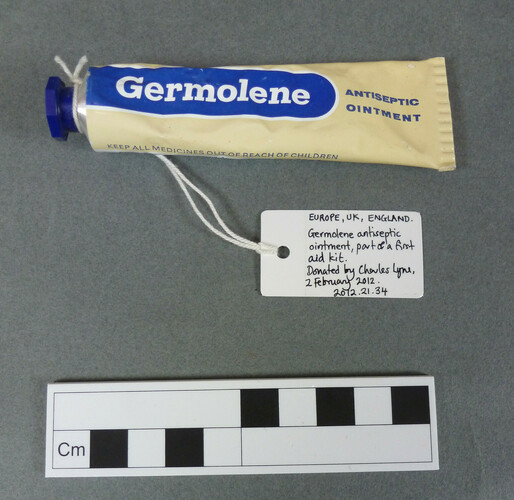 2012.21.34Tube of Germolene antiseptic ointment, part of a medical kit [See 2012.21.2 - .53]. [FB 26/03/2012]2012.21.34
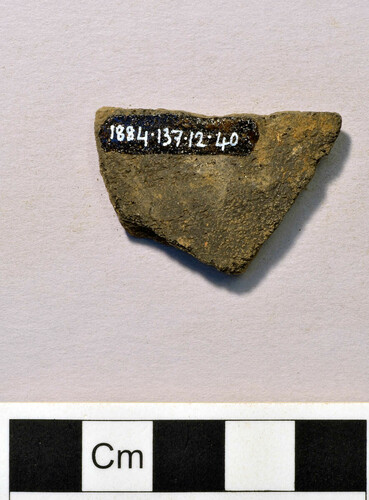 1884.137.12.40Ceramic sherd1884.137.12.40
 1960.7.1.72One of six identical buttons, circular in shape and with the upper side decorated with one central ovoid facet.1960.7.1.72
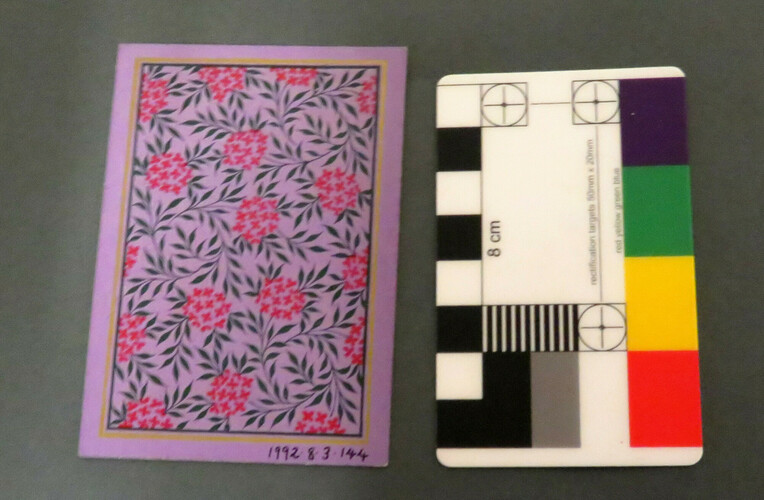 1992.8.3.144Playing card, queen of spades. Purple coloured reverse with gold border and floral and foliate designs in pink, green and gold. For the other playing cards in this incomplete set of 49, see [1992.8.3 .134 - 143] and [1992.8.3 .145 - 185]. [CW [OPS Move] 23/3/2017]1992.8.3.144