
- Collection type
- Object
- Description
- Dagger or sheath-knife with string-bound grip and wooden handle carved in the shape of a bird's head.
- Long description
- Dagger or sheath-knife with string-bound grip and wooden handle carved in the shape of a bird's head. The blade is straight along one edge and has a slight curve near the tip of the other edge. There is a round perforation near the point. Where the blade and handle join, the blade narrows (it becomes thinner than the handle) and extends along one side of the grip to the pommel. The other side of the grip is wood. The two sides have been tightly bound together by thin brown string. The pommel and grip are carved from a single piece of wood. The pommel has been carved as a bird with short feathers visible under its beak and small feet nestled between the feathers. The beak curves downward and is relatively short. Large eyes are visible on either side, and the top of the birds head is carved with feathers and ears. [CAK 23/06/2009]
- Geographical reference
- British Columbia Haida Gwaii (Queen Charlotte Islands) NW Coast
- Cultural groups
- Haida
- Date / Period
- Date made: Before 1901
- Date collected
- By 1901
- Acquisition information
- Purchased: 06/15/1901
- Materials and processes
- Material Iron Metal, Material Wood Plant, Material String, Process Carved, Process Bound, Process Forged (Metal), Process Perforated, Process Nailed
- Dimensions
- Length: max 400 mm
- Object numbers
- Accession number: 1901.60.1
- Research and responses
Mrs Bickmore was a dealer based in the High Street, Oxford [AP 22/01/2007]
The following information comes from Haida delegates who worked with the museum’s collection in September 2009 as part of the project “Haida Material Culture in British Museums: Generating New Forms of Knowledge”:
This dagger was viewed alongside other weapons and tools on Monday Sept 14, 2009. Delegates largely thought this was a functional, rather than ceremonial, dagger. It was observed that the hole in the blade could indicate the re-use of found or traded metal. Christian White commented that the thread bound on the handle could be sail-making thread. He thought the wood of the dagger could be walnut or wood from a gunstock. Christian also thought the metal looked recycled and wondered if it had come from a broken sword. He thought this would be used as a weapon for fighting. Gaahlaay (Lonnie Young) thought the knife would be used for cutting and skinning animals, a kind of utility knife. Jaalen Edenshaw observed that with this, and other, blades, the ribs running lengthways from the tip to the hilt allow for the swift removal of the blade: if the blade were to become lodged in a body, the owner/user of knife would be in increased danger.
In terms of the figure on the dagger, Christain White noted that it had a distinctive eye, and that there was almost a row of teeth visible, suggesting to him that it was a raven. Another delegate thought the bird figure was more probably an eagle.
Discussion of Haida daggers more generally can be viewed on Tape 9, time 5:27, which can be found in the Haida Project Related Documents File. [CAK 12/05/2010]
Search terms: Weapon, Tool, Figure, Dagger, Knife, Bird Figure
Further items to explore
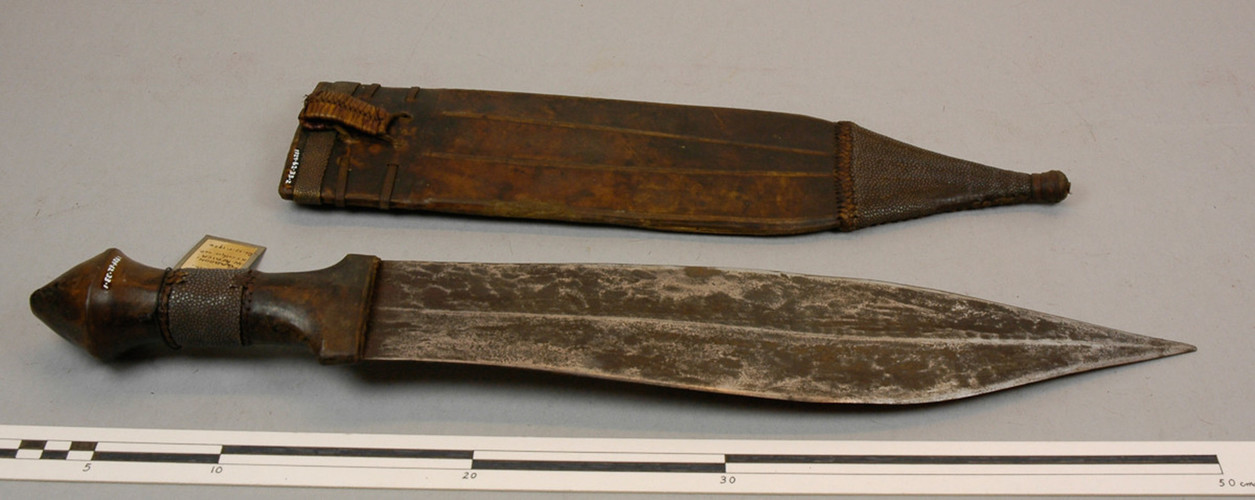 1924.62.33.1Dagger or knife [.1] with broad leaf-shaped blade and leather-covered handle with a band of fish skin. With leather sheath [.2], with tip bound in fish skin and a band of fish skin near the top. [El.B 06/11/2007]1924.62.33.1
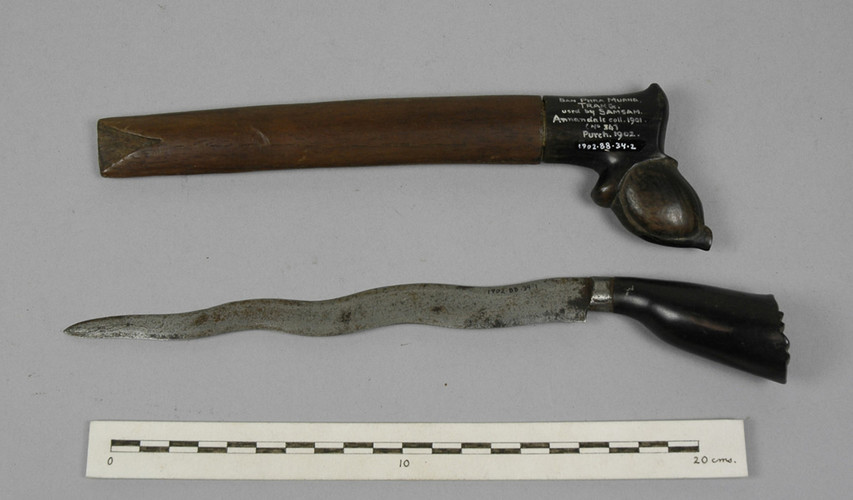 1902.88.34.1Knife [.1] with wavy blade, with wooden handle expanding towards the butt. With wooden sheath [.2] with crosspiece. [El.B 30/5/2007]1902.88.34.1
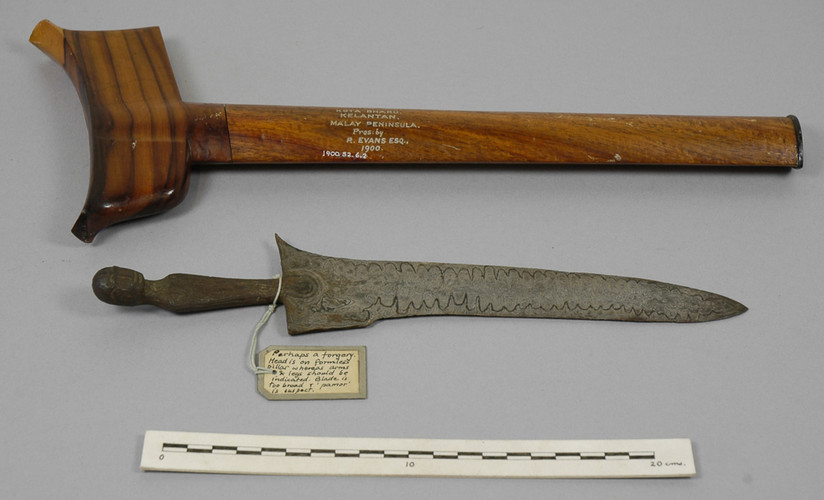 1900.52.6.1Keris [.1] with etched iron handle with the image of a head on it. With an undecorated wooden sheath [.2] [SM 06/03/2007]1900.52.6.1
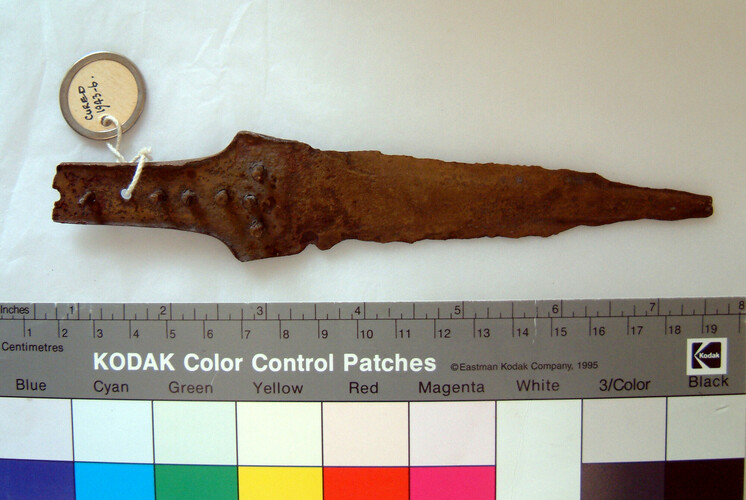 1884.119.285Bronze dagger from Cyprus, with flanged handle with 8 rivet holes and 7 bronze rivets still in place. Probably Middle Bronze Age in date. [Dan Hicks 30/04/2012]1884.119.285
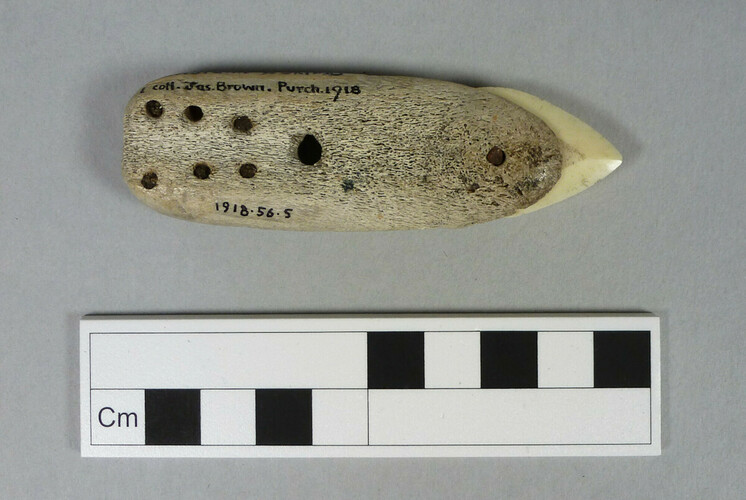 1918.56.5Harpoon head of bone or antler, with ivory blade. [El.B 25/04/2012]1918.56.5
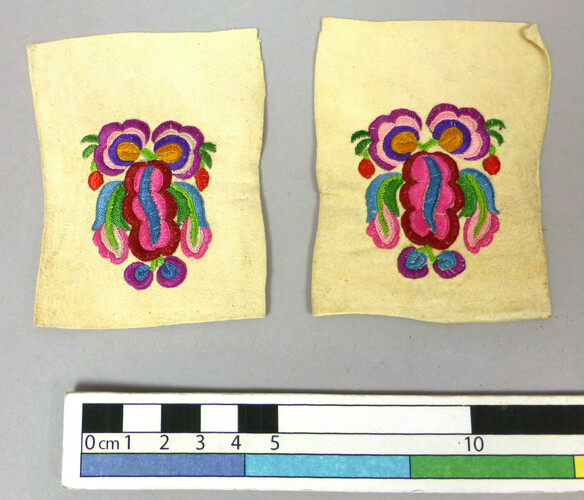 1993.60.1.1Pair of rectangular deerskin moccasin ?pockets [.1-.2] with embroidered floral designs in pinks, purples, blue, green and yellow. [SM (Verve) 25/03/2014]1993.60.1.1
 1994.15.661Drawing by child in pencil of five figures. [MJD 26/01/2015]1994.15.661
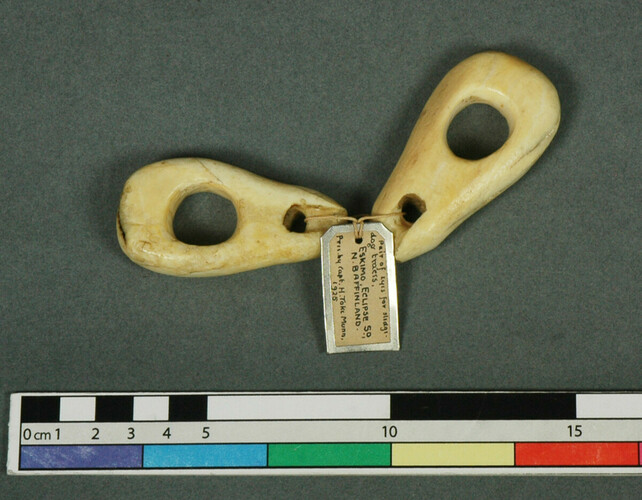 1925.11.47.1One of two ivory toggles for dog-sledge trace, teardrop shaped with two perforations. For the other toggle see [1925.11.47 .2]. [CW [OPS move] 1/8/2017]1925.11.47.1