
- Collection type
- Object
- Description
- Piece of carved argillite pipe depicting a man sitting on a stool with a barrel behind him and a curving form in front of him.
- Long description
- Piece of carved argillite pipe depicting a man sitting on a stool with a barrel behind him and a curving form in front of him. The fragment has been carved from a single piece of argillite and is carved identically on both sides (although one side has suffered more damage than the other). The base of the pipe is squared and decorated with three horizontal lines, each incised with short, perpendicular lines radiating downward. The end of the pipe is carved with a three-plumed object, projecting upward from the base of the pipe, with each plume widening and then curling at the top. The forearms of a man rest against the top of the plumes and his hands hold a stick or tool which enters into the plumes. The man is seated on a stool, and he is dressed in a long-sleeved shirt and trousers with a double stripe down the side and around the calf. He is wearing boots on his feet, which are propped up on an angled plinth. His hair is carved in segments of parallel lines and extends to his shoulders. Behind the stool and is a tall barrel. The edge of the barrel has a portion missing and the base at this point is irregularly shaped, indicating the pipe would have extended further at this point originally.
- Geographical reference
- British Columbia Haida Gwaii (Queen Charlotte Islands) NW Coast
- Cultural groups
- Haida
- Date / Period
- Date made: 1830-1860
- Date collected
- 1860 - 1939
- Acquisition information
- Bequeathed: 1939
- Materials and processes
- Material Argillite Stone, Process Carved
- Dimensions
- Height: max 91 mm, Length: max 124 mm
- Object numbers
- Accession number: 1938.35.1543 Other numbers: Balfour No. 2212
- Research and responses
It is unlikely fragments 2212 and 2213 (1938.35.1543 and 1938.35.1544) are two pieces of the same pipe as the scale of the human figures and bases are very different and as the base of each pipe features a different design; pipe bases normally represented the hull of a ship at the water line, hence it would be unlikely to have two such different designs on one pipe (i.e. one ship). [CAK 21/05/2009]
The following information comes from Haida delegates who worked with the museum’s collection in September 2009 as part of the project “Haida Material Culture in British Museums: Generating New Forms of Knowledge”:
This pipe was viewed alongside other argillite carvings on Tuesday Sept 15, 2009. The figure was described by delegates as European because of the style of his trousers (the line running down the side of the leg) and the fact that he is depicted wearing shoes. Natalie Fournier thought the figure might be a blacksmith, and proposed there could be cold water in the barrel and abstract curling smoke. There was another suggestion that there is a bellows in the scene. One delegate suggested the figure could be carving while sitting, and that at the very least, he was doing some form of work and appeared to have a tool in his hand. One delegate wondered if he was pulling something out of the barrel.
A group discussion about argillite raised the following points. Argillite is only carved on Haida Gwaii. It is a natural resource of the islands, is very brittle and difficult to carve. Black is the most common variety, but rarer red and brown varieties also exist. It requires a skillful hand to carve it successfully. In addition to early trading, argillite served an important purpose during difficult years in Haida communities. Even when not skillfully executed, argillite allowed carvers to record stories and oral histories, like previous generations did in wood before them; they were able to preserve a significant amount of information that might otherwise have been lost. Argillite also provided a medium for Haidas to be satirical about the Europeans they were encountering.[CAK 18/05/2010]
Further items to explore
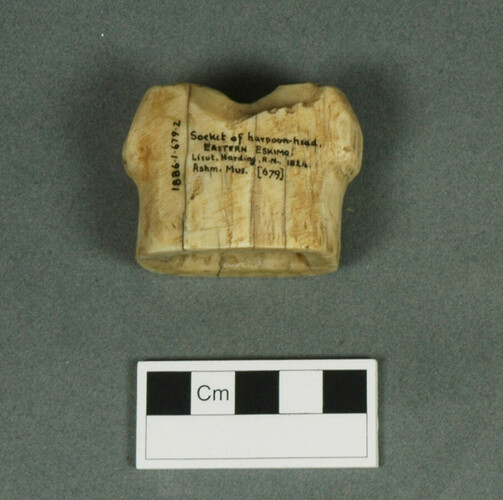 1886.1.679.2Ivory socket from the top of a harpoon-shaft. [El.B 01/03/2012]1886.1.679.2
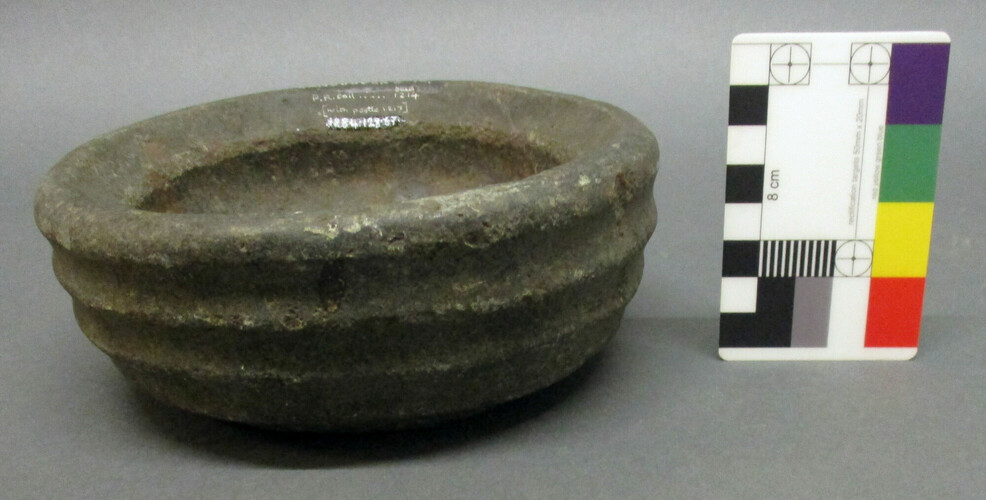 1884.128.67Stone mortar. Round basin-like mortar of greenish brown ?balsaltic stone. Designed with ridges on the exterior. [ASh [OPS move] 24/10/2016]1884.128.67
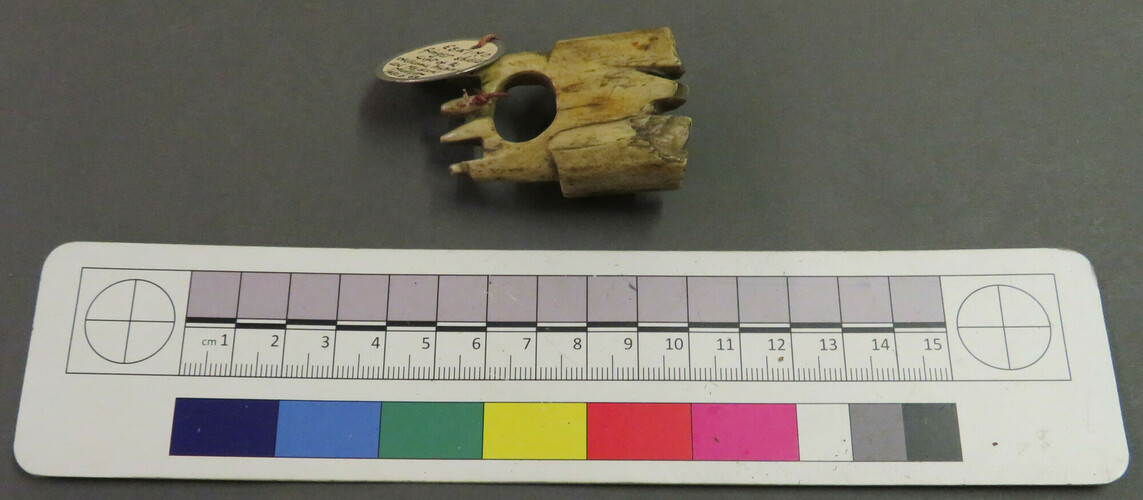 1951.6.69Bone finger shield. [SB [OPS move] 31/7/2017]1951.6.69
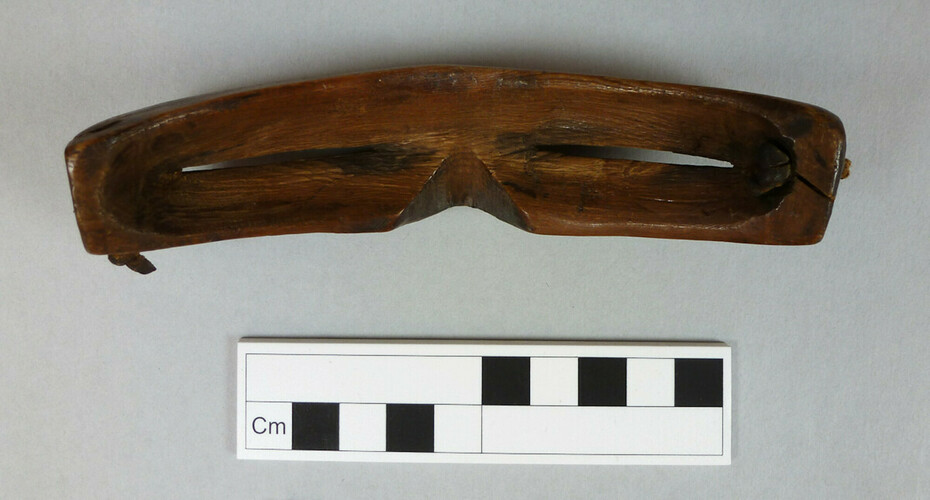 1906.20.1Wooden snow goggles with remains of leather strap. [El.B 24/04/2012]1906.20.1