
- Collection type
- Object
- Description
- Small, wooden face carved in relief on the front, and flat on the back. [CAK 24/08/2009]
- Long description
- Small, wooden face carved in relief on the front, and flat on the back. Said to be a portrait of a shaman or sgaaga, this was not worn as a mask on the face, but as an amulet worn on the chest or possibly set into a headband. It is carved from a single piece of wood that due to the pronounced grain appears to be red cedar. There are holes on either side of the face that appear to have been used for tying the mask on during use. There are eleven holes in the top edge of the mask, some of which contain broken ends of wood. It is not known what these holes used to contain but there appears to be stub ends of hair or fur alongside some of the wood. The eyes and eyebrows contain black pigment, with red pigment used on other areas of the face. The back is flat with no defining features except a museum label written on the object in red. [HR 28/10/2005] [CAK 06/04/2010]
- Geographical reference
- British Columbia Haida Gwaii (Queen Charlotte Islands) NW Coast
- Cultural groups
- Haida
- Date / Period
- Date made: Before 1882-1890
- Date collected
- Between 1882 and 1890 ?
- Acquisition information
- Purchased: 02/03/1891
- Materials and processes
- Material Wood Plant, Material Pigment, Process Carved, Process Painted, Process Incised, Process Pegged
- Dimensions
- Length 108 mm
- Object numbers
- Accession number: 1891.49.17
- Research and responses
The following information comes from Haida delegates who worked with the museum’s collection in September 2009 as part of the project “Haida Material Culture in British Museums: Generating New Forms of Knowledge”:
This carving was viewed alongside the masks on Thursday Sept 10, 2009. PRM asked delegates whether 'mask' was an appropriate description for this object. Gwaai and Jaalen Edenshaw characterised this carving as an amulet or charm, but said it was not a mask. One reason given by delegates for not considering this a mask was that it was not carved out on the reverse. They clarified that for Haidas, 'amulet' and 'charm' would be interchangeable terms. Diane Brown characterised this carving as part of clothing or regalia. [Cara Krmpotich note: The idea that this was a mask seems to originate with June Bedford, rather than in the accession records.] Delegates said a carving like this would be worn on the chest or set into a headband. A discussion of this carving and a modern example made by Susie [this could be referring to Ruth Gladstone-Davies sister, Sue Gladstone] occurs in Tape 4, time 27:15, which can be found in the Haida Project Related Documents File. [CAK 06/04/2010]
Similar maskette shown on a Tlingit frontlet collected by Emmons in the 1880s, reproduced in Objects of Bright Pride: NW Coast Indian Art from the American Museum of Natural History (1988) plate 34. The caption says that the maskette depicts a very powerful chief [Laura Peers, 10/04/2006].
- Associated publications
- Reproduced in black and white as figure 9 on page 7 of 'Haida Art in the Pitt Rivers Museum, Oxford, and the Rev. Charles Harrison', by June Bedford, in European Review of Native American Studies, Vol. XII, no. 2 (1998), pp. 1-10. Caption reads: 'Small mask representing an important shaman'. [JC 16 4 1999] Discussed by Charles Harrison on p. 86 of his Ancient Warriors of the North Pacific (London: H.F. and G. Witherby, 1925): 'Another mask represented the most powerful Shaman whose memory tradition preserved. It was small and so was not worn on the face but on the breast of shamans of later days, for it was believed that the spirit of their distinguished ancestor would guide them aright.’ [NM 25 2 1997]
Search terms: Ornament, Dance, Clothing, Figure, Amulet, Dance Accessory
Further items to explore
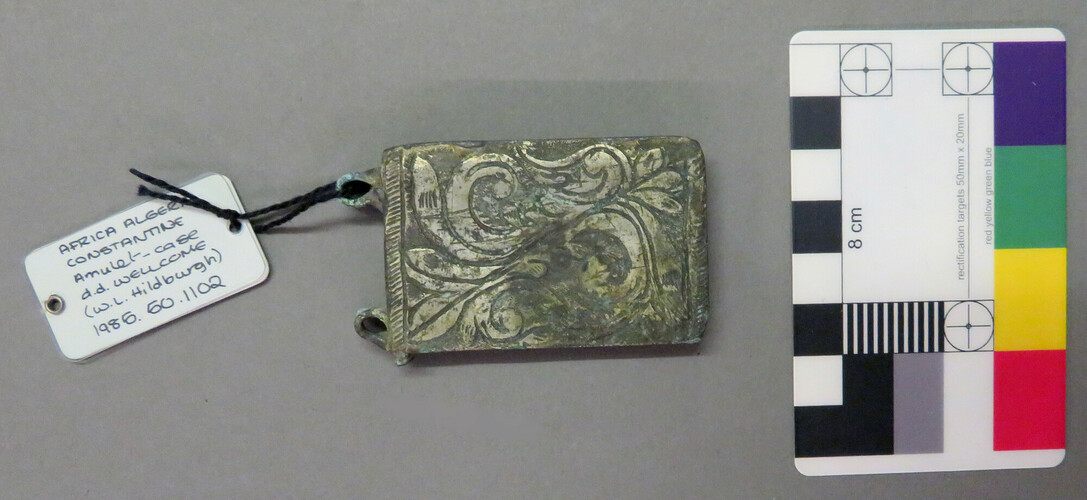 1985.50.1102Tinned copper amulet case or amulet. Rectangular, with two loops on one edge and incised foliate designs on both sides. [EH [OPS move] 13/11/2017]1985.50.1102
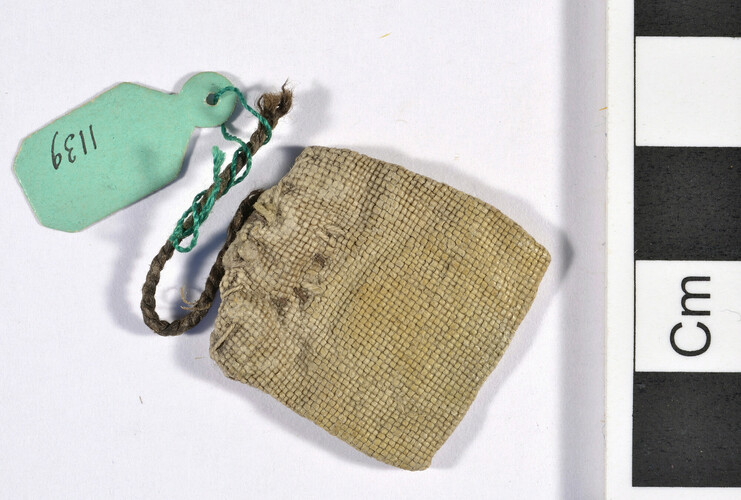 1985.52.610Amulet, linen satchel containing a metal medal, stitched closed, with a brown cotton cord which originally would have formed a loop for suspension. [ACA 23/03/2012]1985.52.610
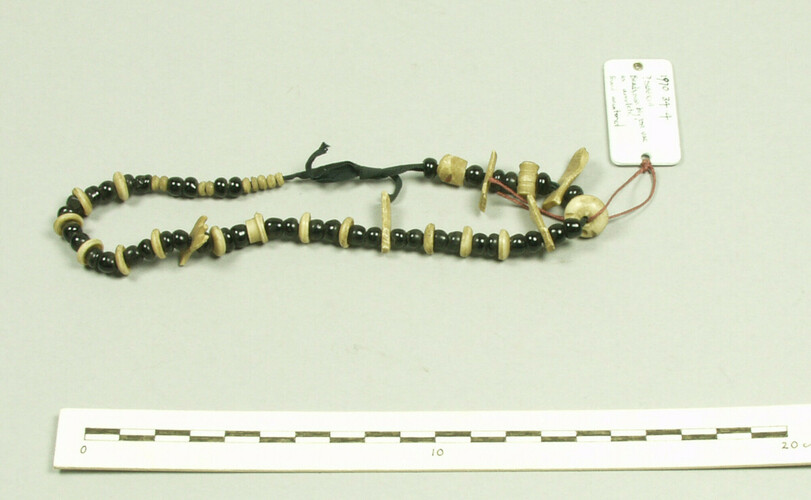 1970.34.4Beads, bone disks, animal feet and carved bone objects threaded on a dark blue ribbon.1970.34.4
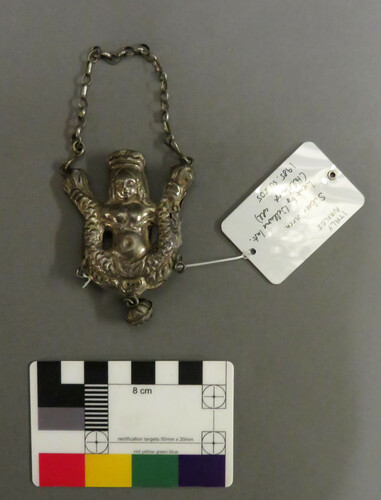 1985.50.805Silver siren (mermaid), double tailed, with double chain and places for 3 bells, 2 of which are missing.1985.50.805
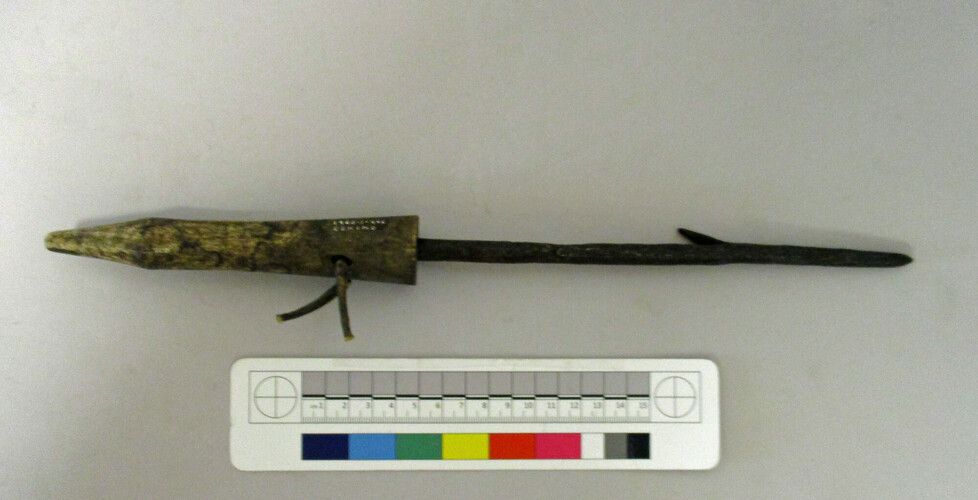 1966.1.996Metal bar socketed into a narwhal handle with a split hide loop threaded through the handle. The end of the hand is pointed. The rod is barbed. [RH [OPS Move] 20/6/2017]1966.1.996
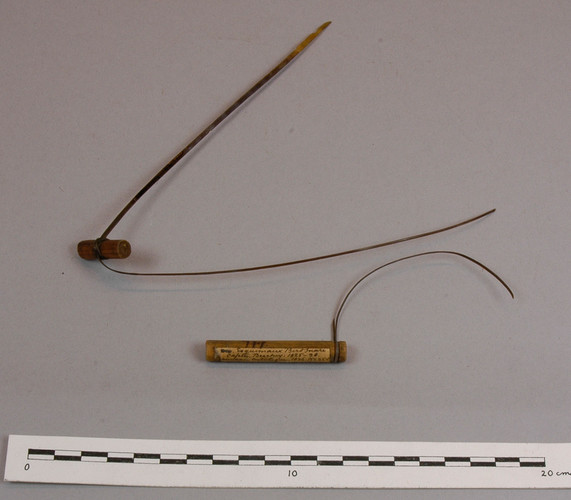 1886.1.779.19.1Bird snare of whalebone and wood. [LM 26/11/2007]1886.1.779.19.1
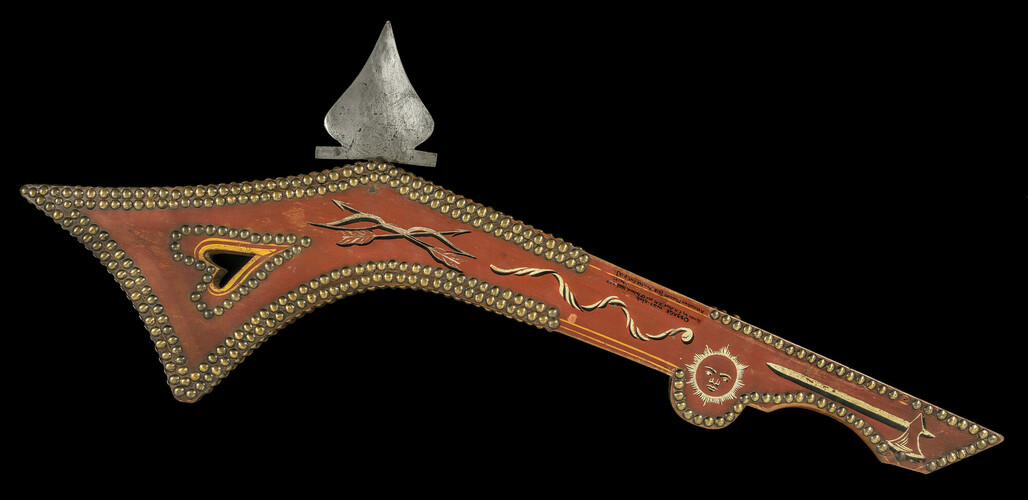 1886.1.818Gun-shaped wooden club painted and bordered with rows of brass round headed tacks, with iron blade. [SM 08/08/2007]1886.1.818
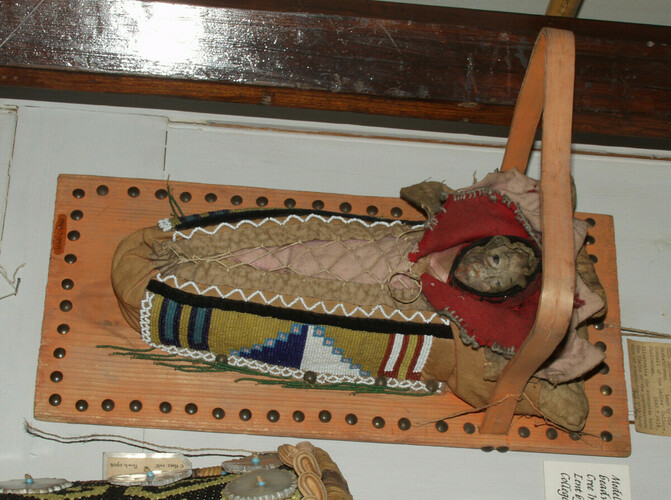 1940.7.0414Model cradle, decorated with beads.1940.7.0414