
- Collection type
- Object
- Description
- Pair of red finger-woven garters [.1, .2] with beadwork design throughout and end tassels including quill, hair and metal cones.
- Long description
- Pair of garters [.1, .2] of finger-woven textile with beadwork design throughout. End tassles of quill-wrapped strands in white, black, red, with metal cones and hair tufts projecting from them. Basic ground is red, with a green band along each long edge; interwoven white beads in zigzag patterns. Garters are finger-woven, not loom woven. There is a band of green along each long edge on both. There is a tiny bit of blue or black wool in one tassel. [LPeers 4/10/2005] The red finger-woven band is probably fro re-used Stroud cloth. [JN 12/11/2012]
- Geographical reference
- Cultural groups
- Native American
- Date / Period
- Date made: 1730-1800
- Date collected
- By 1952
- Acquisition information
- Loaned: 05/1952 Purchased: 01/1966
- Materials and processes
- Material Wool Textile Animal, Material Bead, Material Animal Hair, Material Pigment, Process Woven, Process Bound, Process Plaited, Process Beadwork, Process Dyed, Process Finger Woven
- Dimensions
- Length: max 70 mm, Length: max 665 mm, Width: max 70 mm
- Object numbers
- Accession number: 1952.5.06.1 Accession number: 1952.5.06.2
- Research and responses
The possibility that this was formerly the property of James Bisset and acquired by Colonel Shirley via the Leamington Museum is discussed in 'Painted Coats for a Coronation? (Research Notes)' by Linda Mowat in Journal of Museum Ethnography, no. 8 (1996), pp. 109-110 (photocopy). [JC 20 5 1996]
Revolutionary War?, last quarter of 18thC; these are of a period with 1952.5.07, a chest ornament with three panels of imitation wampum. [L Peers 4/10/2005]
Examined by the GRASAC research team on 11 December 2007 as part of a research project to create a digital database. This will incorporate information about collections of indigenous material culture from the Great Lakes region of North America that are housed in a number of museums on several continents; see https://icslac.carleton.ca/grasac/ The team identified the materials as red and green woollen yarn, white glass pony beads, metal cones, red deer hair, and porcupine quills. They have been finger-woven with a beadwork design interwoven throughout. The motif made up of parallel triple line of zigzags forming a central line of diamonds. Dated as eighteenth or early nineteenth century. North American nation of origin Anishinaabeg/ Hodenosaunee (Eastern Great Lakes, could be all the way down to Virginia). [see researchers file GRASAC]. [ZM 11/12/2007]
This object was studied by Carol James, sash weaver, on 15 October 2013. She noted that this textile was fingerwoven interlacing. [MJD 17/10/2013]
- Associated publications
- Illustrated in colour and listed as catalogue number 85 on page 91 of On the Trails of the Iroquois, edited by Sylvia R. Kasprycki (transl. Christian E. Feest) (Bonn: Kunst-und Ausstellungshalle der Bundesrepublik Deutschland, 2013). Catalogue entry: '85 Garters | Iroquois or Ojibwa, late 18th/early 19th century | Red and green woollen yarn, glass beads, porcupine quills, deer hair, metal, 66.5 x 7 cm and 68 x 7 cm | Pitt Rivers Museum, Oxford, cat.no. 1952.5.06.1/2 (Col.Shirley coll.) | "Fingerweaving" is a term used for a form of braiding in which the threads are running diagonally to the length of a narrow textile. In its most simple form hatched or zigzag lines could be produced by threading white glass beads on the yarn. The preference for white is a carryover from the older tradition of work with shell beads. C[hristian]F[eest]. [FB 08/04/2013; JC 3 2 2016]
Search terms: Clothing Footgear, Garter
Further items to explore
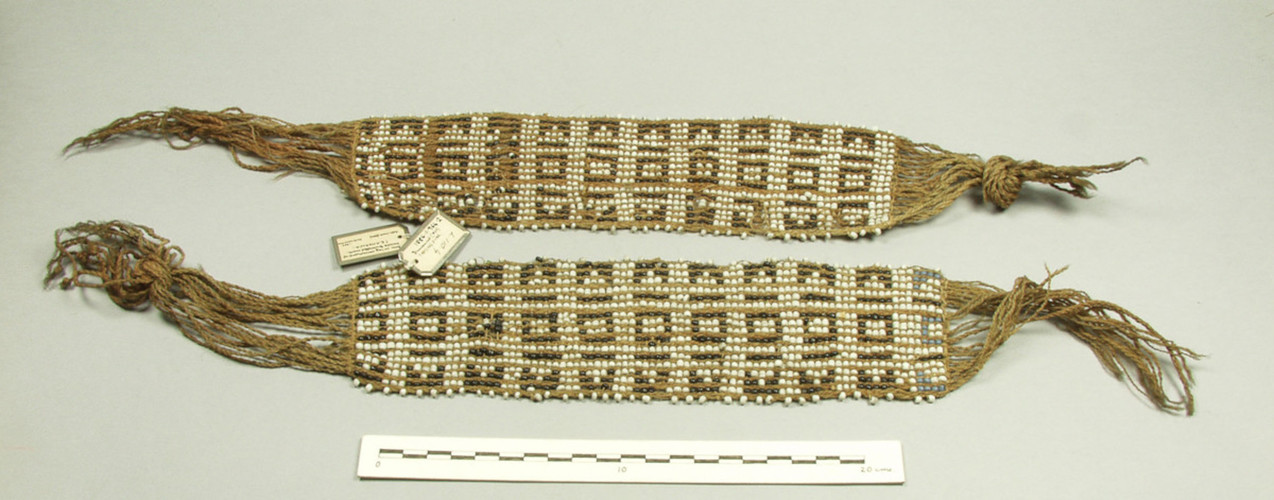 1886.1.964.1A pair of leg bands [.1 & .2] of wool interwoven with glass beads, in square shaped patterns [SM 15/09/2008]1886.1.964.1
 1886.1.806?boot or gaiter1886.1.806
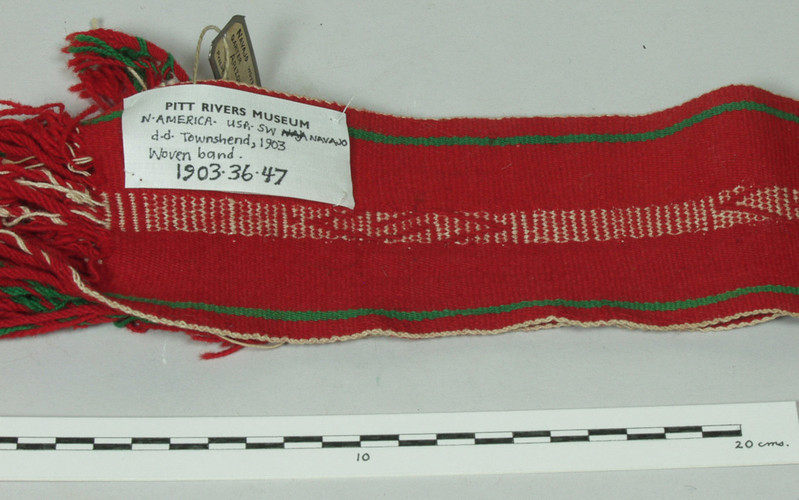 1903.36.47Red and white woven band.1903.36.47
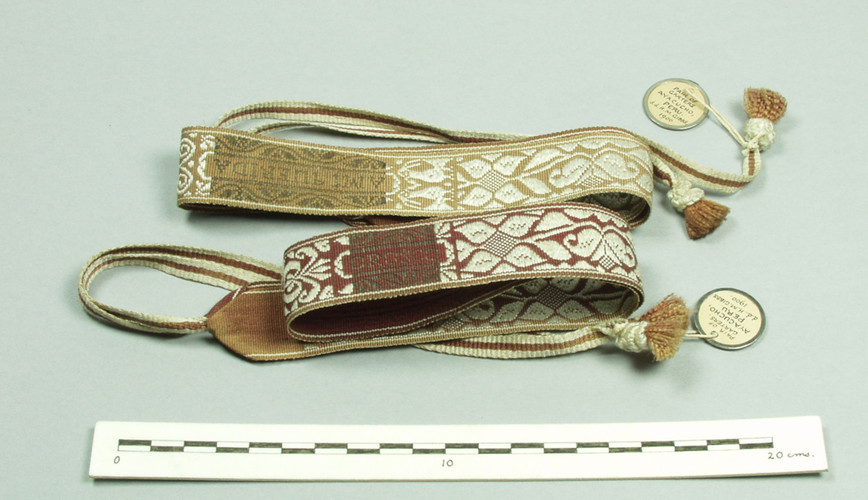 1900.30.64.1Pair of ornamental woven garters. One [.1] with the words 'AMI QUERIDA MADRE', the other [.2] with 'BENTURA OROSCO'. [El.B 'DCF 2004-2006 What's Upstairs?' 12/9/2005]1900.30.64.1
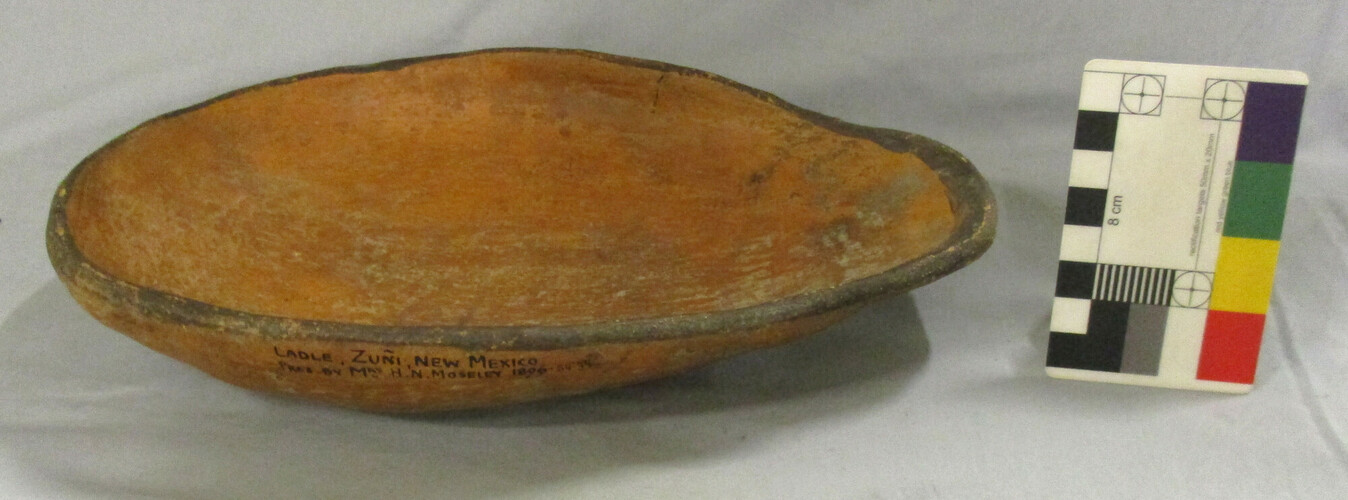 1896.54.34Ceramic ladle or vessel without a clearly defined spoon and handle. [MOBB [OPS move] 05/04/2016]1896.54.34
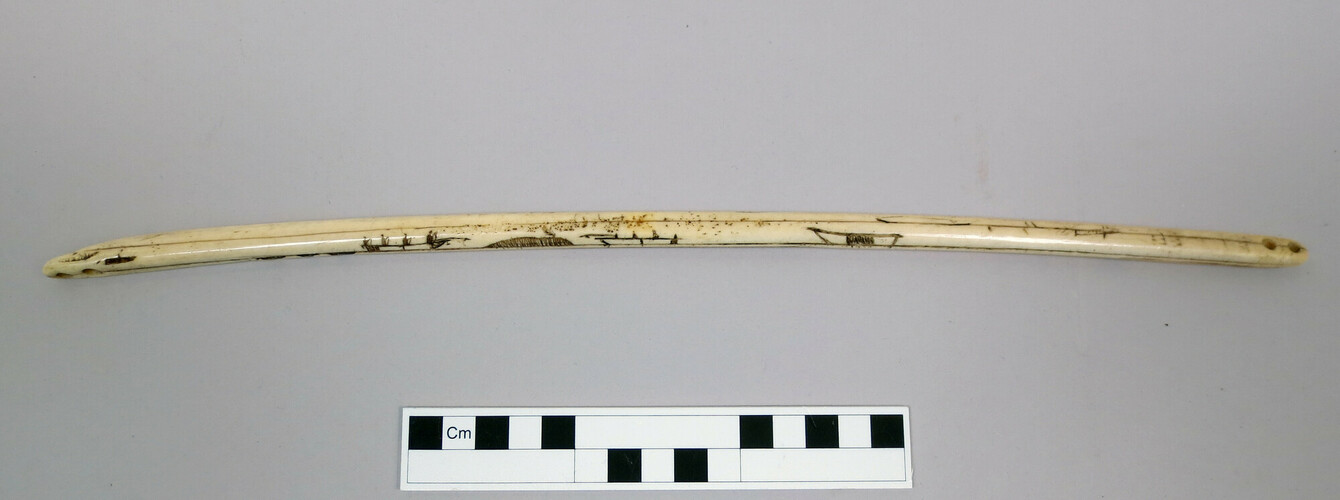 1886.1.696Bow drill with perforations at each end, and little carving.1886.1.696
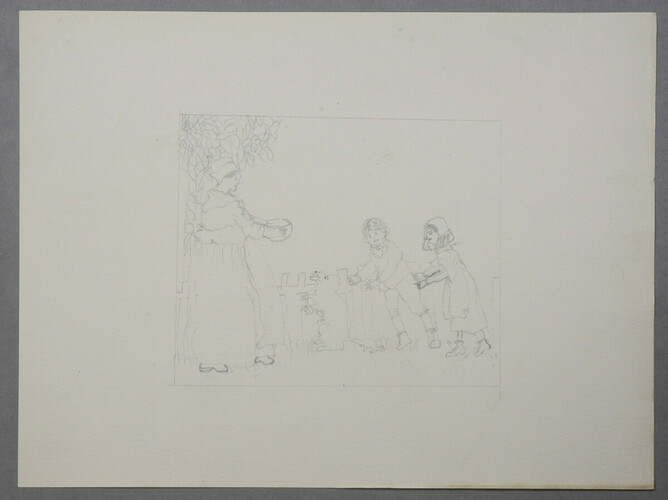 1994.15.2542Pencil drawing of a woman holding a bowl, a dog, a boy and a girl. [El.B 27/05/2008]1994.15.2542
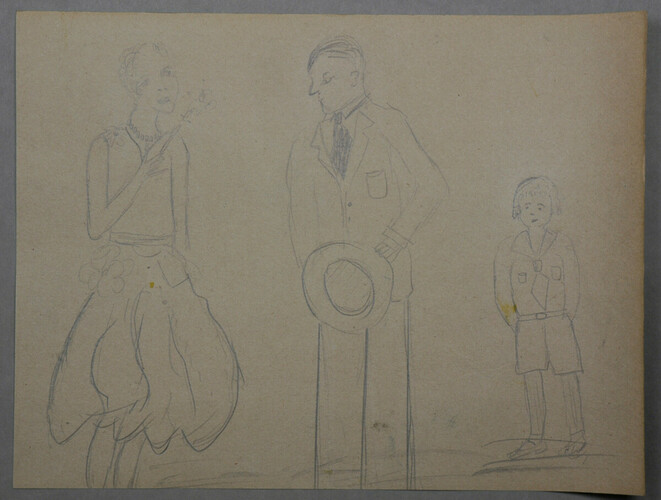 1994.15.2591Pencil drawing of a woman, a man and a boy. [El.B 23/05/2008]1994.15.2591