
- Collection type
- Object
- Description
- Shark-tooth sword. [AB [OPS Move] 24/5/2017]
- Long description
- Shark-tooth sword. Made from wood, it is straight and flat, the tip is pointed. Each edge of the blade has sharks' teeth set into grooves and bound with string. The handle and blade are covered with woven plant fibre and bound with string. [AB [OPS Move] 24/5/2017]
- Geographical reference
- Date / Period
- Date made: Before 1990
- Date collected
- By 1990
- Acquisition information
- Transferred: 03/05/1990
- Materials and processes
- Material Wood Plant, Material Shark Tooth Fish, Material Sennit Coconut Seed Fibre Plant, Material Palm Leaf Plant, Process Bound, Process Perforated, Process Grooved, Process Carved, Process Tied
- Dimensions
- Width: max 56 mm, Depth: max 24 mm, Length: max 660 mm
- Object numbers
- Accession number: 1990.23.22
- Research and responses
Carved from coconut wood, grooved to accommodate the teeth of the Tiger Shark (Galeocerdo cuvier) and/or the Grey Nurse Shark (Carcharias taurus). These teeth are drilled through and lashed onto the blade with the pinnules (side-ribs) of the coconut leaf, and occasionally female human hair. The aim for the use of all I-Kiribati weapons was to open the enemy’s abdomen, or the major artery inside the elbow. Warriors took magical precautions before battle to deflect their enemy’s weapons. Immediately before the battle, the warrior would strip a single pinnule of a coconut leaf and join the ends into a necklace to wear. As he joined the ends, he chanted: “The weapon is descending, it has nearly descended! But I shall deflect it downwards or upwards. The weapon is descending, but it is afraid, it is a coward. Uh! All is well!”. Relevant Reading: Murdoch, G.M. (1923) Gilbert Islands Weapons & Armour. In: Journal of the Polynesian Society, Vol.32, pp.174-5. Gudger, E.W. (1930) Helmets from Skins of Porcupine Fish. In: Illustrated Science Monthly, Vol.30, pp.432-442. Guiart, J. (1963) The Arts of the South Pacific. London: Thames & Hudson. Grimble, A. (1972) Migrations, Myth & Magic from the Gilbert Islands. London: Routledge & Kegan Paul. Koch, G. (1986) The Material Culture of Kiribati. Suva: University of the South Pacific. Grimble, A.F. (1989) Tungaru Traditions: Writings on the Atoll Culture of the Gilbert Islands. Honolulu: University of Hawaii Press. Research Conducted for DCF Cutting Edge 2006/2007 [AM]
Further items to explore
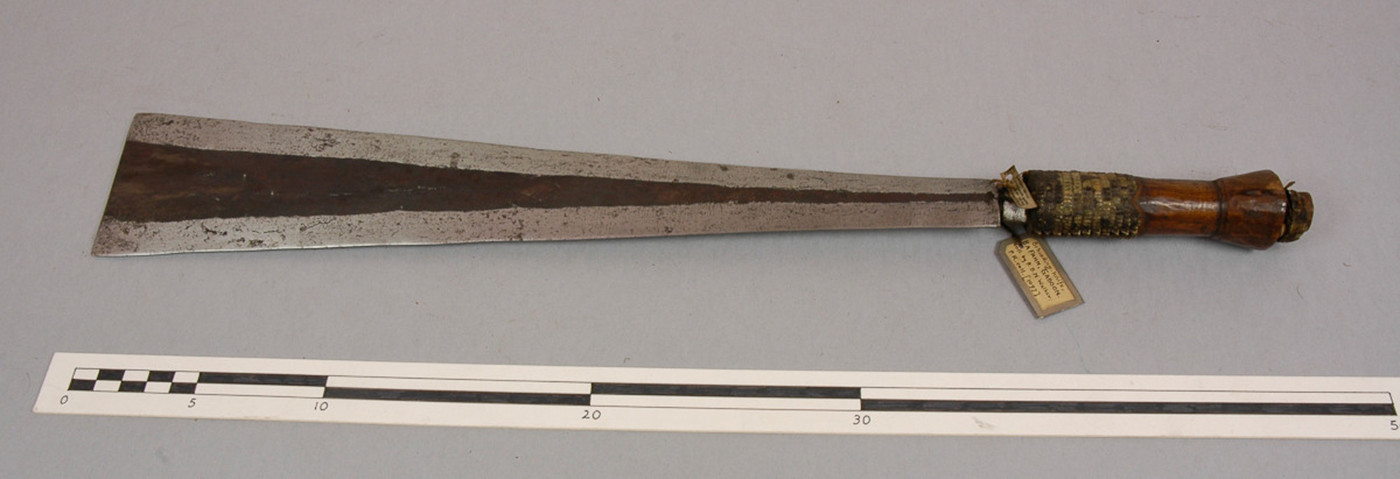 1884.24.20Sword with two-edged, straight-ended blade tapering towards the wooden grip which is bound with reptile skin. The central area of the blade is blackened. [LM 03/07/2007]1884.24.20
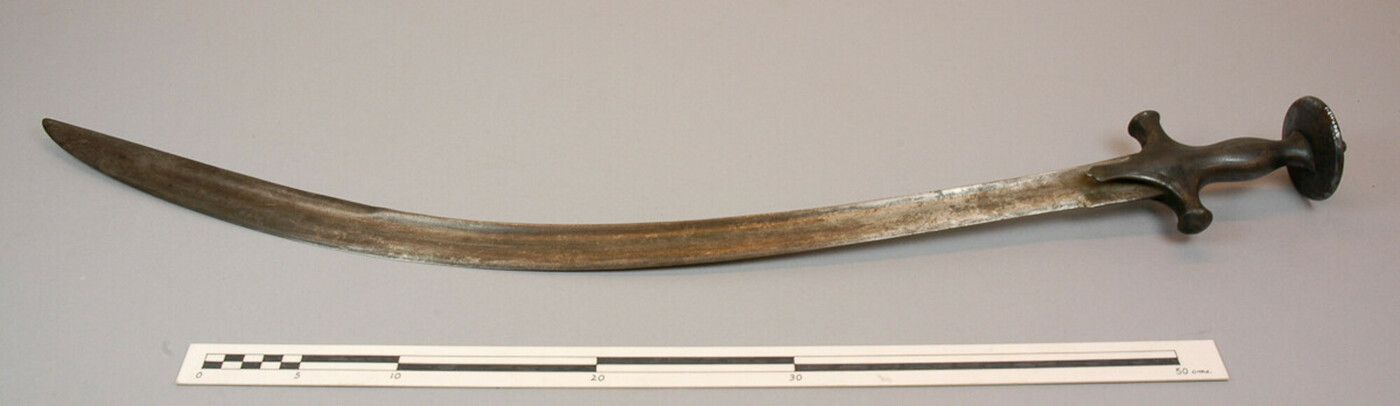 2007.113.1Sword with curved blade and disc pommel. [El.B 30/11/2007]2007.113.1
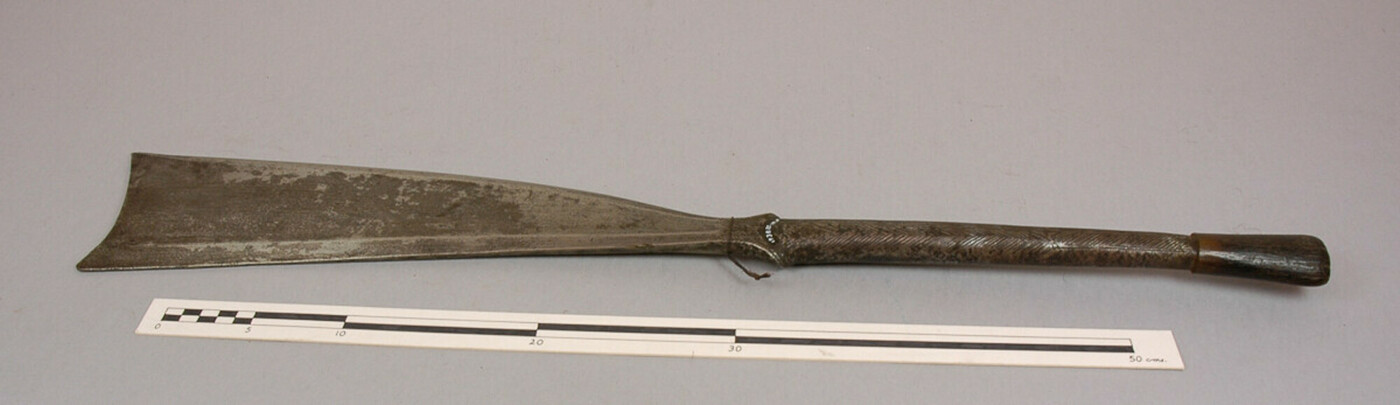 1938.35.1429Dao with long blade widening towards the tip, with handle of the same piece of metal beaten over a wooden core which protrudes at the end. The handle is incised with chevrons.1938.35.1429
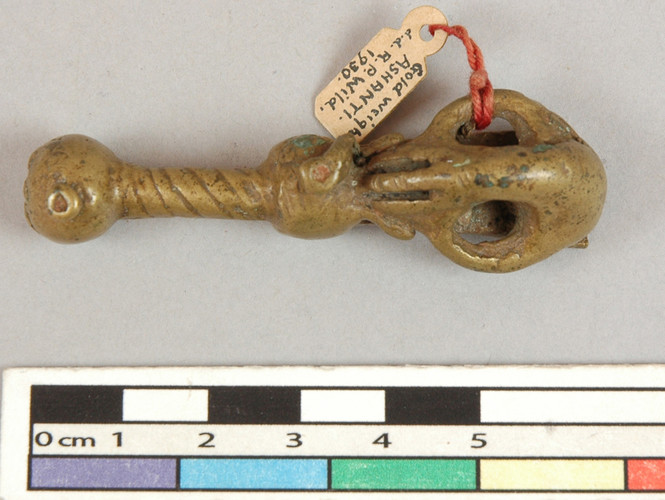 1930.44.502Copper alloy weight for weighing gold representing a sword. [MJD 21/06/2011]1930.44.502
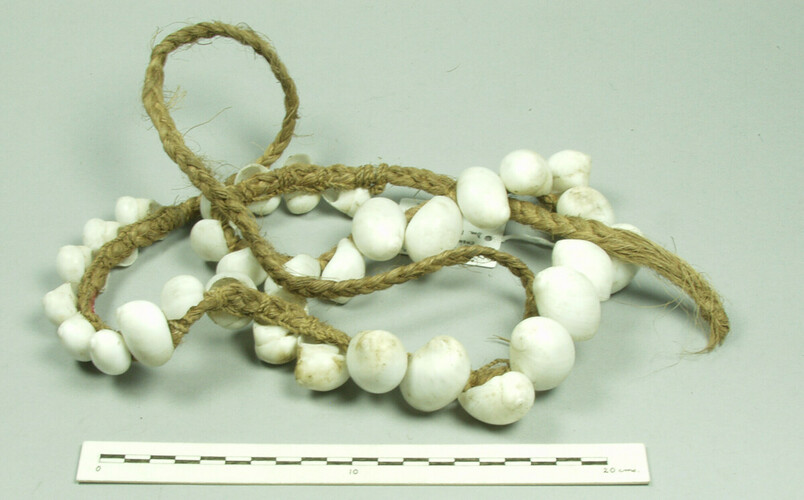 2004.56.20.2Part of a complete woman's dance costume: Length of plaited coconut fibre to which is attached with coconut fibre string 32 white shells of the same type, the larger specimens being secured to the centre of the belt and the smaller ones to the ends. [JP 19/6/2004]2004.56.20.2
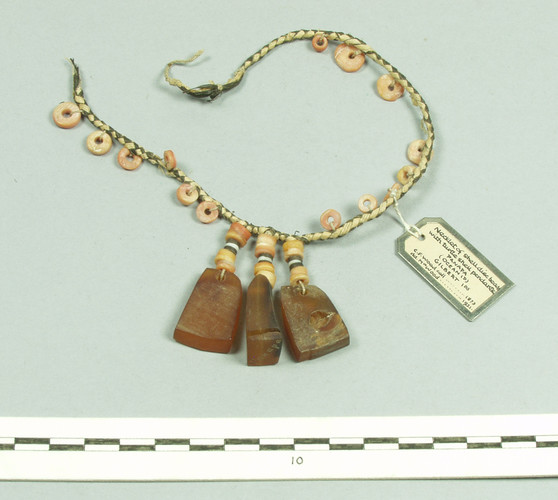 1921.93.372Necklet of plaited plant fibre string with disc-beads of red shell and three pendants of turtleshell. [El.B 'DCF 2004-2006 What's Upstairs?' 3/6/2005]1921.93.372
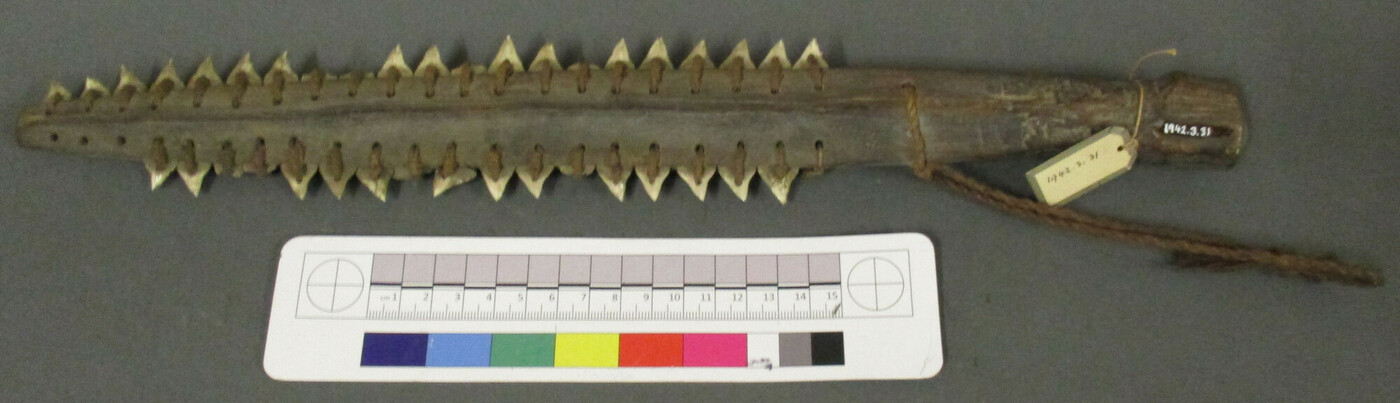 1942.3.31Dagger. The blade has a pointed tip, it has sharks' teeth along each edge. [AB [OPS Move] 24/5/2017]1942.3.31
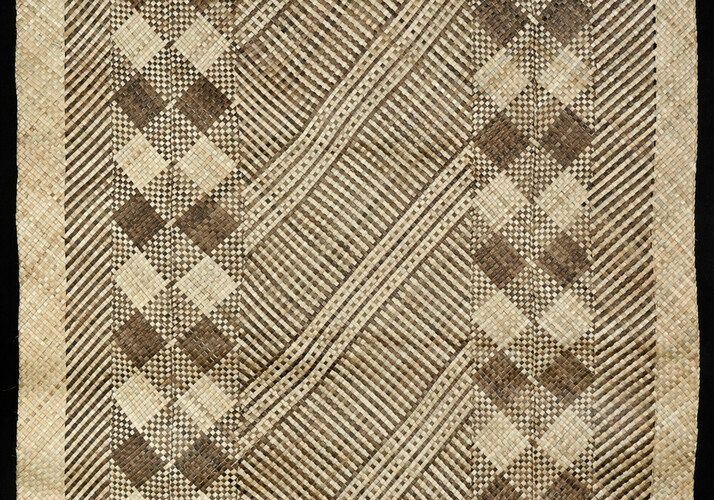 2004.56.22Mat woven from dark and light strips of ?pandanus leaf. On one side the pattern features two longitudinal bands of diamonds connected by diagonal lines on a chequered ground. The other side shows only the ground of small chequer. [BS [OPS Move] 29/6/2017]2004.56.22