
- Collection type
- Object
- Description
- Finger-woven belt.
- Long description
- Belt, finger-woven of red, blue and green wool, with in woven chevron and zigzag pattern in white beads, partially beaded fringes.
- Geographical reference
- Cultural groups
- Ojibwe
- Date / Period
- Date made: Circa by 1909
- Date collected
- 1909
- Acquisition information
- Donated: 1954
- Materials and processes
- Material Wool Textile Animal, Material Bead, Material Linen Flax Bast Fibre Textile Plant, Process Finger Woven, Process Plaited
- Dimensions
- Width: max 140 mm
- Object numbers
- Accession number: 1954.9.15 Other numbers: Beasley no. K. 16.10.1933
- Research and responses
Ascription to Chippewa by Dr. H.B. Burnham, Royal Ontario Museum, Toronto, October 1965. Confirmed by Sherry & Calvin Racette, 1989.
Examined by the GRASAC research team on 12 December 2007 as part of a research project to create a digital database. This will incorporate information about collections of indigenous material culture from the Great Lakes region of North America that are housed in a number of museums on several continents; see https://icslac.carleton.ca/grasac/. The group identified the materials as green, blue, red and yellow woollen yarn, pony beads and linen thread. For construction beads on linen thread have been twined around yarn element, ending in loop with some fringed ending in beaded loops. The border pattern is asymmetrical along the length, on one edge is a large zigzag, one other two smaller ones. An unusual feature is a line of yellow yarn that looks like it is embroidered to edge some of the zigzag lines. Dated as 1750 to 1810 based on stylistic comparison with other known sashes and the materials used, plus selection of colours of yarn. The North American Nation of origin Anishinaabeg/ Hodenosaunee because from the Central Great Lakes. [see researchers file GRASAC]. [ZM 07/02/2008]
Final GRASAC entry on this object reads: Materials: Made with blue-grey, green and red woolen yarn, and decorated with inwoven size 8 white seed beads.
Format/Techniques: Heddle-woven, with inwoven design of bands and zigzags in white beads.
Motifs and Images: There are zigzags down the centre, with parallel diagonal lines down 2 edges.
Symbolism and Interpretation:
Condition: Good.
Other Notes: Although different construction, the dye lots of red and green yarn of 1954.9.15 and these garters are extraordinarily similar which suggests that yarn came from the same source, and/or that the garters/sash were intended to be a set. (GRASAC research team notes) It would be interesting to find out if other heddle woven garters or sashes exist. Ask David Penney. [added by Laura Peers, 08/10/2008]
This object was studied by Carol James, sash weaver, on October 2013. She noted that this textile was fingerwoven interlacing. It was not heddle woven. The cloth is made from one set of threads that twist around each other. There are some ribs running along the belt - signs of tight weave. This belt is quite short. Carol suggested the theory that older belts tend to have short woven sections, enough to fit once round the body, with long fringes. Later belts were longer to provide abdominal and back support for European fur traders. The zigzag lines of beads at the edges are bordered with twined yarn. It looks as if this was included in the weaving process. The beads are strung on linen which is stronger than woollen yarn. Linen is fine and so allows for smaller beads that do not disrupt the surface of the weaving. [MJD 17/10/2013]
Search terms: Clothing, Ornament, Belt, Waist Ornament, Waist Cloth
Further items to explore
 1928.69.1321.2Ornamental baldric with side and end fringes1928.69.1321.2
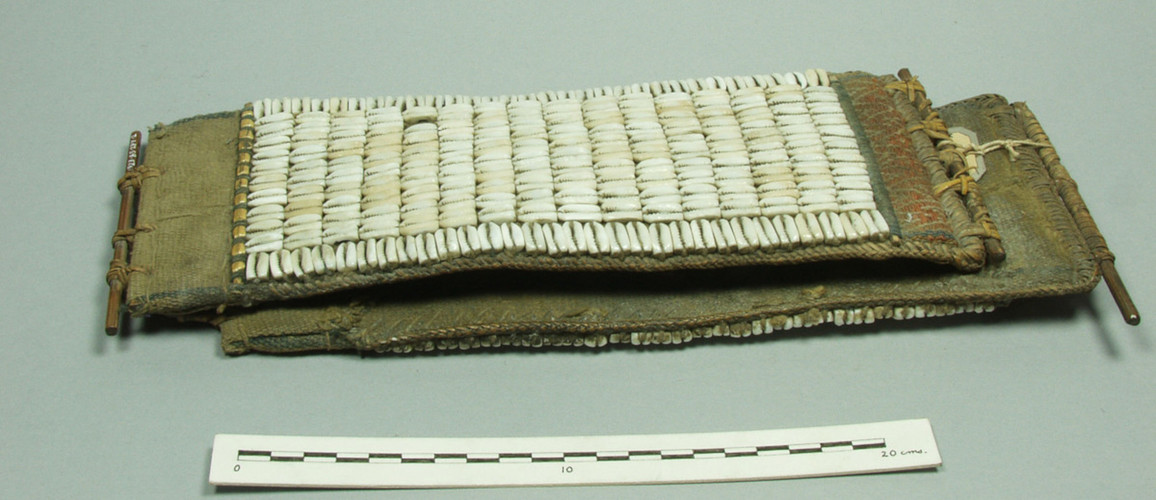 1923.85.284.1Belt in two parts [.1,.2] of thick textile covered with cowrie shells, fastenings of wood and cane. [El.B 'DCF 2004-2006 What's Upstairs?' 25/4/2005]1923.85.284.1
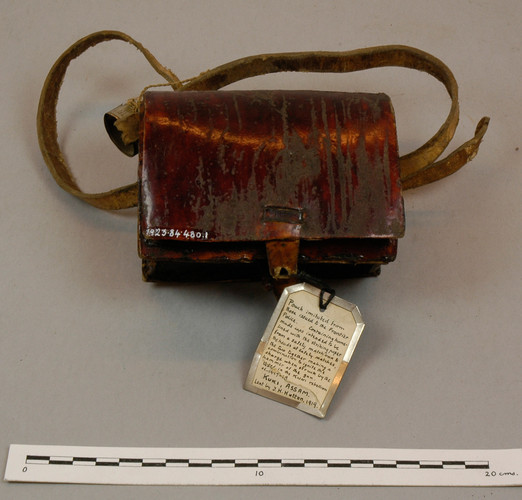 1923.84.480.1Bag of ?animal hide with hide carrying strap and perforated hide strip that attaches to a wooden spike to close the bag [SM 08/10/2007]1923.84.480.1
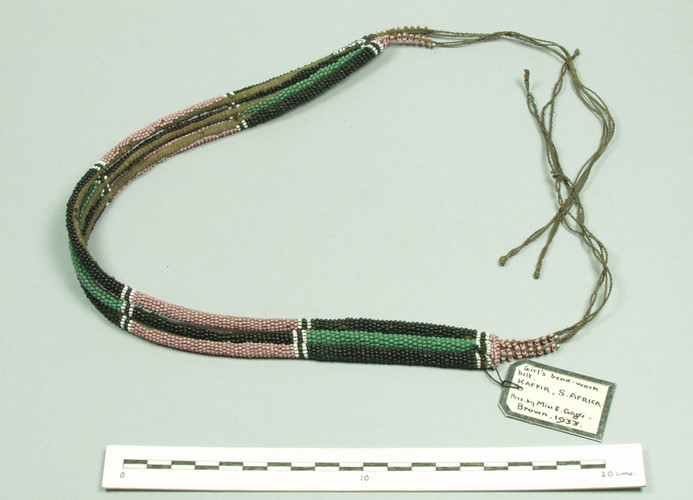 1933.40.33Beadwork belt, triple strand of beads wound on textile cores [L.Ph 'DCF 2004-2006 What's Upstairs?' 12/7/2005]1933.40.33
 1994.15.661Drawing by child in pencil of five figures. [MJD 26/01/2015]1994.15.661
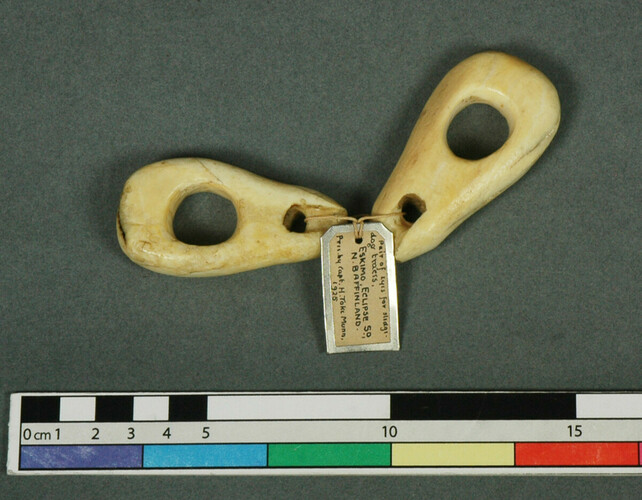 1925.11.47.1One of two ivory toggles for dog-sledge trace, teardrop shaped with two perforations. For the other toggle see [1925.11.47 .2]. [CW [OPS move] 1/8/2017]1925.11.47.1
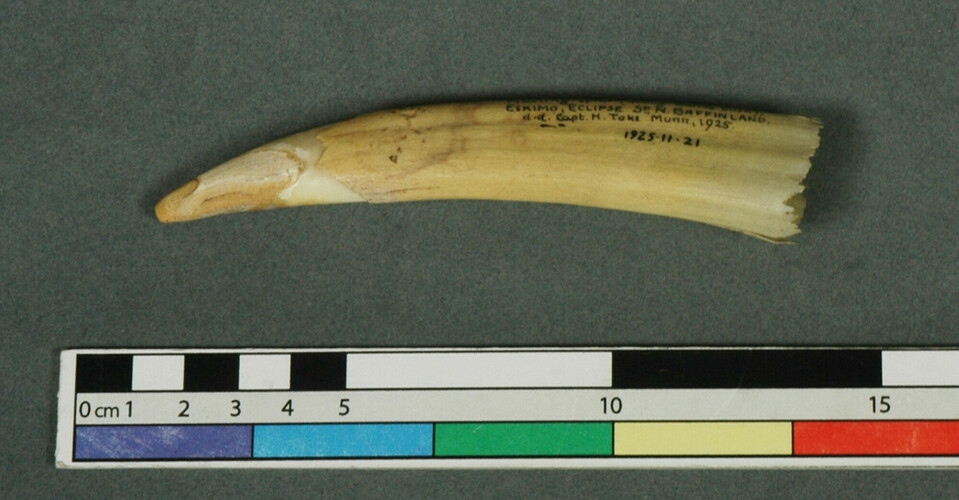 1925.11.21Tusk of a young walrus, probably used as a marlinspike. [El.B 02/03/2012]1925.11.21
 1994.15.709Drawing by child of three figures.1994.15.709