
- Collection type
- Object
- Description
- Club, with stone head hafted to wooden handle by iron pin, decorated with strings of coloured beads. [SM 08/08/2007]
- Long description
- Club, with stone head hafted to wooden handle by iron pin, decorated with strings of coloured beads. The handle is bound with a band of yellow, red, blue and black beads along most of its length, except at the base which is covered with canvas textile. The head is decoratively carved and tapers at both ends. Two tassels of ?copper alloy springs and larger blue beads with black hair tied to the end of them are attached to the iron pin at the head. [SM 08/08/2007]
- Geographical reference
- Alberta near Calgary Blood Indian Reserve
- Date / Period
- Date made: Before 1895
- Date collected
- 1895
- Acquisition information
- Donated: 1952
- Materials and processes
- Material Stone, Material Wood Plant, Material Bead, Material Wood Plant, Material Canvas Textile, Material Glass, Material Copper Alloy Metal, Process Carved, Process Beadwork, Process Woven, Process Bound, Process Stitched, Process Decorated
- Dimensions
- Width: max 131 mm, Length: max 704 mm
- Object numbers
- Accession number: 1952.10.7
- Research and responses
The following notes are drawn from research compiled by Andy Mills as part of the DCF Cutting Edge project in 2006-2007.
Clubs of this type are typical of the Central Plains, and were not only used by the various tribes of the Blackfoot Nation (such as the Peigan and Blood), but also by their enemy neighbours, the Assiniboine, Sioux, Plains Cree, Crow and Gros Ventre, although they were in general supplanted by the gunstock-form of club, which spread into the area up the Missouri river, and from the east, around the mid-19th century (Ewers, J.C. (1944) The Blackfoot War Lodge: Its Construction & Use. American Anthropologist, 46/2/1, pp. 182-92, p. 190; Taylor, C.F. (2001) Native American Weapons. London: Salamander Books, pp. 8-9, 23-4). Conventionally, these bi-conical pecked stone heads are grooved all around their widest point, and hafted with a split sapling or rawhide strap, which was wrapped around the head, and then lashed to itself. Particularly with rawhide examples, wetted beforehand, shrinkage ensured a particularly secure grip. Interestingly, the flexible nature of the haft worked to the weapon’s advantage, and gave the head a not insignificant boost of acceleration prior to the point of contact, provided the wielder swung his weapon correctly. In general terms, the Central Plains technique of club use was to endeavour to strike upwards with a two-handed stroke, and catch the opponent under the chin or in the throat. Prior to the importation of the horse to the Central Plains, around the mid-18th century, weapons such as this were used in hand-to-hand combat on foot, and then on horseback thereafter. By the mid-19th century, firearms were coming to take on greater prominence in warfare, and hand weapons became increasingly decorative as a result. Later examples, such as ours, were covered in elaborate decorative schemes employing European trade-beads in glass, and weavings of split and dyed porcupine quill (Taylor, 2001, pp. 14-16).
This particular example is of interest, in that the head bears the medial groove indicating the conventional hafting method, although it is presently attached to its haft by a socket drilled through the head, which is then attached to the shaft with an iron pin of European-American manufacture; this is probably a less secure method of hafting than the traditional wood or rawhide method, and may indicate a ceremonial use for this object, and the prestige value of iron. Ceremonial or not, the current method of hafting is clearly a re-haft from its earlier traditional method. The remarkably extensive use of beadwork on this piece also seem to indicate a ceremonial or ‘parade’ function for the piece, while the quality and extent of workmanship would seem to belie manufacture for tourists. [El.B 27/02/2008]
Search terms: Weapon, Bead, Ritual and Ceremonial, Club
Further items to explore
 1921.93.140Carved wooden club, slightly thickened between two discoidal stops. [BS [OPS Move] 06/09/2016]1921.93.140
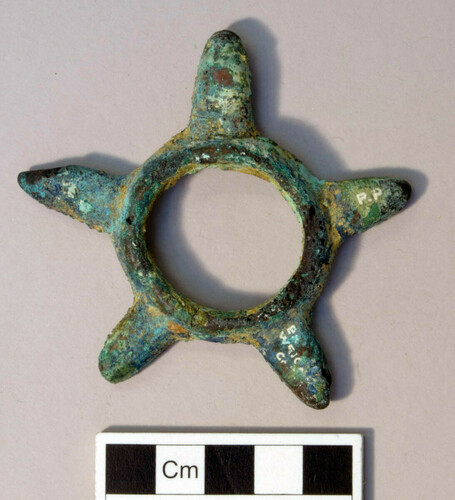 1884.119.441Copper alloy mace head.1884.119.441
 1978.20.443Long slightly curved wooden, barked, practice fighting stick. [RH [OPS move] 22/8/2017]1978.20.443
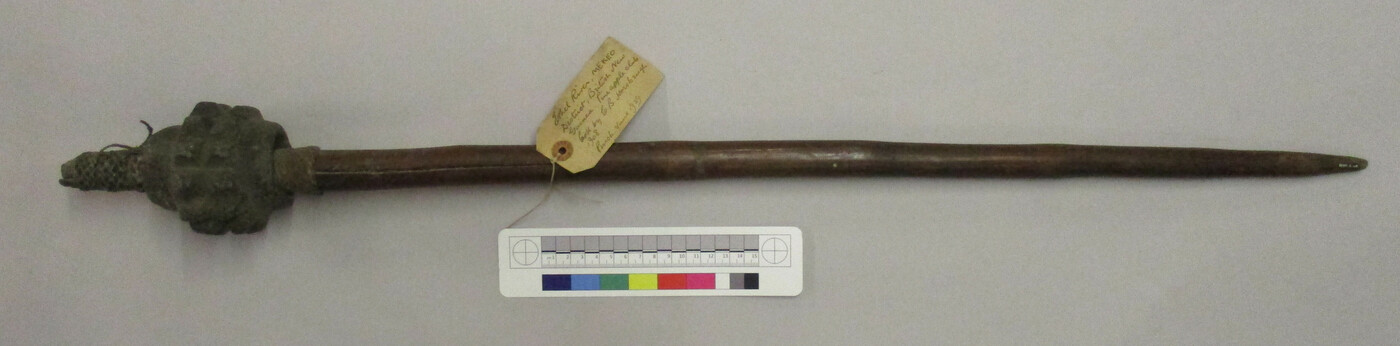 1939.6.4BLong-handled wood club with perforated, 'pineapple' stone head. [JC [OPS Move] 02/08/2016]1939.6.4B
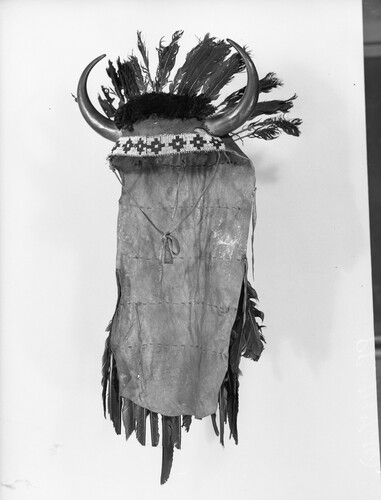 1886.21.7War-bonnet of leather with pair of bison horns, and numerous long black feathers. Cap of red woollen cloth, forehead band of red and white beadwork.1886.21.7
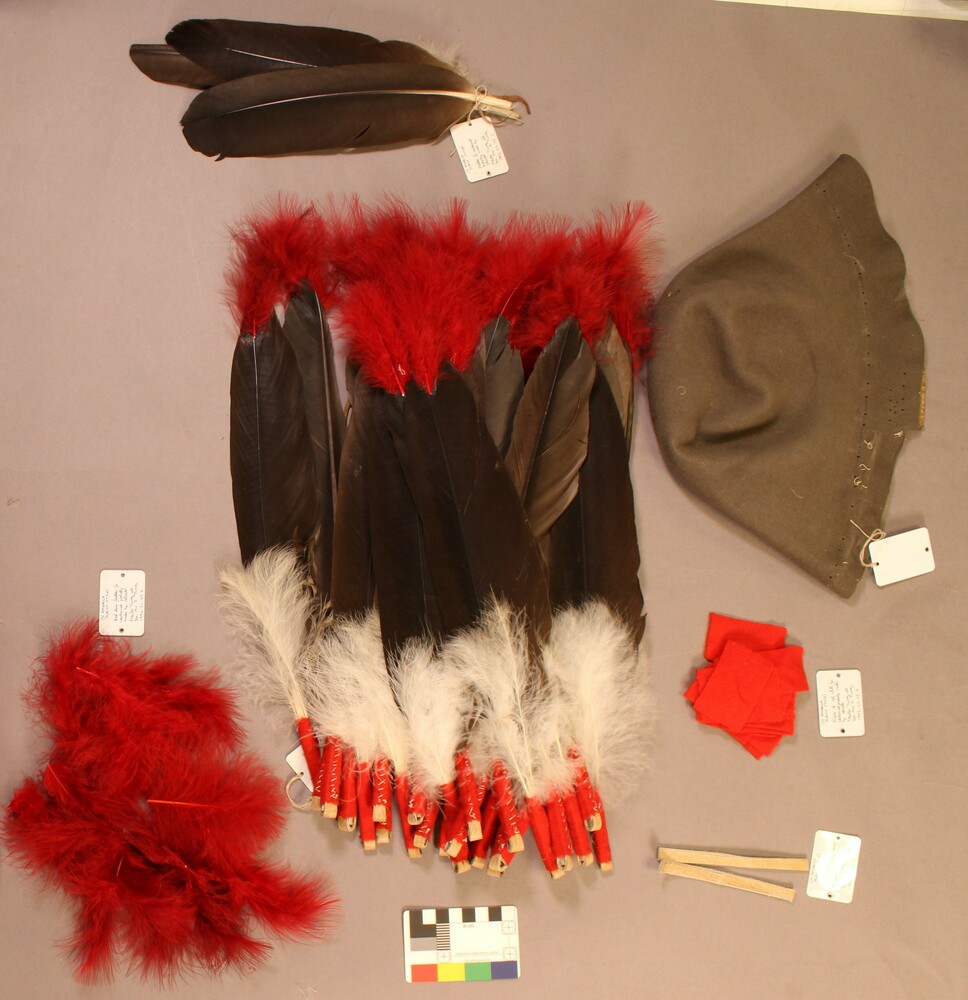 1992.22.25.1Warbonnet [incomplete]1992.22.25.1
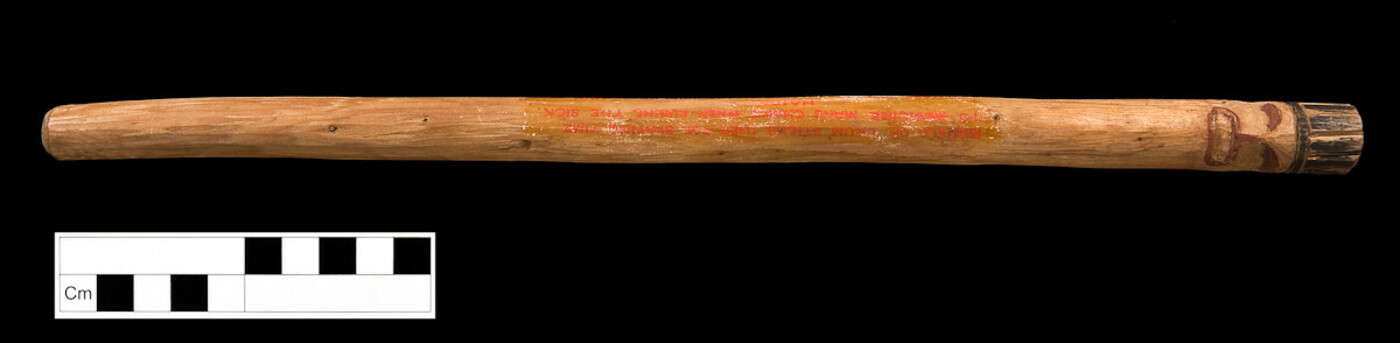 1891.49.27Model wooden stick carved and painted on one end with a human face and headdress. [CAK 19/05/2009]1891.49.27
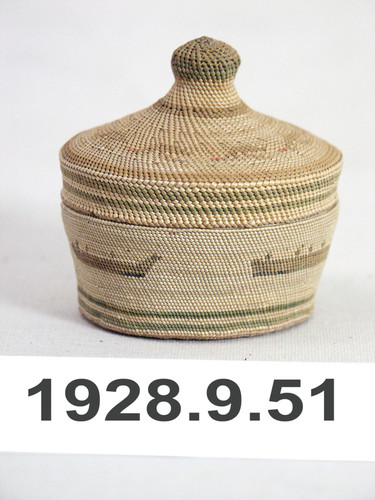 1928.9.51.1Very small circular basket [.1] with knobbed lid [.2], of exceedingly fine technique, (spiral) with designs of dug-out boats and birds in black' (?dark blue LM) and horizontal bands in green.1928.9.51.1