
- Collection type
- Object
- Description
- Woman's pleated embroidered skirt. [FB 12/09/2012]
- Long description
- Woman's pleated embroidered skirt. The skirt is made from three tiers of cotton textile. The waistband of the skirt is a 70 mm wide band of indigo dyed cotton with ties hand stitched to either end of the waistband to fasten the skirt around the waist. The ties are two different woven cotton braids, one in purple and black and the other in blue and white. The central tier of the skirt is pleated cotton dyed shiny green using gentian violet on indigo dyed cotton. The bottom tier of the skirt is made from indigo dyed cotton embroidered with lengths of striped silk ribbon with red, purple, white and blue stripes, the hem with squares of black silk embroidered with white silk polka dots alternating with squares embroidered with a geometric design in bright red, green, blue, orange and white silk yarn in satin stitch. There is a band of satin stitch silk embroidery consisting of geometric patterns along the width of the skirt on the bottom tier. [FB 12/09/2012]
- Geographical reference
- South East Guizhou Province Huangping [Guiyang]
- Cultural groups
- Hmong
- Date / Period
- Date made: Before 10/1997
- Date collected
- October 1997
- Acquisition information
- Donated: 2006
- Materials and processes
- Material Cotton Seed Fibre Textile Plant, Material Cotton Seed Fibre Yarn Plant, Material Pigment, Material Silk Yarn Animal, Process Woven, Process Dyed, Process Embroidered, Process Stitched
- Dimensions
- Width: max 975 mm excluding ties, approx, Length: max 680 mm
- Object numbers
- Accession number: 2009.135.215 Other numbers: 19
- Research and responses
Taken from Miao Costumes from Guizhou Province South West China by Deryn O' Connor. Catalogue of an exhibition at James Hockney Gallery, WSCAD, Farnham, p.49 - 52 "Special dye effects: Indigo as usual is the main dye but particular to this area are two very unusual methods of colouring cloth, one giving a red, the other a shiny green or brown shade, and both using dyes in a very unorthodox way... The story of the second colour is very intriguing. It is found on cotton and silk, and both handwoven and commercially woven cloth in the area of Huangping. It appears as a shiny bronzy green, sometimes very yellow, sometimes more brown, but after handling cloth of this colour one's fingers are tinged with purple. The colour is produced by beating into the cloth, with a wooden mallet. Some green crystals the women buy in the markets. These are crushed and mixed with a little water - if there is too much water the cloth is dyed purple. It seems most likely that this is one of the many Rosaniline purple dyes, the so-called triphenyl methane dyes, invented in the latter part of the nineteenth century and prepared from aniline. This group contains dyes which were marketed under such names as Hofmann's violet, Crystal violet, Methyl violet, Spiller's purple etc. Synthetic dyes were available in China from the 1870w but it may be that these green crystals were introduced to this area for another purpose. Crystal violet, Methyl violet and Methyl rosaniline were used to make Gentian violet, an antiseptic and bacteriocidal agent, often painted on the skin in the recent past in the west, and seen on a child's face in Guizhou in 1993. Practical experiments using both the crystals used in Kali market in Guizhou and green crystals of Gentian violet, obtained from a chemist in Surrey, gave an identical green colour when applied to the cloth as a paste and then beaten. It is tempting to speculate that the green crystals were fist introduced to the Miao by the English missionaries of the China Inland Mission who established a base near Huangping at Panghai in 1895..." [FB 18/10/2012]
- Associated publications
- Miao Costumes from Guizhou Province South West China by Deryn O' Connor. Catalogue of an exhibition at James Hockney Gallery, WSCAD, Farnham. [FB 08/05/2012]
Further items to explore
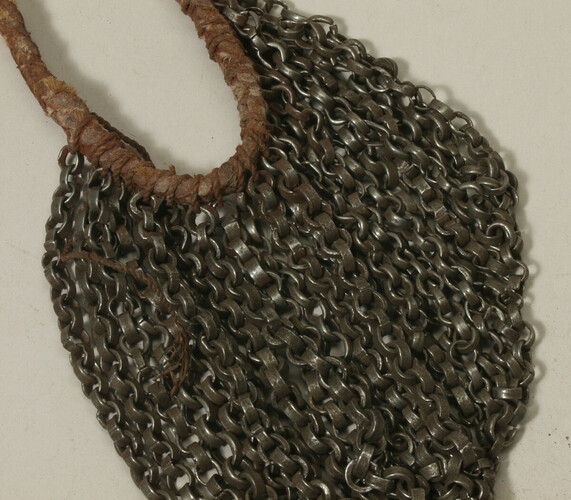 1940.12.599Plaited goat skin belt with iron chain apron at front and projecting 'tail' at back, worn by unmarried women or women who have not yet borne two children [RTS 10/6/2004].1940.12.599
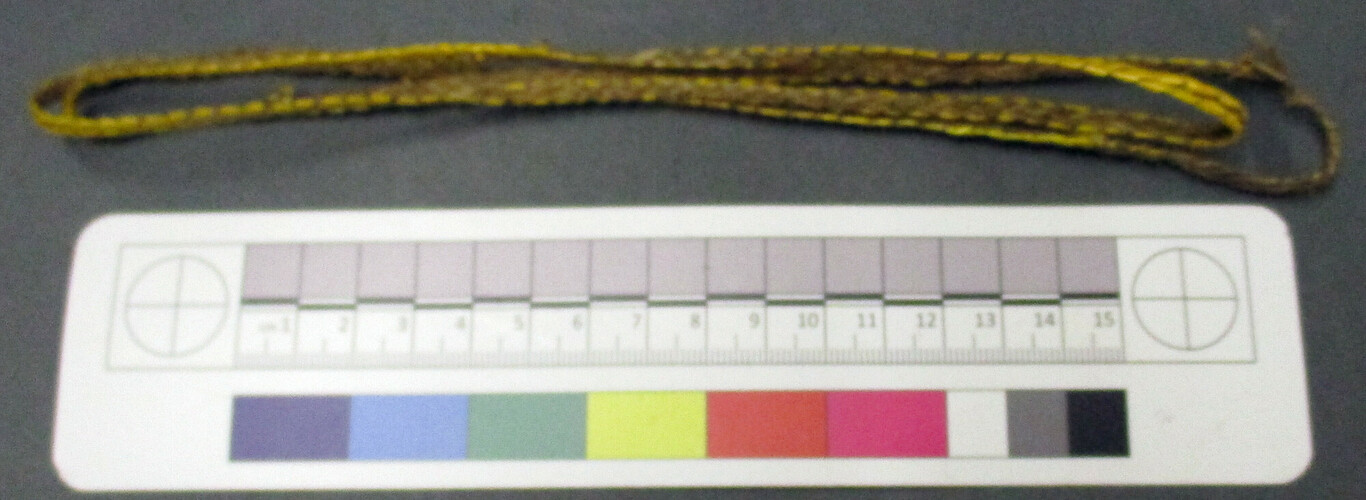 1938.36.722Baldric of plaited pandanus leaf with decoration of yellow strands of orchid stem. [BS [OPS move] 11/11/2016]1938.36.722
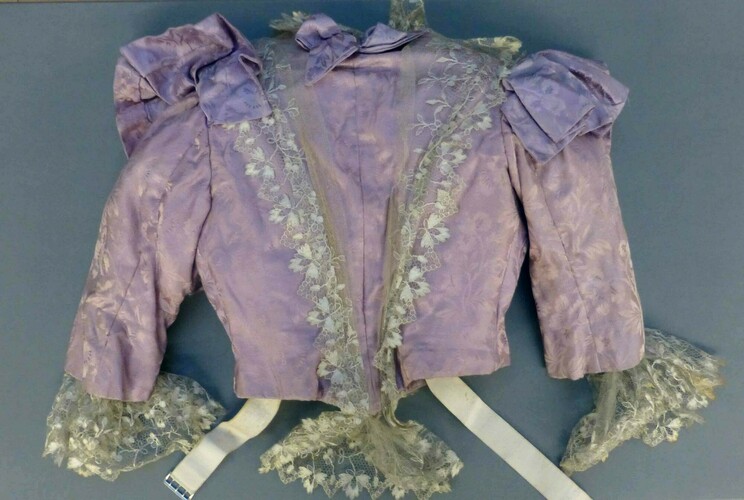 1949.9.85Lavender silk brocade bodice, trimmed with silk blonde lace, for day wear with 1949.9.84. Boned and lined. [FB 16/02/2015]1949.9.85
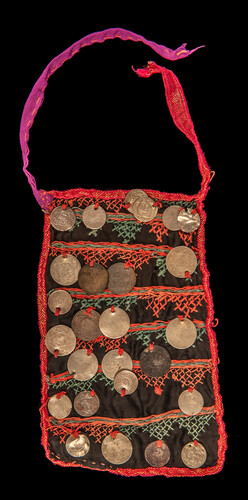 2018.37.50.1Black cotton face veil, trimmed with pink and gold ribbon, decorated with blue and pink cotton embroidery and silver coins. [AFS [OPS move] 18/12/2018]2018.37.50.1
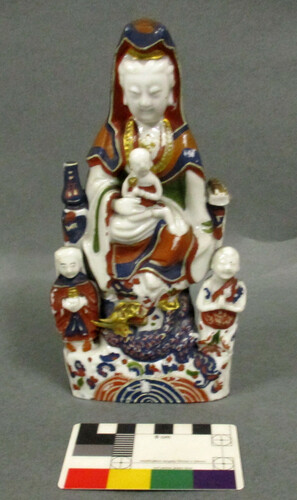 1884.58.29Porcelain figure of a female (Kwan Yin Pusa). She is seated on a throne with a babe on her lap. There are two attendants at her feet with a dragon in between them. Decorated with blue and red paint. [BH [OPS Move] 15/6/2017]1884.58.29
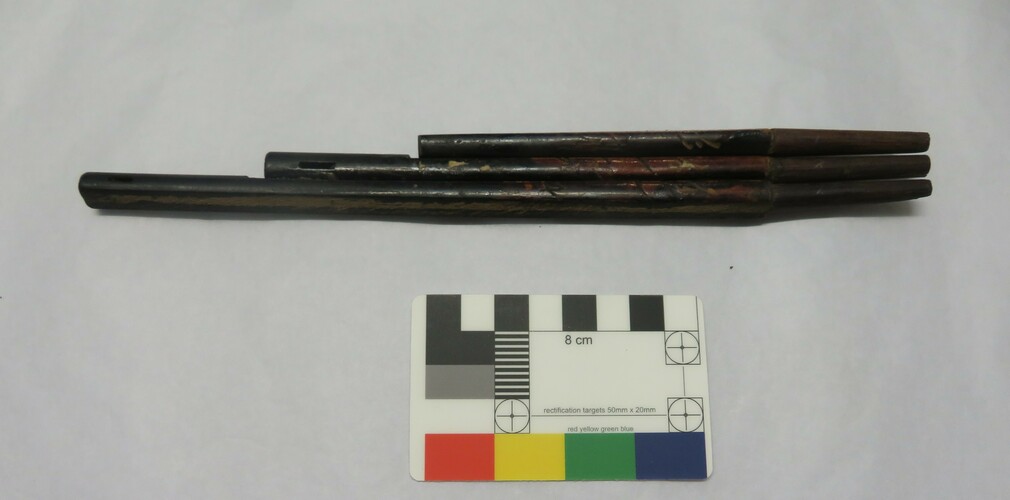 1938.34.107.5Three pipes stuck together that are a part of a mouth-organ.1938.34.107.5
 1988.1.12Tubular bone bead. [El.B 'DCF 2004-2006 What's Upstairs?' 5/7/2005]1988.1.12
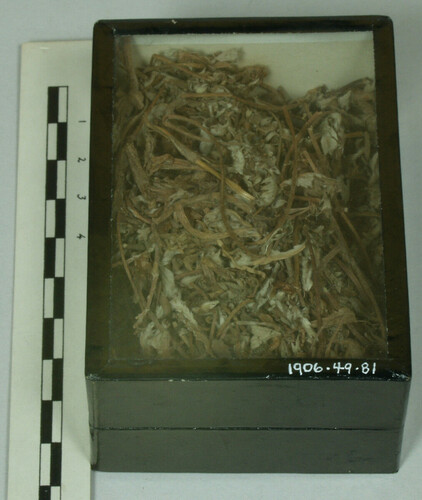 1906.49.81Chinese medicine specimen consisting of plant matter.1906.49.81