
- Collection type
- Object
- Description
- Blue glaze faience shabti figure with slightly curved torso and legs. Mummiform shabti with hands crossed at chest holding a pick and a hoe, as well as possible bag over left shoulder (no longer fully visible). [AS 09/10/2012]
- Geographical reference
- Person
- Maker Unknown Maker
- Field collector Unknown Collector
- PRM source Augustus Henry Lane Fox Pitt Rivers founding collection
- Date / Period
- Archaeological period: Ancient Egyptian
- Date collected
- By 1874
- Acquisition information
- Donated: 1884
- Materials and processes
- Material Faience Pottery, Process Moulded, Process Glazed
- Dimensions
- Depth: max 19 mm, Width: max 22 mm, Length: max 84 mm
- Object numbers
- Accession number: 1884.57.12.11 Other numbers: 630 PR Cat other PR nos: 2730
- Research and responses
This object was examined by Alice Williams, a UCL MA student, who identified it as dating to between 26th Dynasty – Ptolemaic Period and described it [see longer description]. [AS 09/10/2012]
See entry on Shawabti in the "British Museum Dictionary of Ancient Egypt" by Ian Shaw and Paul Nicholson : "shabti (Egyptian ushabti, shawabti) Funerary figurine, useually mummiform in appearance, which developed during the Middle Kingdom out of the funerary statuettes and models provided in the tombs of the Old Kingdom.
The etymology of the word shabti is unknown, as is the variant shawabti, but by the Late Period (747-332BC) the term ushabti, meaning 'answerer', was in general use. The purpose of the statuettes was to spare their owner from menial corvée labour in the afterlife, which would be required for the deceasedto produce his or her food. The figures stood in for both the deceased (in whose name they would answer the call to work) and the servants of the deceased. Some shabtis are uninscribed but most are decorated with Chapter 6 of the Book of the Dead, which is therefore known as the 'shabti chapter'. Several forms of this text have been identified by Hans Schneider, but its basic purpose was to enable the shabtis to accomplish their tasks: 'O shabti, if [name of deceased] be summoned to do any work which has to be done in the realm of the dead - to make arable the fields, to irrigate the land or to convey sand from east to west; "Here am I", you shall say, "I shall do it".' Early New Kingdom shabtis were sometimes accompanied by model hoes and baskets and from the Third Intermediate Period (1069 - 747 BC) onwards some 'overseer figures' were provided with a whip, while later examples have such details moulded or carved as part of the statuette. New Kingdom shabtis were also occasionally shown in ordinary dress rather then in the guise of a mummy. Initially the deceased was provided with only one shabti, but by the New Kingdom the numbers had increased significantly so that there might be 365 figures, one for every day of the year, accompanied by thirty-six overseers, giving a total of 401, although as many as seven hundred are said to have been found in the tomb of Sety I (1294-1279 BC). The increasing number of shabtis led to the manufacture of special containers now known as shabti-boxes. The quality of shabtis and their material varies widely, although wood, clay, wax, stone, bronze, faience and even glass are known. Faience is the material most commonly associated with shabtis, particularly with regard to the fine examples of the 26th to 30th Dynasties (664-343 BC). The poorest quality shabtis were barely recognizable as such, and some - especially of the 17th Dynasty (1650-1550 BC) - were little more than wooden pegs. The use of shabtis died out during the Ptolemaic period (332-30 BC)." [MdeA 21/10/98]
Search terms: Religion, Death, Figure, Grave Good
Further items to explore
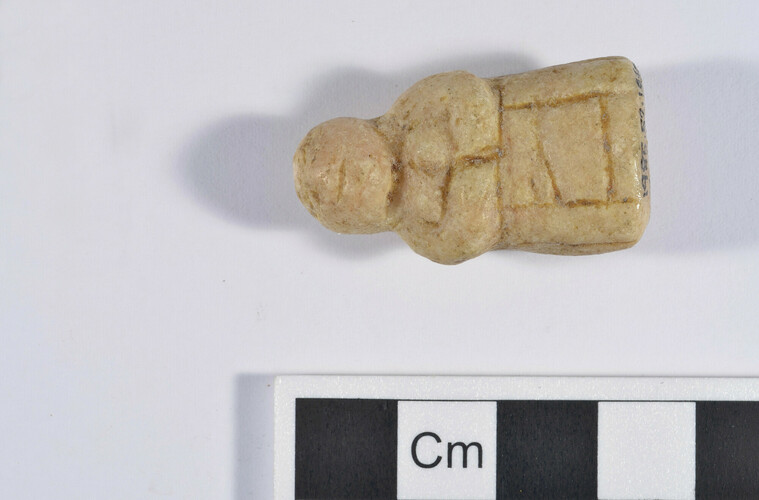 1985.52.1855Amulet, a figure, carved from stone, depicted with the hands in front of the body. [ACA 13/06/2012]1985.52.1855
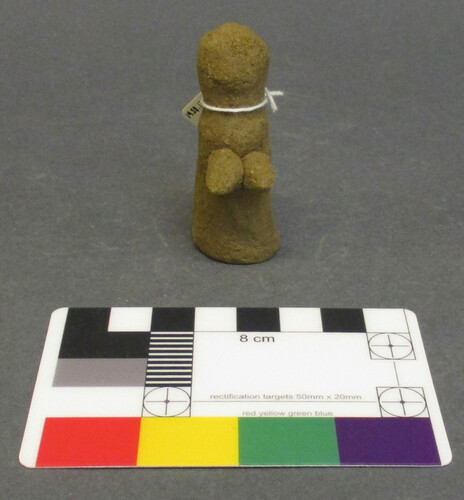 1958.11.2.139Mkaramo clay figure. Cylindrical figure, with a slightly narrower section, defining the difference between the head and body. The figure has no legs. With a flared circular base. There are two prominent, triangular projections representing breasts or arms. No facial details. [BH [OPS Move] 27/4/2017]1958.11.2.139
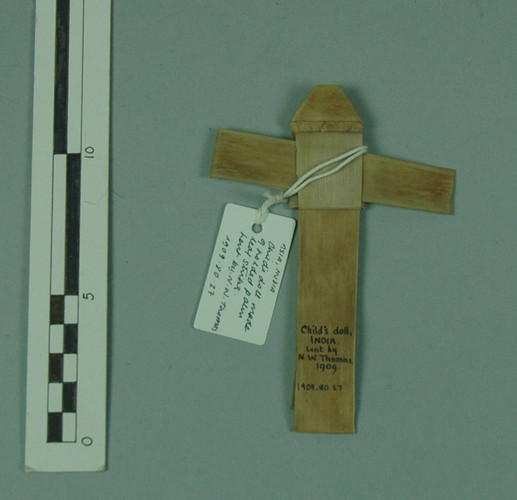 1909.80.27Doll of folded strips of palm leaf, roughly cross shaped with a pointed top.1909.80.27
 1985.52.1210.2Box for the amulet of a statuette of the Holy Family [1985.52.1210 .1]. Cast in lead and rectangular in shape. The detachable lid for this object is 1985.52.1210 .3. [ASh [OPS move] 24/1/2017]1985.52.1210.2
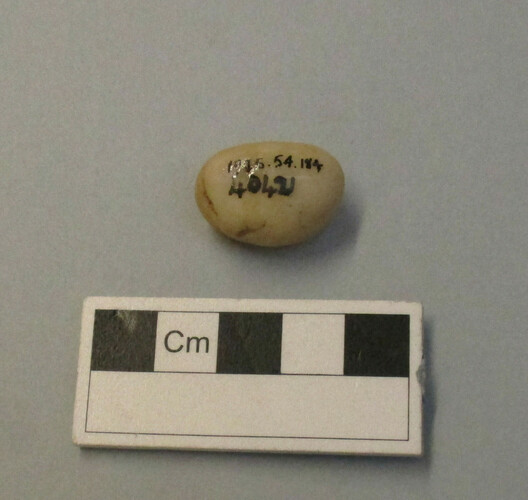 1985.54.184Amulet. Stone, white in colour and oval in shape. Brown veins in the stone. Polished surface. [ASh [OPS move] 1/3/2017]1985.54.184
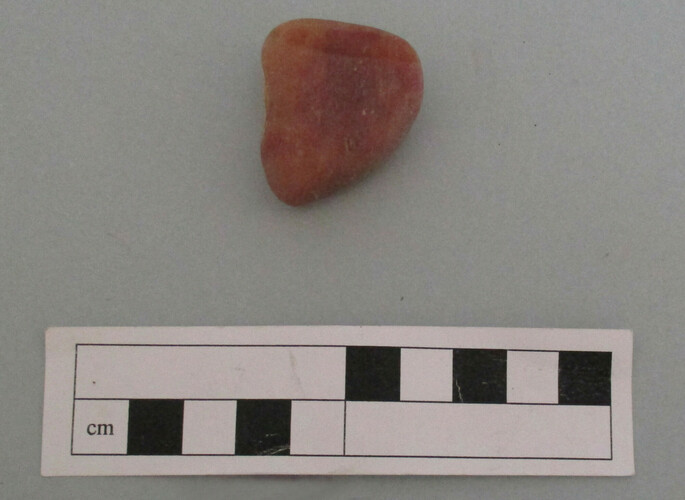 1985.54.1160Amulet. Stone, pink in colour and slightly transparent. Roughly triangular in shape with a smooth upper and lower surface. [ASh [OPS Move Project] 13/03/2017]1985.54.1160
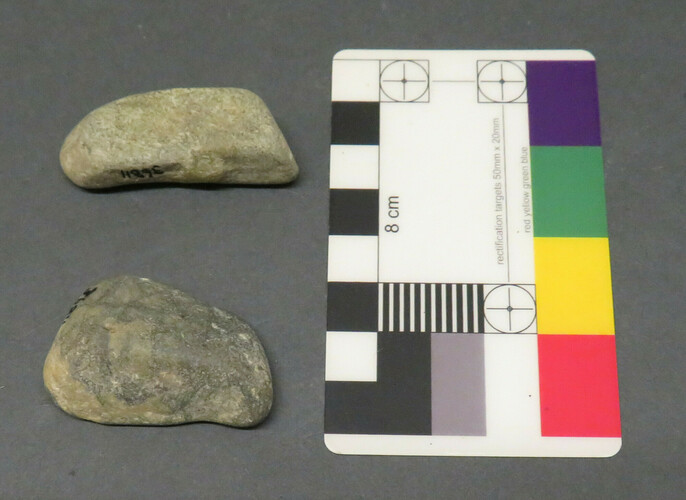 1985.54.1553.1Amulet; grey stone. Used to cure heart palpitations or pain in the limbs. For the other grey stone see [1985.54.1553 .2] [SB [OPS Move] 04/09/2017]1985.54.1553.1
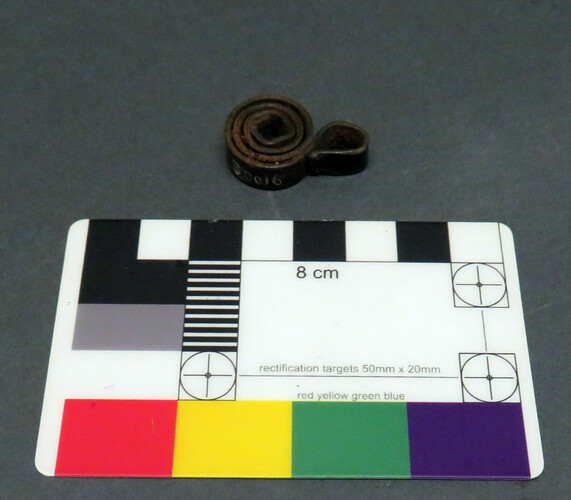 1985.54.1923Amulet, consists of a piece of iron metal which is coiled into a spiral. The end of the spiral extends outwards and bends back on itself. [SB [OPS Move] 15/09/2017]1985.54.1923