- Collection type
- Object
- Description
- Amulet, a rectangular woven textile bag used for holding coca and amulets, and fragments of plant leaves [.2]. [RB 20/08/2012]
- Long description
- Amulet, a rectangular woven textile bag [.1] used for holding coca and amulets, and fragments of plant leaves [.2]. The bag and the leaves were originally found mounted on a Wellcome Institute glass display board along with some samples of 'Shells for making lime' and some 'lime' that have already been removed from the board at some point in the past. The bag and the leaves have also now been removed by conservation. The bag [.1] is comprised of red, white, blue and green coloured textile fibres woven into a pattern. The bag is stitched along three of the four edges, with the top edge open as the bag was used to carry amulets and coca leaves. There is a orange coloured wool cord attached to either side of the bag, possibly for ?suspension. There is some text on the display board relating to the bag which reads: 'WOVEN BAG FOR COCA AND AMULETS INDIANS OF THE CORDILLERAS BOLIVIA, S. AMERICA'. There are also some fragments of unknown plant leaves [.2] but there is no text on the display board relating to them. [RB 20/08/2012]
- Date / Period
- Date made: Before 1931
- Date collected
- By 1931
- Acquisition information
- Transferred: 1985
- Dimensions
- Length x Width: max 180 x 110 mm
- Object numbers
- Accession number: 1985.52.2254.1
Other numbers: 4525 R 67/ 1937
- Associated publications
- This amulet was selected for the Small Blessings project website [http://web.prm.ox.ac.uk/amulets], online text as follows:
In 1903 the French government organized a scientific expedition to Tiahuanaco, a pre-Columbian archaeological site in western Bolivia. The principal archaeologist on the expedition was Adrien de Mortillet and, although de Mortillet returned to France early due to ill health, he brought several stone amulets, known as illas, home with him.
This illa resembles a llama. It is carved from huamanga, an alabaster stone found in the Andes, and would have been carried in this traditional sacred coca bag together with some coca leaves. Illa were, and still are, carried to protect the herds of animals that they represent from harm, and to bring fertility to the animals and prosperity to the herders. They are treasured as guardians of the herd and passed down from generation to generation by Andean herders.
[CB 29/08/2012]

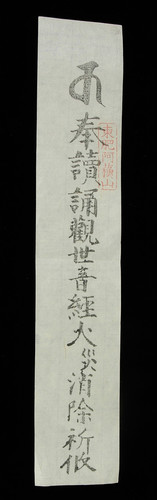 1908.82.140Amulet against fire - a strip of paper with inscriptions stamped in black and red. [SM 08/10/2008]1908.82.140
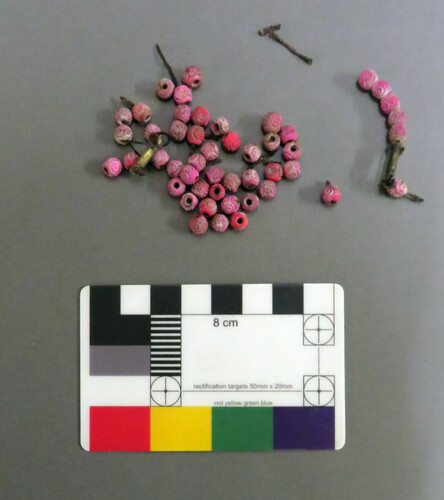 1985.50.318Amulet, made from a broken bracelet of red-pink beads with incised circles. [CW [OPS move] 15/9/2017]1985.50.318
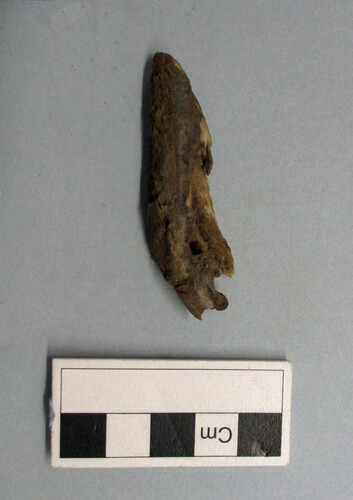 1985.54.296Amulet. Crocodile claw or bone. Perforated at one tip of the claw and cur vertically. [ASh [OPS move] 28/2/2017]1985.54.296
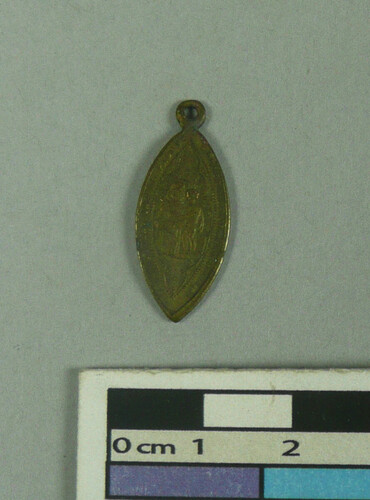 1985.51.515Devotional medallion depicting a figure and child on one side and crosses, hearts and a crown on the other. [SM 25/02/2011]1985.51.515