
- Collection type
- Object
- Description
- Amulet, metal Loreto bell with a red ribbon tied to the perforated handle, attached to which is a broken red wax seal. [RB 29/02/2012]
- Geographical reference
- Person
- Field collector Unknown Collector
- PRM source Wellcome Institute
- PRM source Wellcome Historical Medical Museum
- Date / Period
- Date made: Before 1931
- Date collected
- By 1931
- Acquisition information
- Transferred: 1985
- Materials and processes
- Material Ribbon Textile, Material Wax, Material Brass Metal, Process Perforated, Process Incised, Process Cast
- Dimensions
- Length x Width: max 55 x 38 mm
- Object numbers
- Accession number: 1985.52.783 Other numbers: 1512
- Research and responses
"I now give an example of what might perhaps be called a magico-religious use of the rosary. In certain parts of Poland, namely in the districts of Piotrkow, Czestochowa and Plock, the following custom is in use to keep off lightning.
During a storm a rosary with beads of cedar-wood from the Holy Land - or one made in imitation - is carried round the house three times, together with a little bell called 'the bell of Loreto,' and sometimes also a lighted candle, blessed on Candlemas Day. The bell is rung, and the rosary is used with the words 'God save us' at the large beads and 'Holy Mother, be our mediator' at the small ones." (p.277)
Winifred S. Blackman (1918) The Rosary in Magic and Religion. Folklore, Vol.29, No.4 pp.255-280. Hard copy held in RDF.
"One important field for the use of bells was control of the weather. Bells have always been thought to possess the power to repel thunderstorms by many cultures (Thomas 1982; Knuf 1983a), and little hand bells were sold for this purpose at the well-known Italian place of pilgrimage, Loreto in the 1930s (Kriß 1931: 255)." (p.413)
"Kriß (1931: 255) has found that at the famous Italian pilgrimage place of Loreto silk ribbons carrying the stamp of Loreto are sold in the vestry to afford pregnant women an easy delivery if they tie them round their midst." (p.362)
Joachim Knuf (1986) Amulets as Tokens for Communication: A Comparative Analysis. Thesis held in the Balfour Library.
[CB 29/08/2012]
- Associated publications
- This amulet was selected for the Small Blessings project website [http://web.prm.ox.ac.uk/amulets], online text as follows: White and brass metal hand bells like this one were sold in the famous pilgrimage town of Loreto in Italy. The main attraction in this hill town is the Santa Casa, a holy house that is believed to be the home in which the Virgin Mary raised Jesus. The Santa Casa is thought to have been brought from Nazareth to Loreto, via Croatia, in 1294. According to legend, the house was borne through the air by angels and it is from this tradition that Our Lady of Loreto is venerated as a patron saint of aviation today. An alternative, perhaps more credible, explanation is that crusaders moved the house brick by brick. In 1469 the Basilica della Santa Casa was built around the small, holy house, and in 1510 the Church approved Loreto as an official place of pilgrimage. Today it is one of the most popular pilgrimage destinations in Europe, attracting more than four million visitors a year. Between 1750 and 1754 a large bell tower designed by the Italian architect Luigi Vanvitelli was built next to the basilica, and miniature Loreto hand bells became popular religious souvenirs. The tower, which still stands today, houses a carillon of nine bells that sing the Litany of Loreto. An even bigger bell tower, with thirty bells said to have been playing on the hour since 15 August 1695, stands in the Loreto Palace in Prague. This Loreto is named after the Italian pilgrimage town, and was built in the 17th century as part of a campaign to promote Catholicism. Loreto bells also became popular in parts of Poland, where they were used in magico-religious rituals to protect homes, land and crops from lightning and thunderstorms. When storms threatened, consecrated Loreto bell towers were rung to protect land for as far as the sound of the bell could be heard, and Loreto hand bells, together with a rosary and sometimes a candle, were carried round homes three times. The bell was rung, and the rosary was used with the words, ʻGod save usʼ and ʻHoly Mother, be our mediatorʼ. [CB 29/08/2012]
Search terms: Religion, Music, Amulet, Bell, Musical Instrument, Religious Object
Further items to explore
 1985.54.769.3Amulet. Yellow pellet of incense, triangular in shape, one of four. For other pellets see [1985.54.769 .1 - .2 & .4] Used to drive away anger and sadness [SB [OPS] 07/03/2017]1985.54.769.3
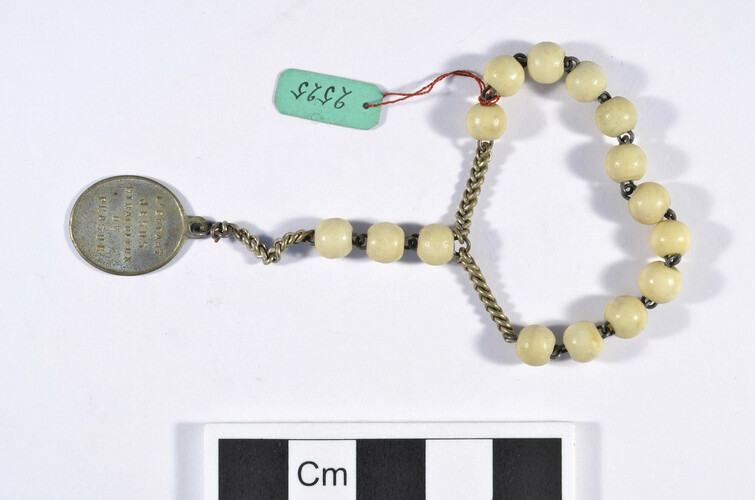 1985.52.1251Amulet, small rosary of white beads on a chain with inscribed medallion on the end. [El.B 16/05/2012]1985.52.1251
 1985.53.147.3Paper charms tied with a red string of paper. The three paper parcels contain paper charms. For the other charms see [1985.53.147 .1] and [1985.53.147 .2] [EH [OPS Move] 26/4/2017]1985.53.147.3
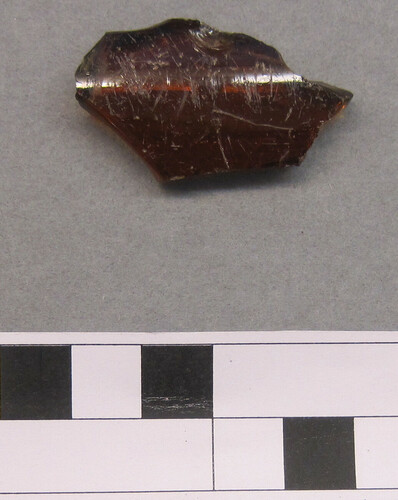 1985.54.1266Amulet. Piece of broken amber coloured glass. [MOBB [OPS move] 10/3/2017]1985.54.1266
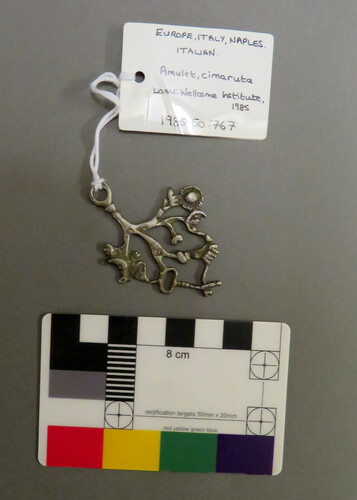 1985.50.767Silver amulet of a sprig of rue, a key, a moon and a flower. [ZM 22/7/2004]1985.50.767
 1897.21.1Votive offering in the form of male genitalia.1897.21.1
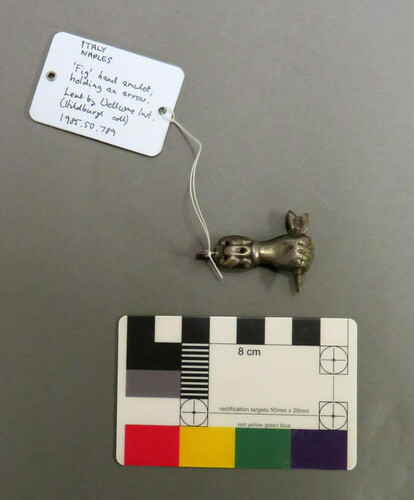 1985.50.789Amulet, in the form of a silver hand clasped around an arrow. There is suspension loop at the base of the wrist. [CW [OPS move] 8/9/2017]1985.50.789
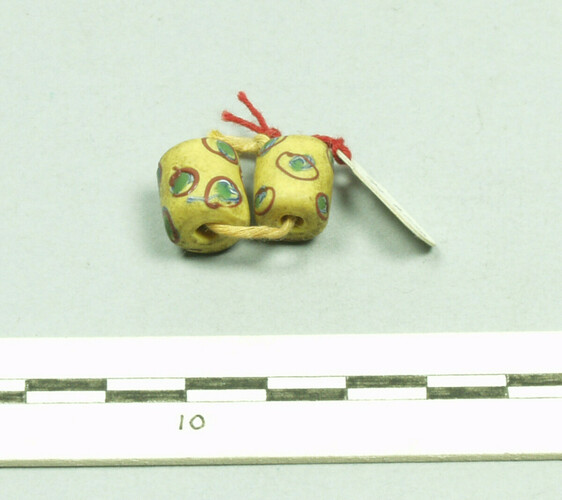 1941.8.0116String of two short tubular glass beads. [El.B 'DCF 2004-2006 What's Upstairs?' 14/6/2005]1941.8.0116