
- Collection type
- Object
- Description
- Cylindrical wooden club, Bowai. [FB 12/03/2012]
- Long description
- Cylindrical wooden club, Bowai. The club is tapered with a slightly domed head, flat base and flares at the base of the handle. The club is carved all over with bands of zigzag tavatava design and geometric shapes. A metal hook has been inserted at the butt end of the club. The wood is split in places. [FB 12/03/2012]
- Person
- Field collector H.A. Tufnell
- Field collector Henry Archibald Tufnell
- Field collector Sir William MacGregor
- PRM source Henry Anson
- Date / Period
- Date made: Before 1899
- Date collected
- By 1899
- Acquisition information
- Donated: 07/1899 Found unentered: 12/03/2012
- Materials and processes
- Material Wood Plant, Process Carved
- Dimensions
- Diameter: max 70 mm, Length: max 950 mm
- Object numbers
- Accession number: 2012.28.1
- Research and responses
Related Documents File - Handwritten note to Balfour from H. Anson, dated 21 March 1899: 'If you would kindly call at 34 Chester Square on Col. Tufnell he will have been advised by me of your coming. The curios are in his house at Wimbledon & he will give you ever facility. The greater [?sic] part of the Collection belonged to Sir Will MacGregor late Governor of British New Guinea, he is in London now and I will ask him to make a note or two for me about some of the things. There is a catalogue but as the books here left to the Revd. Lt. Tufnell and it was included probably in this despatch I cannot get at it until the library is unpacked. i should think Col Tufnell could wait until you return from Italy.' Photocopy of the armourial bearings of Sir William MacGregor, 1847 - 1919, Governor of Newfoundland 1904 - 1909. [MOB 9/10/2001]
See F Clunie 'Fijian Weapons and Warfare' 1977 Fiji Museum, Suva, Bulletin of the Fiji Museum no.2 and R. Ewins, Fijian Artefacts: Tasmanian Museum and Art Gallery collection' Australia 1982: p.29. "Bowai (baseball-bat clubs) and Gadi (pole clubs). The difference between bowai and gadi is often not very clear. Typically, a bowai is shaped like a baseball bat, with distinctly tapered shaft and rounded tip. In practice, many examples appear as hybrids. Cakobau presented his favourite bowai to Queen Victoria at the time of Cession; it was ornamented in silver and returned by King George V to Fiji as the Mace of Parliament, which it remains today. The bowai was probably introduced from Tonga (where it was called povai) or Samoa. Gadi were named for the wood from which they were frequently made (gadi-Storckiella vitiensis), and were virtually straight-shafted heavy poles, sometime plain, sometimes decorated, usually with flat ends." [FC 26/09/2011]
The following notes are drawn from research compiled by Andy Mills as part of the DCF Cutting Edge project in 2006-2007.
The bowai (pron. Um-bow-eye) is another transnational club style in Western Polynesia, commonest in Fiji and of Fijian origin, but also to be found in Tonga and Samoa as the povai (Clunie, F. (2003) Fijian Weapons & Warfare. Suva: The Fiji Museum, p.128). In one sense, it is the most simple and straightforward design of club imaginable – a plain, slightly tapering cylinder – but to assume that this apparent simplicity reflects a simplicity of conception in the work of the carver would be to do the Fijian matai, Tongan tufunga and Samoan tufuga – master woodcarvers - a great disservice. Recent research (Mills, A. (2007) Tufunga Tongi ‘Akau: Tongan Club-Carvers & Their Arts. Unpublished Ph.D. Thesis, University of East Anglia) into the formal proportions of weapons such as the bowai has revealed that all of the weapon’s principal dimensions are carefully interrelated through a complex series of fractional relationships, mathematical squares, and so on; the formal aesthetics of their shape was not only determined by eye and hand, but also by reference to complex ideas of mathematical appropriateness; the principles of appropriateness were inscribed into the weapon by the carver, who used lengths of cordage to transfer dimensions from one part of the carving to another, subdividing and multiplying the cordage into complex fractions and multiples as he did so. Furthermore, ergonomics cannot be overlooked when discussing the form of the bowai, so close to that of an American baseball bat; of course, this is no coincidence, and the tapering cylinder offers the greatest consistency of grip and weight distribution, whether the object to be struck is a ball or a skull. [FB 10/10/2011]
Search terms: Weapon, Ritual and Ceremonial, Club, Ceremonial Object
Further items to explore
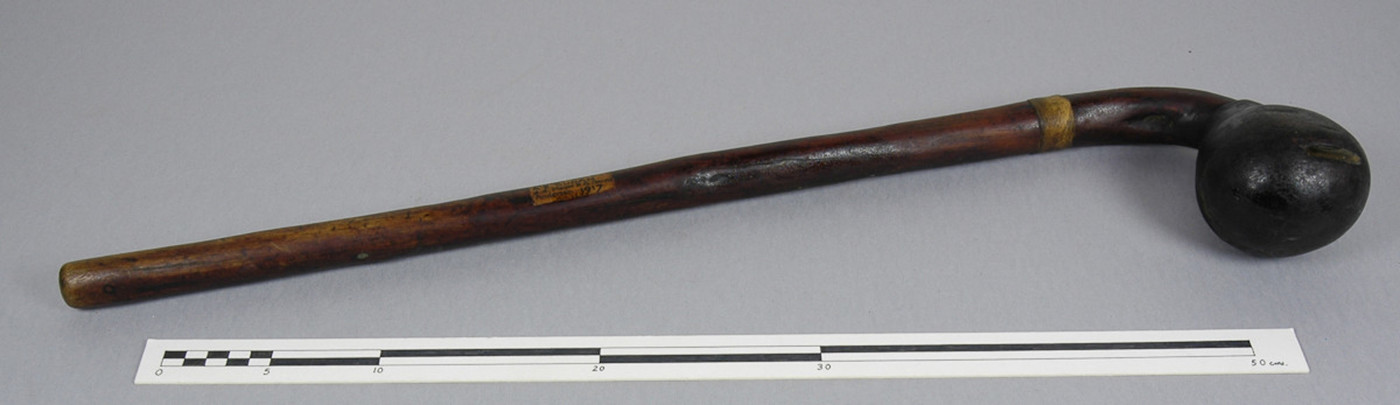 1917.25.4Wooden club with straight shaft which curves towards its ball shaped head [SM 21/03/2007]1917.25.4
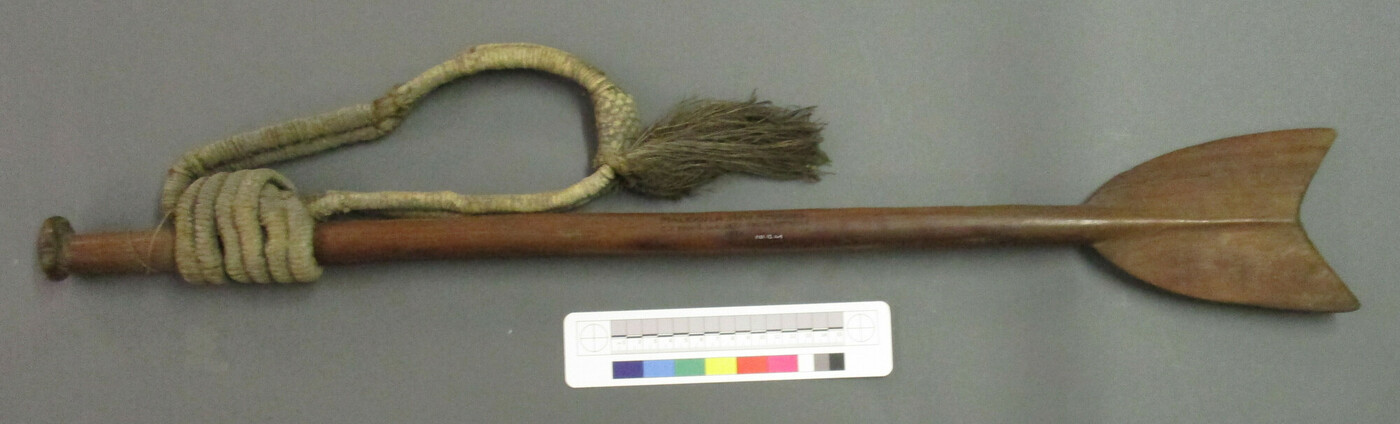 1921.93.149Wooden club with flat, fish-tail-shaped head. [JC [OPS Move] 12/09/2016]1921.93.149
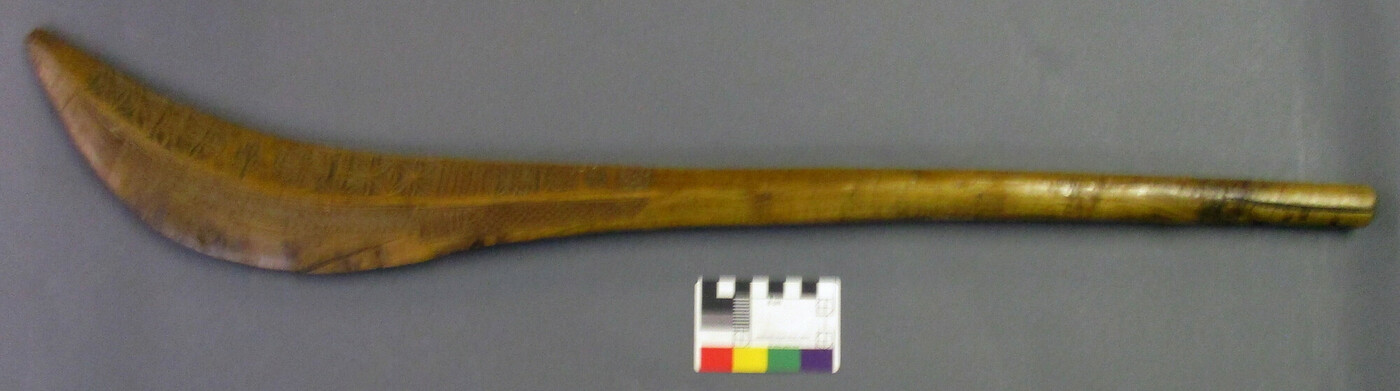 1929.95.4Wooden glaive club with a lozenge section and a curved blade. [BS [OPS Move] 10/10/2016]1929.95.4
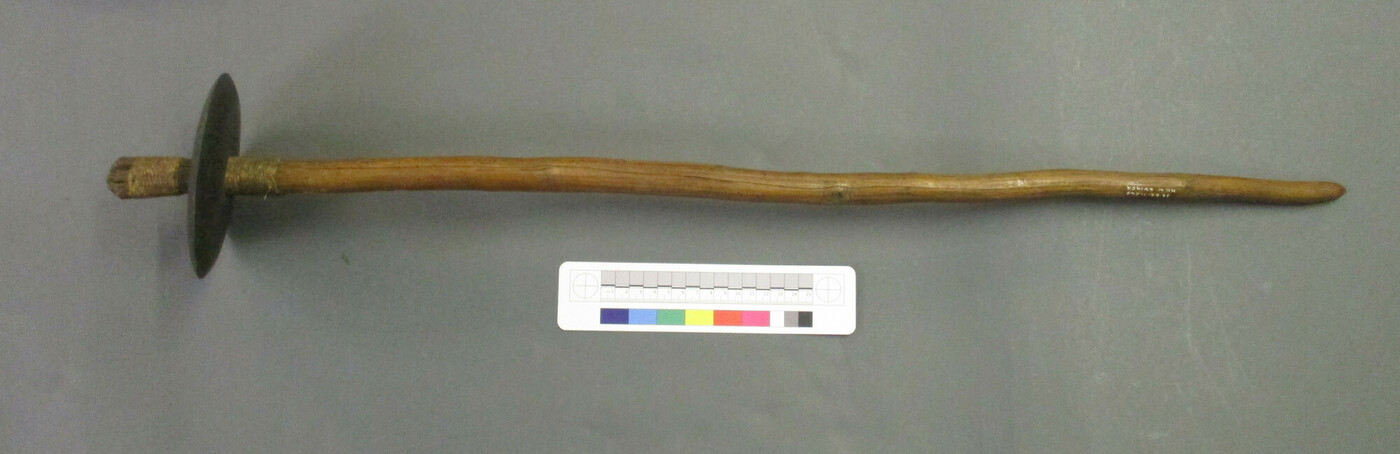 2016.87.3Wooden club with discoidal stone head. [BS [OPS Move] 21/09/2016]2016.87.3
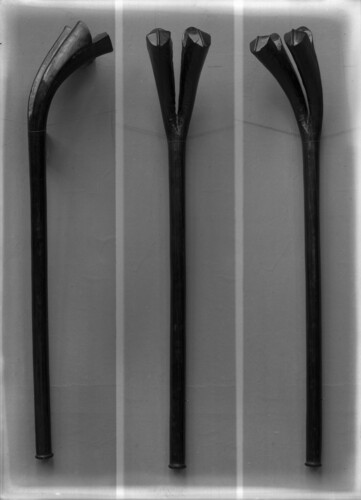 2012.18.1Double headed wooden club with short, broad spurs (Gata 'snake' club). [FC 08/08/2011]2012.18.1
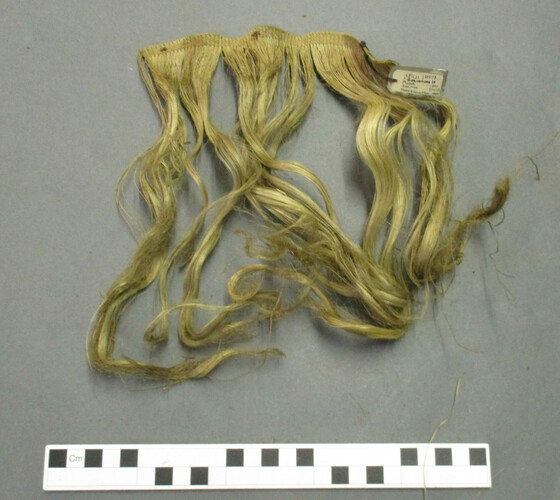 1886.1.1402Hair ornament, band of processed, curled plant fibre strands secured to a twined band. [MOBB [OPS move] 16/1/2017]1886.1.1402
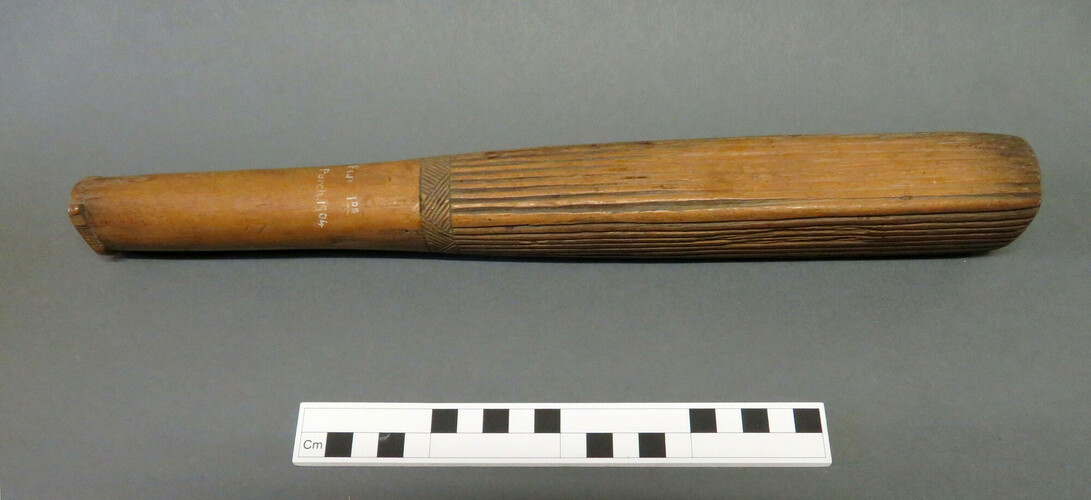 1904.55.8Wooden barkcloth beater. It has a plain cylindrical handle which expands into the long, square sectioned head which is grooved longitudinally on three faces. Between the head and handle is a band of incised oblique lines forming triangles. There is an expanded rim at the proximal end, much of which has been carved away. [JC [OPS Move] 28/3/2017]1904.55.8
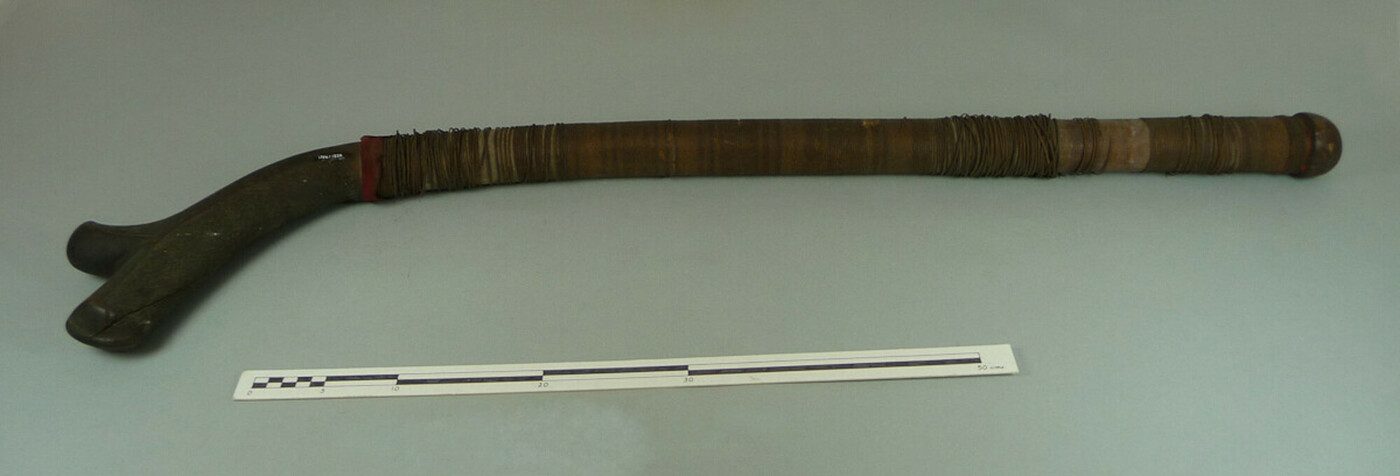 1886.1.1357Wooden dance/ceremonial club, (Kiakavo). [FC 08/08/2011]1886.1.1357