
- Collection type
- Object
- Description
- Silver amulet in the form of a half moon with face, protection against the evil eye. [FB 24/01/2012]
- Long description
- Silver amulet in the form of a half moon with face, protection against the evil eye. The half moon if facing to the right. There is a decorative heart shaped hole at the top of the half moon so that it can be worn as a pendant. The back of the amulet is plain. [FB 24/01/2012]
- Cultural groups
- Italian
- Date / Period
- Date made: Before 1880
- Date collected
- between 1880 - 1900
- Acquisition information
- Bequeathed: 05/07/2010
- Materials and processes
- Material Silver Metal, Process Incised, Process Moulded, Process Cast, Process Struck
- Dimensions
- Length x Width: max 46 x 23 mm, Weight 5.2 g
- Object numbers
- Accession number: 2010.46.31 Other numbers: 9b
- Research and responses
See 'Neapolitan Charms Against the Evil Eye' by Veronica Berry in Folklore, vo.79, No. 4 (Winter 1968), pp. 250 - 256: " Waning, waxing and full moons, embellished with a masculine face, are common amulets (the origin perhaps of the man in the moon?). Old and new moons (Fig. 1E & F) with their menacing 'horned' aspect were considered more effective against the Evil Eye then the more benevolent full moon. The horned crescent moon is a symbol of Diana, in her aspect as Queen of Heaven. Horses were dedicated to the moon because of their hooves made the mark of a crescent, thus giving rise to the belief that the horseshoe was also a 'lucky' emblem..." [FB 24/01/2012]
and 'The Evil Eye An Account of this Ancient and Widespread Superstition' by Fredrick Thomas Elworthy (1895) [FB 24/01/2012]
See Eustace Neville-Rolfe, Naples in 1888, Trübner, 1888. [FB 24/01/2012]
See Eustace Neville-Rolfe, Naples in the Nineties a sequel to Naples in 1888, Adam and Chas. Black, London, 1897: p.53 "Diana, in her capacity of goddess of heaven, is always represented with the crescent moon on her head, and this again is frequently as a boar's tusk, to unite the emblems of the goddess of the heaven with that of the presiding genius of the chase..." [FB 25/01/2012]
Eustace Neville-Rolfe lived in Naples between 1880 and 1900 and was an enthusiastic researcher and collector of amulets against the evil eye. He first loaned artefacts to PRM in 1892 (including a lemon stuck with nails which is now on display) and subsequently in 1893, 1903 and 1908. Rofle was consul in Naples, he was part of a network of amulet specialists including many whose collections are now at PRM (AE Gunther and Elworthy in particular as well as Balfour). [FB 24/01/2012]
Further items to explore
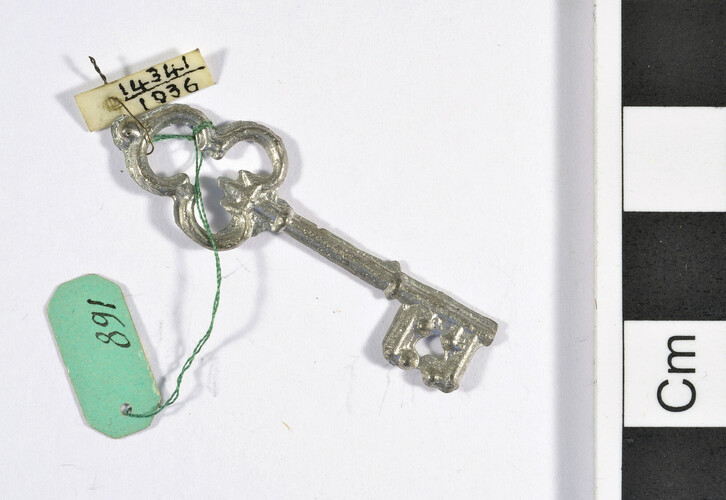 1985.52.461Amulet, a key of St Valentine made of white metal. [RB 15/03/2012]1985.52.461
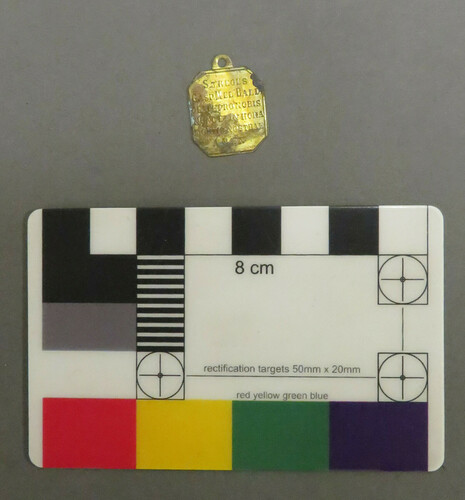 1985.50.210Amulet, thin brass medal, rectangular with corners cut off, with suspension loop. [MJD (Verve) 12/9/2017]1985.50.210
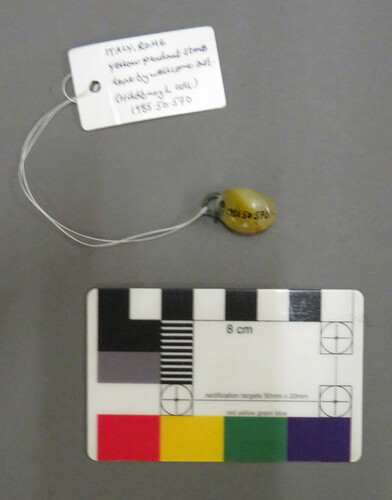 1985.50.570Yellow pendant stone, banded, ovoid in shape. Perforated at one end with two metal loops for suspension. [RH [OPS move] 18/9/2017]1985.50.570
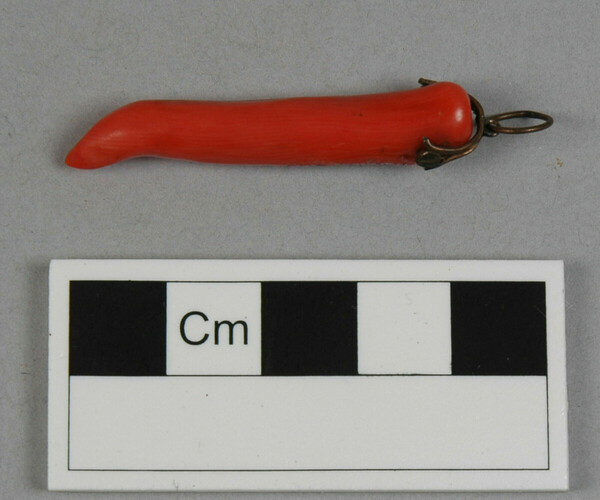 1985.51.313Coral pendant, used as an amulet. Piece of coral, perforated through one end with a suspension loop. [SM 10/02/2011]1985.51.313