
- Collection type
- Object
- Description
- Fire stick decorated with faded bands of painted decoration.
- Geographical reference
- Person
- Field collector Ida Mann
- PRM source Bodleian Library, University of Oxford
- PRM source Catherine Parker
- Date
- Date collected
- by 1970
- Acquisition information
- Transferred: 02/09/2011
- Materials and processes
- Material Wood Plant, Material Pigment, Process Painted
- Dimensions
- Diameter: max 14 mm, Length: max 410 mm
- Object numbers
- Accession number: 2011.68.4.1
- Research and responses
Biographical information: Ida Mann (1893 - 1983) ophthalmologist. Ida Mann was born in West Hampstead, London and educated at Wycombe House School, Hampstead. Having passed the Civil Service Girls Clerk's exam, she secured a job at the Post Office Savings Bank, aged seventeen. A benevolent visit to the London Hospital in Whitechapel revived a fierce desire to study medicine and she was amazed that such a career was possible if she enrolled in the only medical school open to women, the London School of Medicine for Women. Despite opposition from her father, she passed the London marticultation exam in 1914, one of only eight women out of hundreds of passes. She completed her studies, 'with no trouble and intense delight', and qualified in 1920. After applying for many junior posts, she was appointed to work under the Ophtalmic House Surgeonship at the hospital. Although she had no particular interest eyes, she soon realised that this fascinating subject was to be her life's work. She developed her specialism in ophthalmology and enbryology and at the same time acquired her qualification in general surgey, becoming F. C. R. S. in 1924. She was appointed to staff a post at Moorfields in 1927 (an unpaid but prestigious position), the first woman to achieve this seniority. SHe funded her independence by establishing a private practice in Harley Street.
In 1941 she was appointed as the Margaret Ogilvy Reader in Ophthalmology at Oxford University. During her tenure she oversaw the building of the Nuffield Laboratory of Ophthalmology, appointed Antoinette Pirie 'Toni' as Biochemist, replaced the matron with a more competent sister from Moorfields, re-started the diploma courses, inaugurated the Orthoptic School and re-instituted the Oxford Congress. She also continued her work for the war effort with research into the effects of various chemicals on the eyes. She collaborated with Professor Peters who had discovered British anti Lewsite, an antidote to the chemical warfare agent, Lewisite, and she also collaborated with Sir Howard and Lady Florey on the effects of penicillin on bacteria in humans. Her efforts were recognised by the university in 1945 when she was given a personal professorship, the first woman to receive one.
In 1944 she married Professor William Gye, a pathologist and director of the Imperial Cancer Research Fund. After the war, partly due to his poor health, they emigrated to Australia where she continued her clinical practice and also conducted research into the impact of genes and the environment on eye disease, with particular reference to the Aboriginal people. She travelled extensively throughout Australia and Oceania studying the incidence of eye disease in different races and cultures. In particular she highlighted the high incidence of trachoma amongst Aboriginal peoples at the time when it was thought to have been eradicated in Australia. She was incredibly hard-working and insatiably curious, and continued working and exploring into old age. She was appointed CBE in 1950, and DBE in 1980. She died at home in Perth in 1983. [FC 13/09/2011]
Search terms: Fire, Fire Accessory
Further items to explore
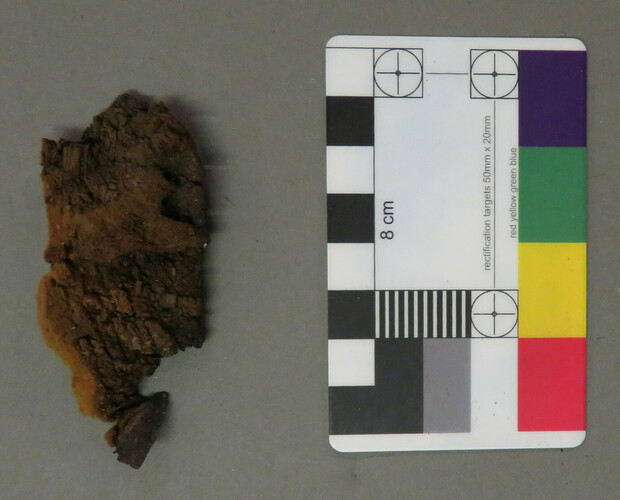 1938.35.1890.4Fungus tinder. Orange brown in colour. For the associated components of this pouch see [1938.35.1890 .1 - .5] [BS [OPS move] 10/8/2017]1938.35.1890.4
 1940.4.37.12Sulphur match ("spunk"). From a tinder box set. The match is made from wood. It is flat with one pointed tip, the other end is broken. The tip has remnants of sulphur coating. The match is blackened. For the tinder box see 1940.4.37 .1, steel see 1940.4.37 .2, and matches see 1940.4.37 .3 - .13 [AB [OPS Move] 7/4/2017]1940.4.37.12
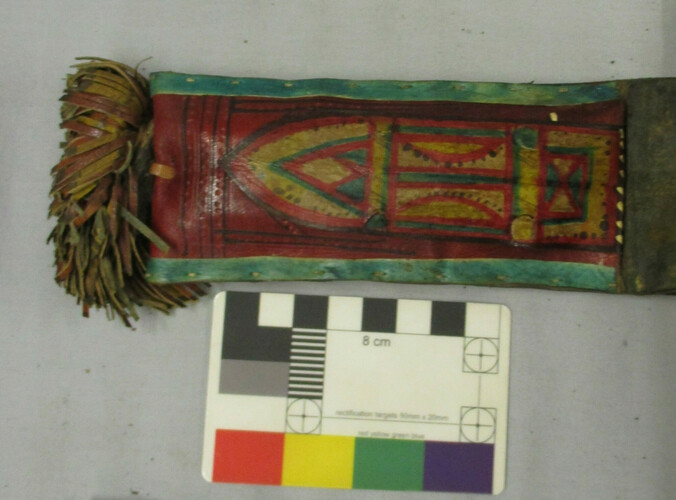 1940.7.0205.2Outer case of leather pouch. For the inner case see 1940.7.0205 .1, for the accessories see 1940.7.0205 .3 - .6 [AB [OPS Move] 5/10/2016]1940.7.0205.2
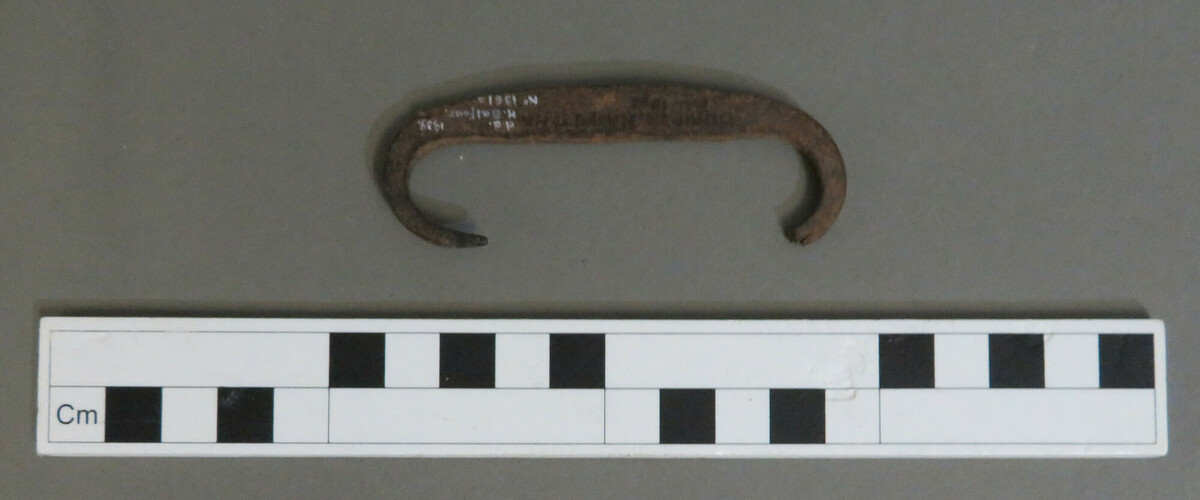 1938.35.679.1Fire steel. 1938.35.679.1
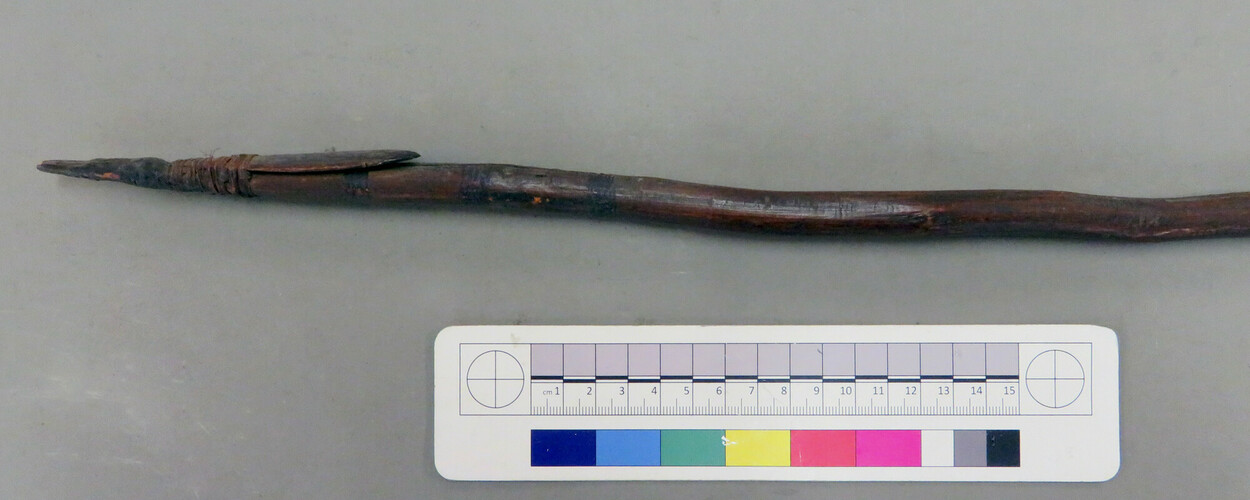 1945.12.10Wooden spear, shaft unstraightened, with flat wooden barb bound on tip with thin fibre binding covered with gum. Three black bands below barb. [MOBB [OPS move] 13/8/2018]1945.12.10
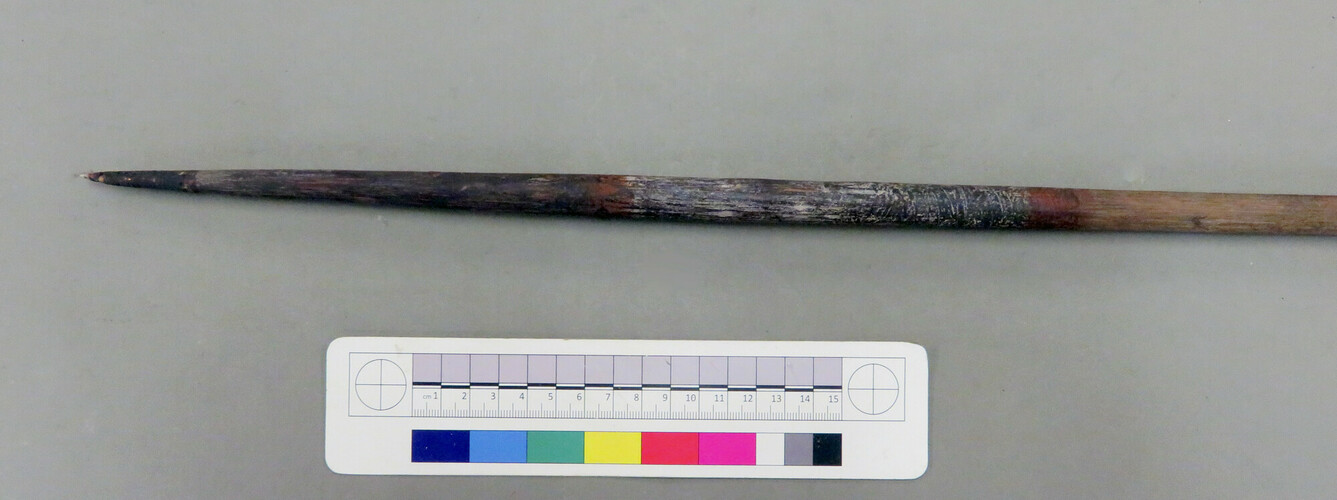 1887.1.650Spear of wood with bone tip (barb of bone is broken off), which is bound to the point with ?plant fibre and resin. [MOBB [OPS move] 13/8/2018]1887.1.650
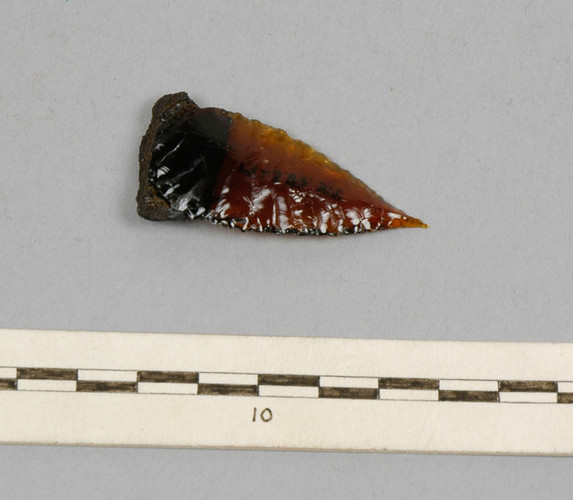 1923.87.318Brown glass spear-head set in resin [El.B 31/1/2007]1923.87.318
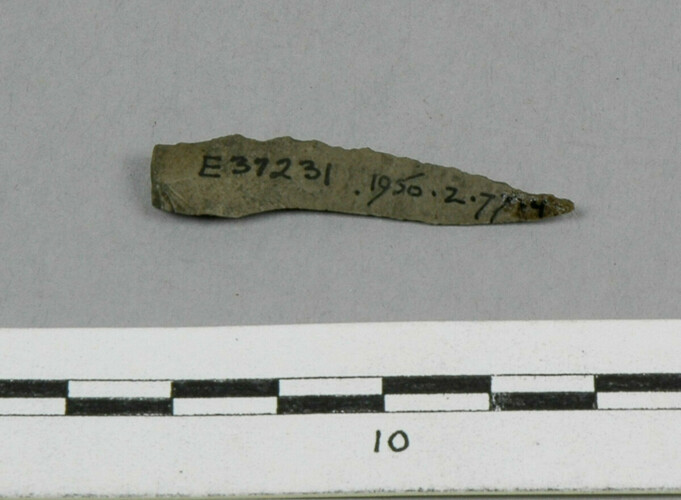 1950.2.77.4Stone tool, small 'Bondi' type point. [El.B 14/08/2007]1950.2.77.4