- Collection type
- Object
- Description
- Fossilised shark's tooth embedded in a phosphate concretion. Used as an amulet against cramp. [SM 12/05/2011]
- Geographical reference
- England Suffolk Red Crag
- Date / Period
- Date made: Before 1933
- Date collected
- By 1933
- Acquisition information
- Transferred: 1985
- Dimensions
- Width: max 31 mm, Length: max 52 mm
- Object numbers
- Accession number: 1985.51.923
Other numbers: R 3824/ 1936 A 177249 L AM C lot 244
- Associated publications
- Illustrated in colour in the pamphlet accompanying the Reading Room displays at the Welcome Collection with the caption “Fossilised shark’s tooth in phosphate Natural materials UK RRa0194/1985.51.932 Pitt Rivers Museum, University of Oxford. This fossilised tooth was used to protect against cramp.” [FB 15/8/2016]
Illustrated in colour on page 198 in ‘Reading Room Companion consisting of a rare and valuable collection of diverse curiosities acquired by and for Henry Wellcome with a great variety of books’ Written and compiled by Anna Faherty published in 2014 by the Wellcome collection, London. Illustrated alongside 1985.52.21, 1985.51.177, .340, .350 and. 361 with the caption “Amulets made from animals or animal parts. Pitt Rivers Museum. Any object can become a protective amulet or good-luck charm, so long as its owner belives (or hopes) it has the power to affect the world around them. Just as the value of an object in a museum collection is transformed from its intrinsic natural or functional purpose into something more representational, amulets are redefined and repurposed by those who use and value them. Derived from the Arabic term hamala, which means ‘to carry’, most amulets are worn in some way or kept in bags or pockets.
The amulets and charms on display in the Reading Room were collected by three different individuals. There original owners employed them as protection against threats such as the ‘evil eye’, or hoped that they would bring fertility, good health and good luck. For full details on each amulet, please consult the dedicated Amulets, charms and votives booklet.” [FB 15/8/2016]

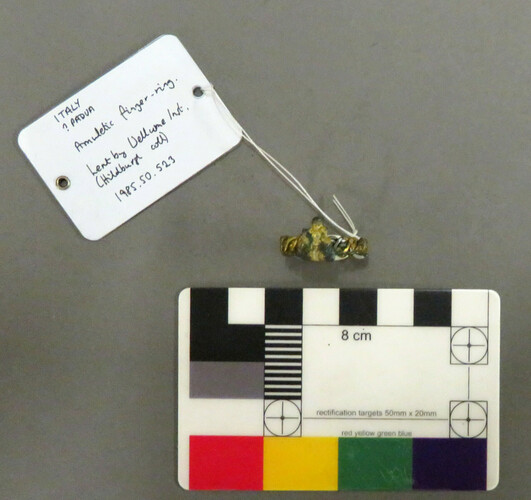 1985.50.523Amulet ring of a twisted gilded metal wire band with a flat triangular bezel featuring two figures and flowers. [RH [OPS move] 14/9/2017]1985.50.523
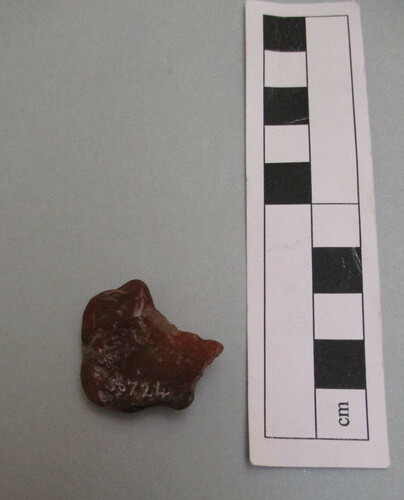 1985.54.579Amulet; stone, dark yellow/brown in colour, semi-transparent, polished, irregular in shape. [AF [OPS Move] 6/3/2017]1985.54.579
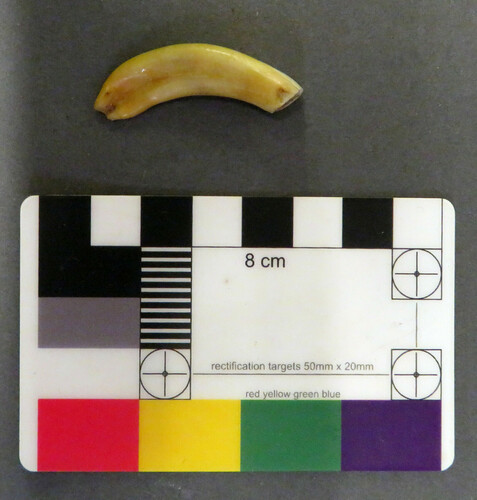 1985.54.2784Amulet. Tooth, possibly that of a fox. Two pointed roots on the underside. Used for a child who is always ill. [ASh [OPS move] 22/11/2017]1985.54.2784
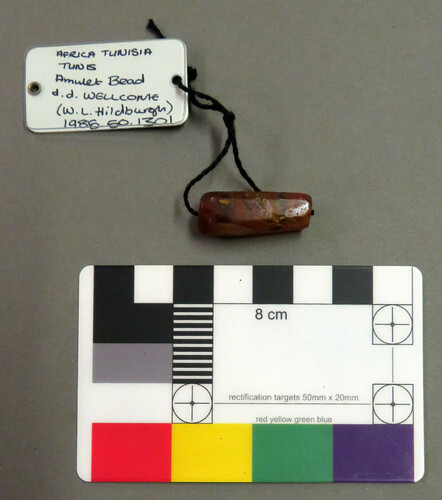 1985.50.1301Amulet, a bead of semitransparent polished red cornelian, with black streaks. Roughly faceted into 8 sides and perforated transversely for suspension. [EH [OPS move] 21/11/2017]1985.50.1301
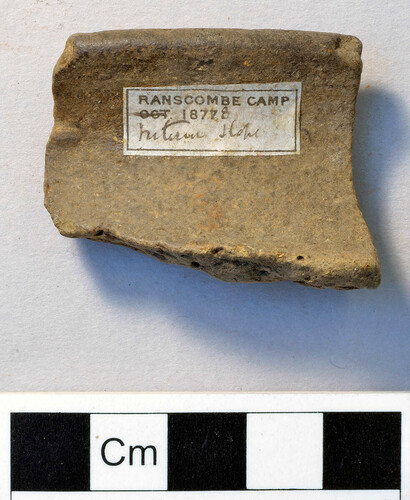 1884.136.2.3Ceramic rim sherd1884.136.2.3
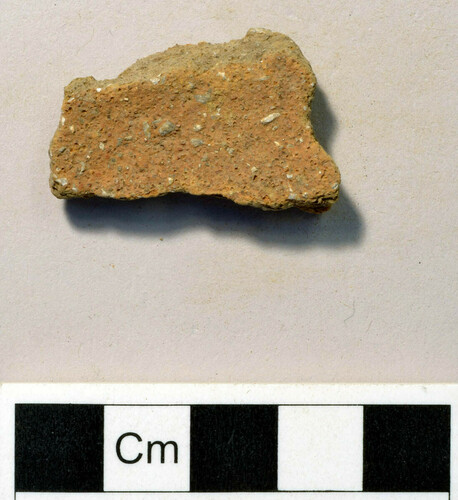 1884.140.1637.55Ceramic sherd1884.140.1637.55
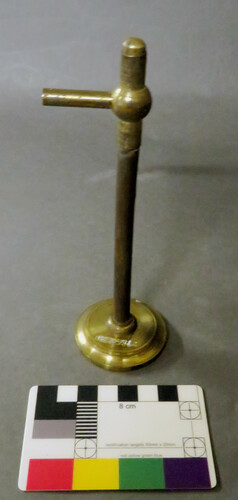 1971.30.7.11Microscope stand?. For the related records see 1971.30.7 .1 - 18 [MOBB [OPS move] 13/6/2018]1971.30.7.11
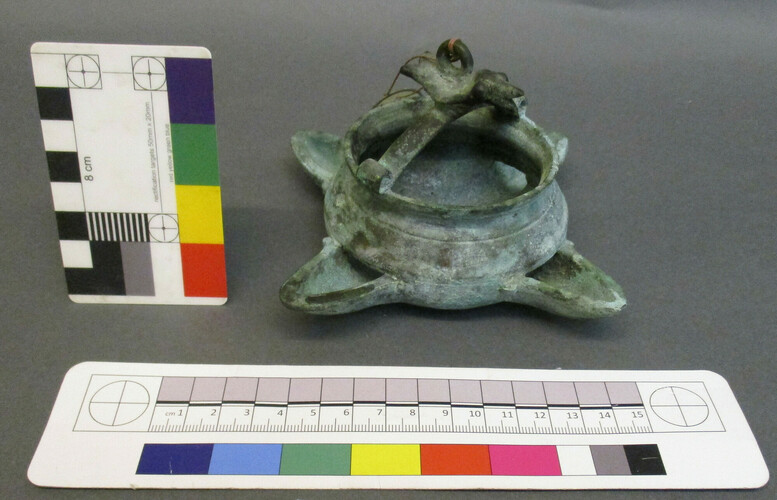 1953.5.14Hanging lamp. Circular copper alloy metal lamp with four projecting wick nozzles. Flat bottom with expanding, slightly rounded sides along the wick level. The upper portion is also rounded but narrows to the neck from which a flared rim expands. An arch reaches over the opening of the vessel with a small bird attached to the centre. [MOBB [OPS move] 15/3/2017]1953.5.14