
- Collection type
- Object
- Description
- Stone tool: cleaver
- Date / Period
- Archaeological period: Early Stone Age Acheulian
- Date collected
- ? 1927 ? 1929 ? 1931
- Acquisition information
- Donated: 1947
- Materials and processes
- Material Stone, Material Lava Stone, Process Flaked
- Object numbers
- Accession number: 1947.2.249 Other numbers: 1931-933
- Research and responses
Kariandusi was discovered by Dr Solomon and Miss Kitson of the East African Archaeological Expedition in May 1929. Excavations were carried out there as it was realised that there were Acheulean implements in situ. Solomon (1931) gives the geological sequence at the site as follows: lava overlain by volcanic sands and tuffs; overlain by diatomite; overlain by gravels, volcanic sands and tuffs (upper pumice beds) in which the Acheulean artefacts occur; overlain by fine stratified tuffs; overlain by gravels and silts. Three seasons of excavation were conducted by Leakey at Kariandusi, the first in 1929, the second in 1931, and the third in 1946-47. The East African Archaeological expedition also camped at Kariandusi River on the 18th of November 1934 and they collected many handaxes. In 1931 The PRM collection of artefacts, derives from the first two seasons of excavation. Leakey (1936: 46) states that “we now have a collection of over two thousand specimens excavated from an area barely 10 feet square”. Around half of these artefacts probably stayed in the National Museum in Kenya, 721 were sent to Cambridge and the remaining 207 were sent to the PRM. In the 1929 season an area of 10 x 5 feet was excavated and 80% of the tools extracted were of fresh obsidian. In the 1931 season a second locus was excavated which yielded rolled lava bifaces. As some of these bifaces appeared unfinished and there were some unretouched flakes Leakey called this second locus the factory site. An area 10 x 8 feet was excavated which yielded over 1200 artefacts most of which were bifaces. In the 1946-47 a much larger area seems to have been opened up as the plan of the excavation illustrated in Gowlett & Crompton (1994) shows a 9x3 m trench. The bifaces from this excavation were left in situ for display in a field museum. These bifaces exposed in 1946-47 are mostly obsidian while the vast majority (over 95%) of those in the Cambridge and Pitt Rivers museums are lava (mostly trachyte, but also phonolite and rhyolite). In general the obsidian bifaces are fresh while the lava bifaces are rolled. Leakey (1931) states that the rolled bifaces belong to an earlier facies of the Acheulean, while the fresh bifaces belong to a later facies. Gowlett excavated another locality at Kariandusi in 1974 (Gowlett & Crompton, 1994). Here he unearthed lava bifaces, large flakes and trachyte lava blocks in a secondary context, which he presumed to be younger than Leakey’s in situ obsidian bifaces. Metric analysis indicates Gowlett’s lava bifaces are similar to those from Olorgesailie while Leakey’s Obsidian bifaces are similar to the Late Acheulean bifaces of the Kapthurin Formation (Gowlett & Crompton, 1994).
Faunal comparison indicated that the Kariandusi Acheulean industries were broadly contemporary with Olduvai Gorge Bed IV (Cole, 1954), c. 1 million years old. Potassium-argon dates from pieces of tuff associated with the Kariandusi bifaces yielded dates of 1.1 and 0.93 million years ago (Evernden & Curtis, 1965). Palaeomagnetism on pumice overlying the artefacts suggests they must be at least 0.73 million years old (Gowlett & Crompton, 1994).
Sourcing studies indicate the obsidian was transported distances of up to 30 km from three different sources (Merrick & Brown, 1984). This is also the earliest known use of obsidian in east Africa (Clark, 1988). The Gilgil trachyte source is just 80 m from the site, while the minimum transport distance for the Rhyolite is estimated to be 15 km (Gowlett & Crompton, 1994).
The PRM collection of Kariandusi artefacts consists largely of bifaces as well as the occasional large flake and a couple of possible hammerstones. In general the PRM collection is very similar in composition to the Cambridge collection. Both handaxes and cleavers are represented, with the great majority of bifaces made on large flakes although there is the odd example of the use of a tabular piece of trachyte. The assemblage includes numerous rolled trachyte bifaces, occasional rolled phonolite and rhyolite bifaces, occasional fresh trachyte and phonolite bifaces, and occasional fresh obsidian bifaces. On the rolled bifaces the degree of rounding varies between pieces indicating differential transport distances before their redeposition. The sandy matrix still adheres to many of the rolled trachyte bifaces. Several specimens were noted which are differentially abraded on each surface, suggesting some of the abrasion could have occurred in situ by sand washing over the artefacts. The fresher lava bifaces nearly all come from the 1929 excavation season when locus 1 was excavated and they have a finer matrix adhering to them, suggesting they were deposited under a different regime and constitute a separate assemblage. [CBS 2/8/2010]
CLARK, J.D. 1988: The Middle Stone Age of East Africa and the beginnings of regional identity. Journal of World Prehistory 2: 235-305
COLE, S. 1954: The prehistory of East Africa (Harmondsworth).
EVERNDEN, J.F. & CURTIS, G.H. 1965: The potassium-argon dating of late Cenozoic rocks in East Africa and Italy. Current Anthropology 6: 343-385
GOWLETT, J.A.J. & CROMPTON, R.H. 1994: Kariandusi: Acheulean morphology and the question of allometry. The African Archaeological Review 12: 3-42
LEAKEY, L.S.B. 1931: The Stone Age Cultures of Kenya Colony (London).
LEAKEY, L.S.B. 1936: Stone Age Africa: an outline of prehistory in Africa (London).
MERRICK, H.V.M. & BROWN, F. 1984: Obsidian sources and patterns of source utilization in Kenya and northern Tanzania: some initial findings. The African Archaeological Review 2: 129-152 SOLOMON, J.D. 1931: The geology of the implementiferous deposits in the Nakuru and Naivasha Basins and the surrounding area in Kenya Colony. In Leakey, L.S.B. The Stone Age Cultures of Kenya Colony (London), 245-266.
- Associated publications
- COLE, S. 1954: The prehistory of East Africa (Harmondsworth). EVERNDEN, J.F. & CURTIS, G.H. 1965: The potassium-argon dating of late Cenozoic rocks in East Africa and Italy. Current Anthropology 6: 343-385 GOWLETT, J.A.J. & CROMPTON, R.H. 1994: Kariandusi: Acheulean morphology and the question of allometry. The African Archaeological Review 12: 3-42 LEAKEY, L.S.B. 1931: The Stone Age Cultures of Kenya Colony (London). LEAKEY, L.S.B. 1936: Stone Age Africa: an outline of prehistory in Africa (London). MERRICK, H.V.M. & BROWN, F. 1984: Obsidian sources and patterns of source utilization in Kenya and northern Tanzania: some initial findings. The African Archaeological Review 2: 129-152 SOLOMON, J.D. 1931: The geology of the implementiferous deposits in the Nakuru and Naivasha Basins and the surrounding area in Kenya Colony. In Leakey, L.S.B. The Stone Age Cultures of Kenya Colony (London), 245-266. Shipton, C. 2011. Taphonomy and behaviour at the Acheulean site of Karidandusi, Kenya. African Archaeological Review 28, 141-155. [AS 04/07/2011]
Further items to explore
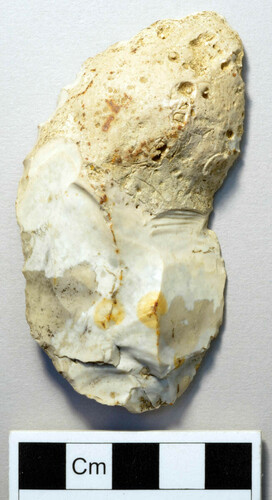 1884.123.314Stone flake1884.123.314
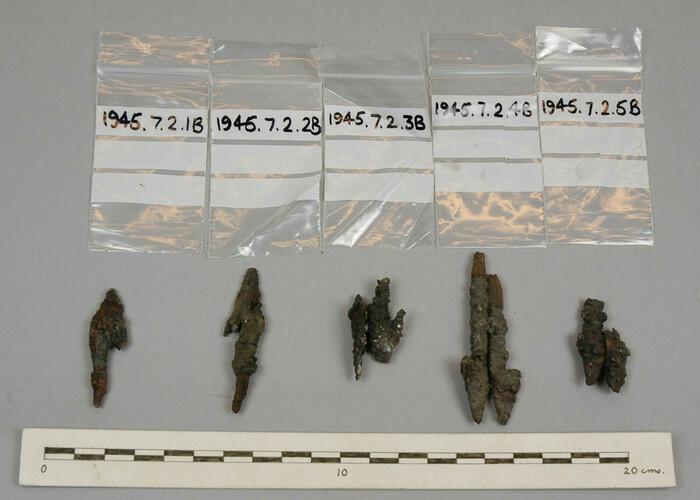 1945.7.2.1BCorroded iron arrowhead with asymmetrical barb [SM 02/01/2008]1945.7.2.1B
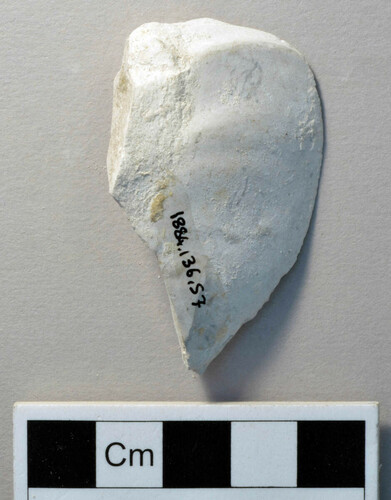 1884.136.57Stone flake1884.136.57
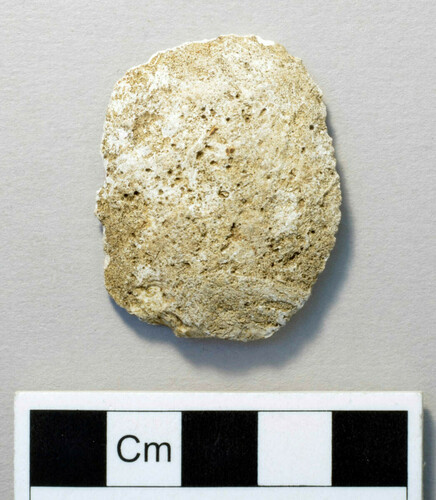 1884.123.468.3Stone flake1884.123.468.3
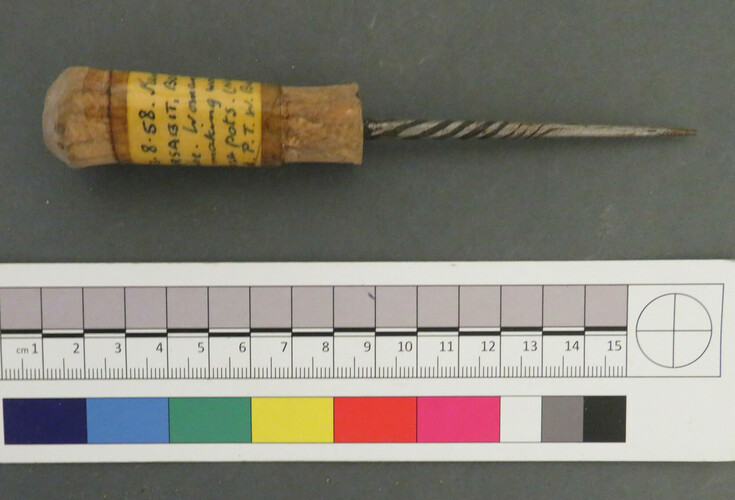 1953.8.58Needle or awl for woven pots. Roughly carved wooden handle with flattened end and sides tapering towards the needle end. The needle point is made from metal and the upper part is decorated with inscribed spiral decoration along the shaft. [CW [OPS Move] 12/4/2017]1953.8.58
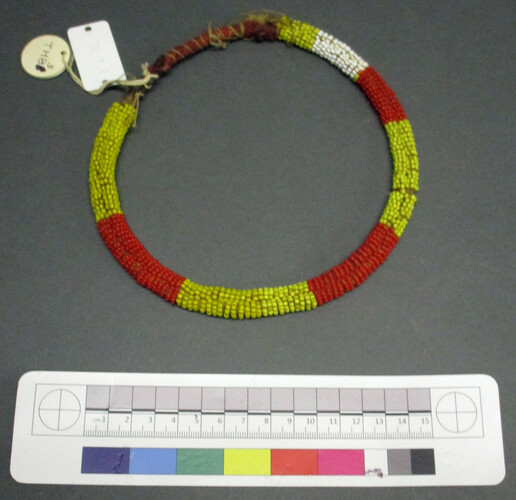 1968.20.66Wire necklet bound with beaded thread and patterned red fabric. [BS [OPS Move] 8/12/2016]1968.20.66
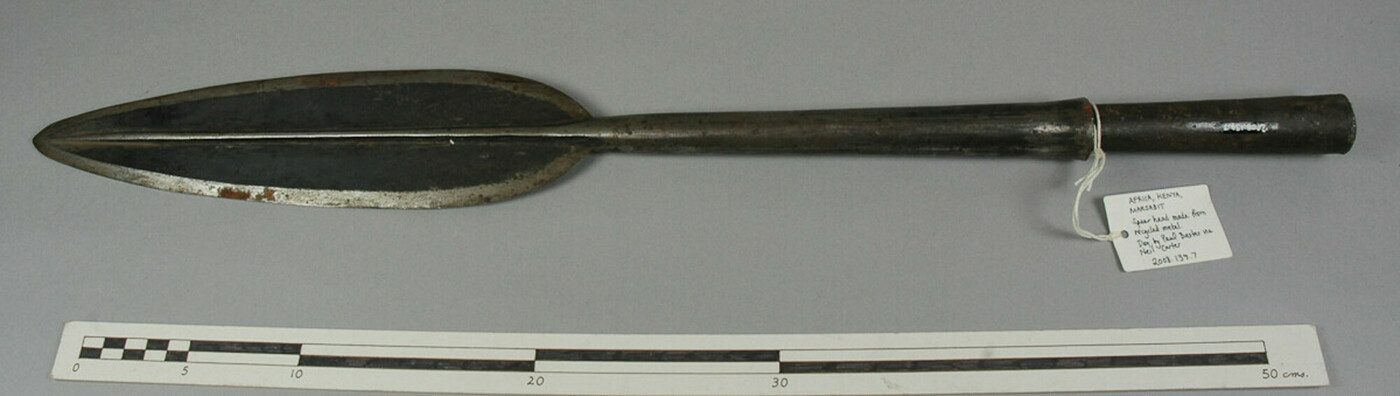 2008.139.7Spear head made from recycled car metal, in this case the spring leaves. [FC 13/04/2010]2008.139.7
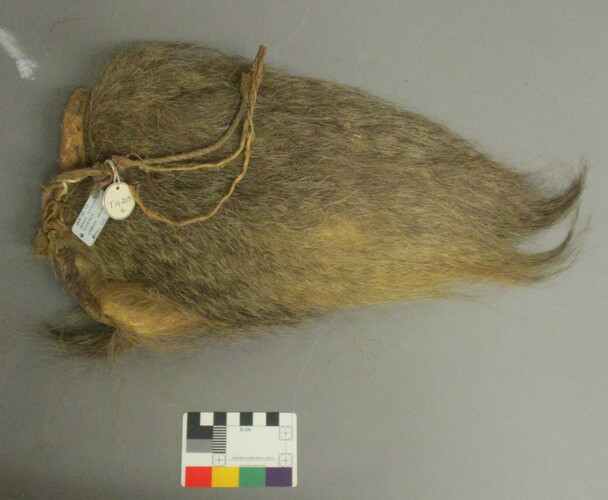 1968.20.117Baboon skin warrior's helmet with fibre chin strap and minimal red bead decoration.1968.20.117