
- Collection type
- Object
- Description
- Flake with hinged termination. Towards the proximal end approx. 20% cortex remains. [MN 04/02/2010]
- Long description
- Flake with hinged termination. Towards the proximal end approx. 20% cortex remains. A large flake has been removed on the dorsal face across the mesial section, from left to right edges. The flint has a moderate light grey patina. [MN 04/02/2010]
- Geographical reference
- England Suffolk near Lakenheath
- Date / Period
- Archaeological period: Upper Palaeolithic
- Date collected
- By 1897
- Acquisition information
- Donated: 1897
- Materials and processes
- Material Flint Stone, Process Flaked
- Dimensions
- Depth: max 9 mm, Width: max 39 mm, Length: max 79 mm, Weight 27 g
- Object numbers
- Accession number: 1897.11.45
- Research and responses
Flower refers to Lakenheath in his publication "Flower, J.W. 1869. ‘On some recent discoveries of flint implements of the Drift of Norfolk and Suffolk, with observations on the theories accounting for their distribution.’ Quarterly Journal of the Geological Society of London. 25:449-460" which may be relevant [CB 8/12/2009]
Dr Joshua Pollard (University of Bristol) examined 1897.11.43 - .85 (flints from Lakenheath) on the 2/02/2010, and thought them probably to be Upper Palaeolithic rather than Neolithic. [AS 04/02/2010]
Dr Alison Roberts (Ashmolean Museum) examined 1897.11.43 - .85 on the 21/05/2010 and confirmed that they are final Upper Palaeolithic. [MN 24/05/2010]
Further items to explore
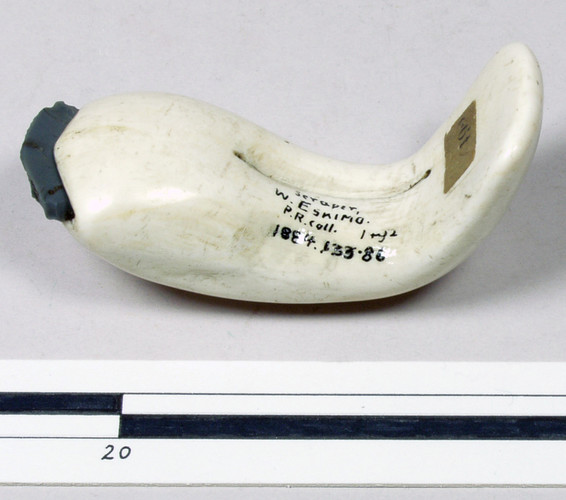 1884.133.86Chert scraper set in curved ivory handle.1884.133.86
 1935.13.106.374Light yellow-beige stone flake with two dorsal crests running toward tapering distal edge. One strongly curved lateral side. [LKG 07/06/2010]1935.13.106.374
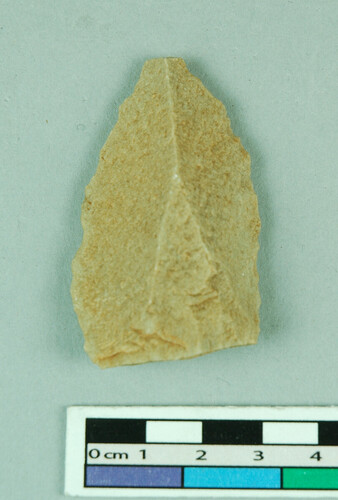 1935.9.46.17Stone flake, brownish yellow in colour and tapering towards the distal edge. [MJD 26/05/2010]1935.9.46.17
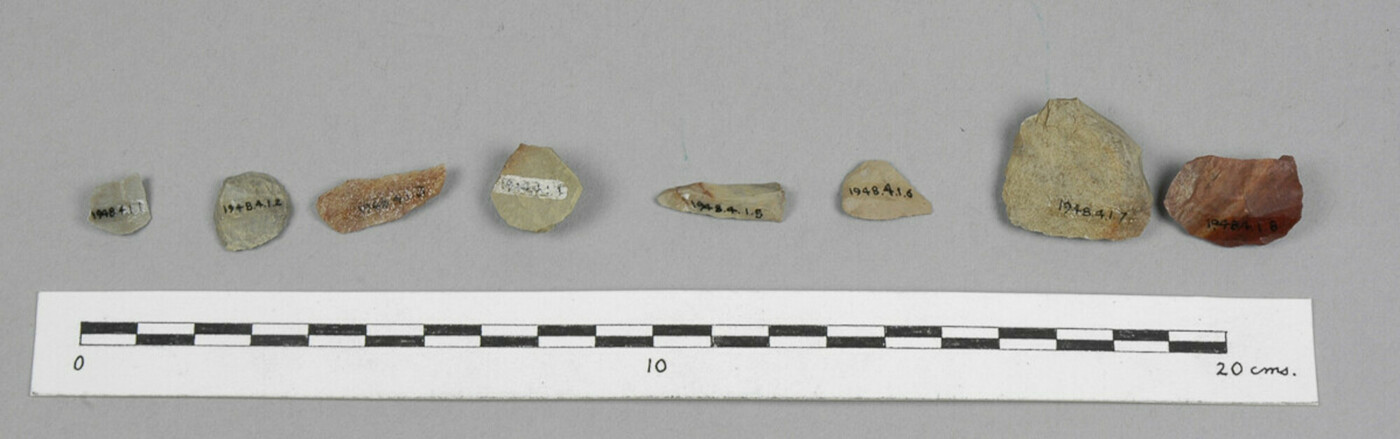 1948.4.1.1Flake or small microlith from dunes [SM 09/08/2007]1948.4.1.1