
- Collection type
- Object
- Description
- Bag made of folded bark. [MJD DDF Body Arts Project 2010/2011 16/11/2010]
- Long description
- Bag made of folded bark. The bag is made of one piece of 'stringy bark' which is stitched on either side. The bag is wedge shaped. The opening is circular and half the rim is stitched. The bag is decorated with yellow and white pigment in a diamond pattern. Lines in one direction are white and over painted in the opposite direction with yellow lines. [MJD DDF Body Arts Project 2010/2011 16/11/2010]
- Geographical reference
- Northern Territory Tiwi Islands; Melville Island
- Cultural groups
- Tiwi
- Date / Period
- Date made: Before 1913-1914
- Date collected
- 1913-14 ?
- Acquisition information
- Donated: 1915
- Materials and processes
- Material Bark Fibre Plant, Material Pigment, Process Bent, Process Stitched, Process Painted
- Dimensions
- Width 335 mm, Length 467 mm
- Object numbers
- Accession number: 1915.10.19 Other numbers: [23]
- Research and responses
Of 'stringy-bark' (Eucalyptus tetradonta). For carrying food etc. Used in Pukamani funerary ceremonies. [LMM ?, undated]
- Associated publications
- Reference: Ancestors, artefacts, empire: Indigenous Australia in British and Irish museums, Main author: Gaye Sculthorpe; Main author: Maria Nugent; Main author: Howard Morphy; London, 2021, Page: 114, Page illustrated: 115, Notes: This object is illustrated as figure 11.3 on page 115 in Ancestors, artefacts, empire: Indigenous Australia in British and Irish museums, Gaye Sculthorpe, Maria Nugent and Howard Morphy, 2021 with the caption: Bark basket (tunga), c. 1913, from Melville Island. Large painted, folded and sewn bark baskets were used in funerary ceremonies to bring gifts. Afterwards, they were placed upside down on top of grave posts. Early observers noted that these baskets were made by women and painted by men. Their decorative nature appealed to collectors. Collected c.1913 by Dr Henry Kenneth Fry (1886-1959) and donated by him to the Pitt Rivers Museum, Oxford in January 1915. H. 46.7 cm W. 33.5 cm. PRM 1915.10.19.
- Illustrated in colour as figure 51 on page 47 of Australia in Oxford, edited by Howard Morphy and Elizabeth Edwards (Oxford: Pitt Rivers Museum, University of Oxford, Monograph 4, 1988). [JC 1995]
Search terms: Bag, Vessel, Death, Religion, Ritual and Ceremonial, Transport and Travel, Grave Good, Carrying Device
Further items to explore
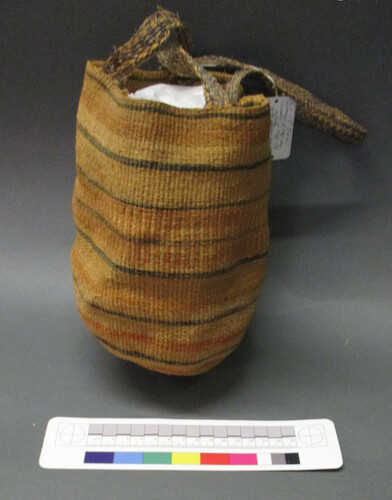 1996.21.55Twined basket with two plaited fibre handles. The basket is made of fine twined fibre. It is mainly natural brown in colour but there are also horizontal stripes of dark blue/grey and darker brown fibre and also vertical and horizontal stripes of orange fibre. [CW [OPS Move] 30/11/2016]1996.21.55
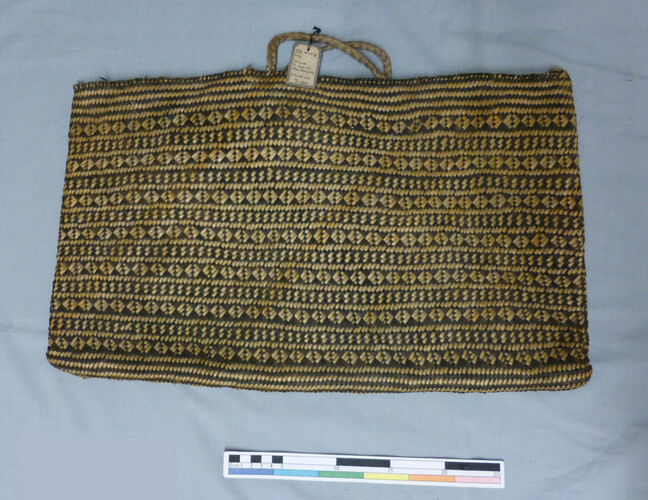 1923.87.141Matwork bag of light and dark strips of harakeke woven in pattern. [MJD 19/09/2013]1923.87.141
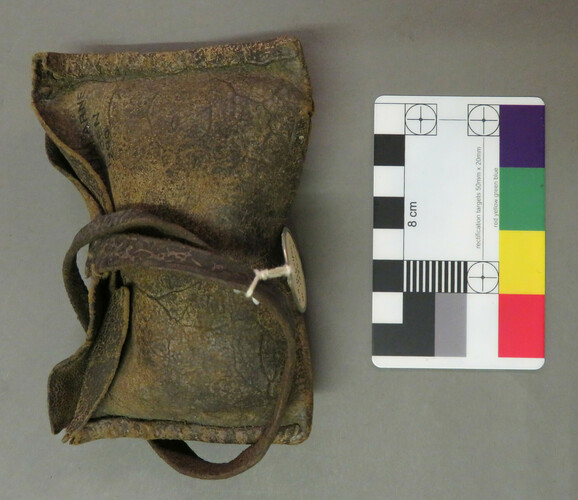 1938.35.1891.1Leather tinder pouch. For contents of pouch see [1938.35.1891 .2 - .5] [EH [OPS move] 9/8/2017]1938.35.1891.1
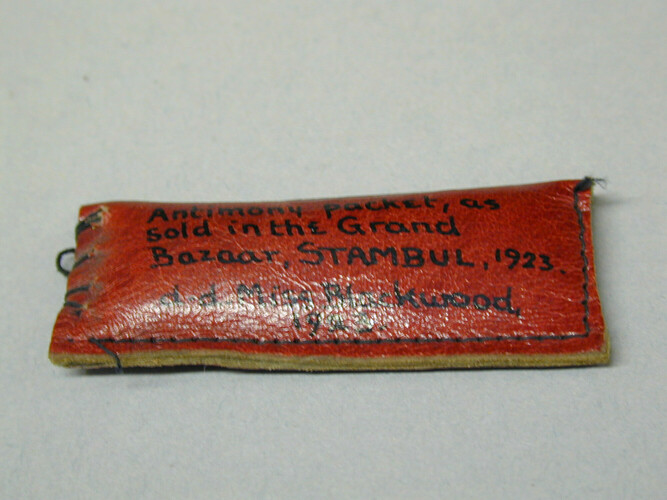 1923.64.6Red leather packet of antimony1923.64.6
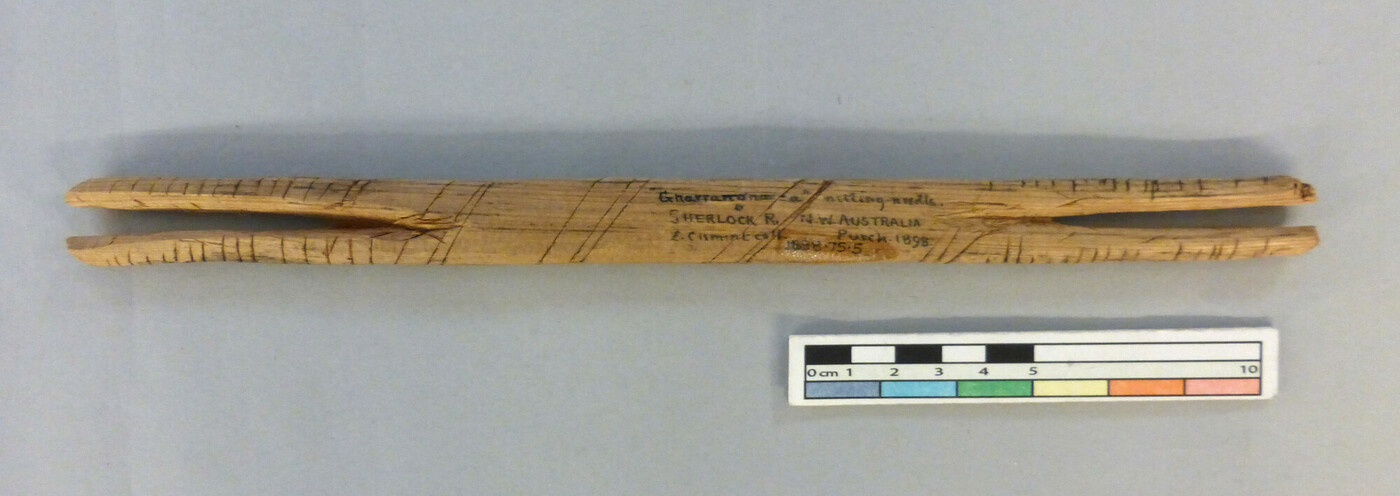 1898.75.5Netting needle.1898.75.5
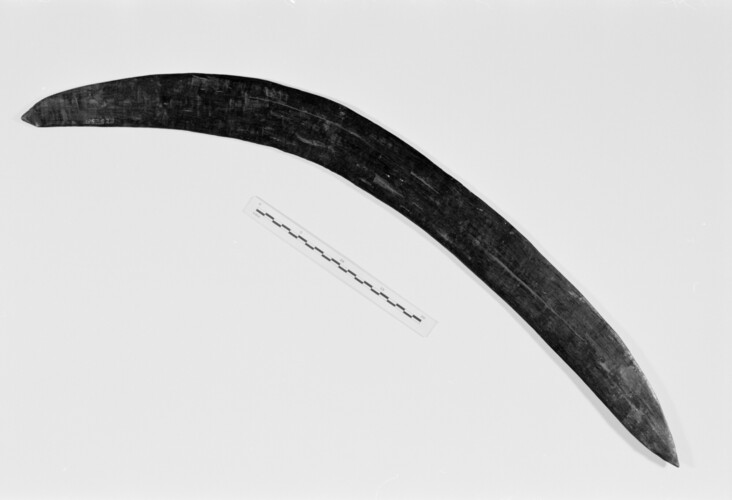 1994.4.125Dark wooden boomerang with pointed ends. On both sides there are deep grooves running along the length of the boomerang. [El.B 20/08/2007]1994.4.125
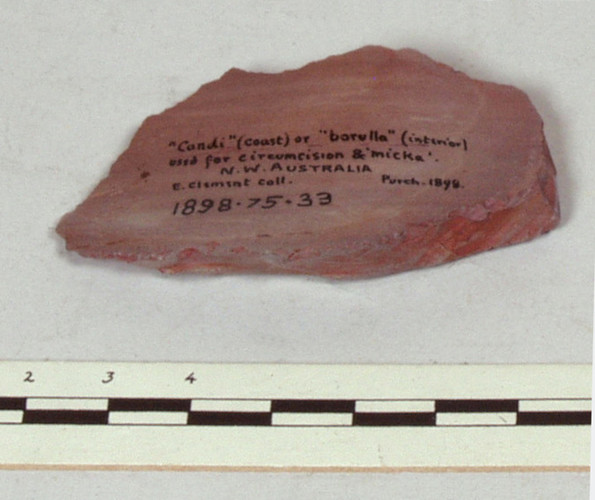 1898.75.33Stone knife used for circumcision and 'micka' operation.1898.75.33
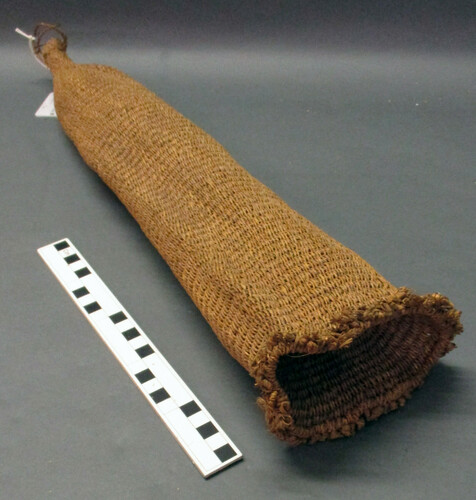 2017.7.1Basket, 'dilly bag', conical in shape tied at the bottom. [FB 12/1/2017]2017.7.1