
- Collection type
- Object
- Description
- Flag on a bamboo staff, part of complete suit of Japanese armour. [El.B 4/4/2007]
- Long description
- The flag is of white textile with a red circle painted in the centre which has then been painted over in gold. The staff has black bands painted on it. [El.B 4/4/2007]
- Geographical reference
- Cultural groups
- Japanese
- Date / Period
- Date made: Before 1901
- Date collected
- By 1901
- Acquisition information
- Donated: 1901
- Materials and processes
- Material Bamboo Plant, Material Textile, Material Pigment, Process Stitched, Process Painted
- Object numbers
- Accession number: 1901.46.1.30
- Research and responses
The following notes are drawn from research compiled by Andy Mills as part of the DCF Cutting Edge project in 2006-2007. This is a very full suit of highly ornate, and archaistic, armour from the Tokugawa Period. It is either a Presentation Armour for diplomatic gifting between high-ranking individuals, or the Parade Armour of a daimyo, one of his close relatives, or a high-ranking samurai retainer.
The banner (sashimono) of white silk bearing a gold circle, depicts the Buddhist halo (kohai) - commonly seen in Japanese art – and indicates the presence of deity. It is, however, the insignia of this particular bushi. Sashimono developed as identification insignia between 1550-1575 (see The Armour Book in Honcho-Gunkiko , by H. Arai, published 1964. p.83), in response to accidental killings of allies on the battlefield, which itself resulted from the increased use of face-masks (men-yoroi). [SM 08/05/2008]
From the diary (in a private collection) of Arthur Heathcote, who accompanied Henry Martin Gibbs to Peru in 1873: Just before we left Lima Gibbs had offered to him for sale a most curious suit of armour, which on finding that the owner was a gentleman in every way reliable who had been for many years in Japan he bought. It is said to be very rare & certainly most curious, I should much like you to see it & perhaps if you go to Tyntesfield after we get back, you may. The Chinese & Japanese are very numerous in Lima & one can get very pretty things in their shops - but (like everything else in Lima) they are very expensive.
- Associated publications
- Illustrated in colour on page 41 of Pitt Rivers Museum: An Introduction, by Julia Cousins (Oxford: Pitt Rivers Museum, University of Oxford, 2004). Caption (same page) reads: 'Complete suit of decorative Samurai armour; made in Japan in the late nineteenth century.' [JC 8 10 2004]
Search terms: Armour Weapon, Insignia, Armour, Flag, Staff
Further items to explore
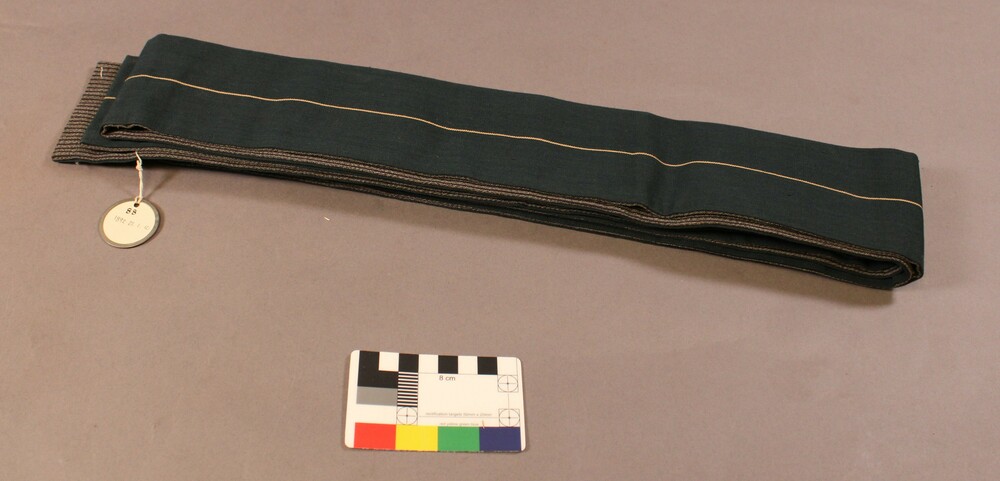 1892.21.1.10Belt worn on pilgrimage1892.21.1.10
 1996.17.102.1Incense box, pottery, shaped like a wrapped boiled sweet, glazed with an orange-pink glaze both inside and out. There are impressed lines within the foot. The lid for this box is 1996.17.102 .2.1996.17.102.1
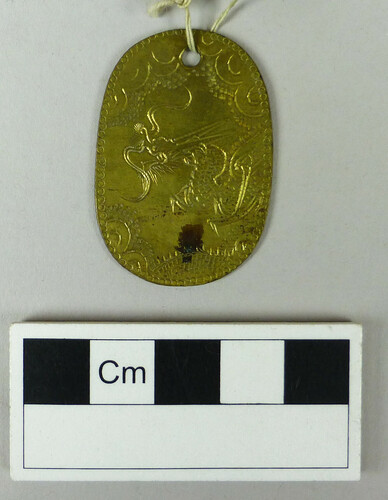 1985.53.521.3Amulet, oval metal pendant incised with a picture of a dragon, perforated for suspension. [El.B 30/10/2013]1985.53.521.3
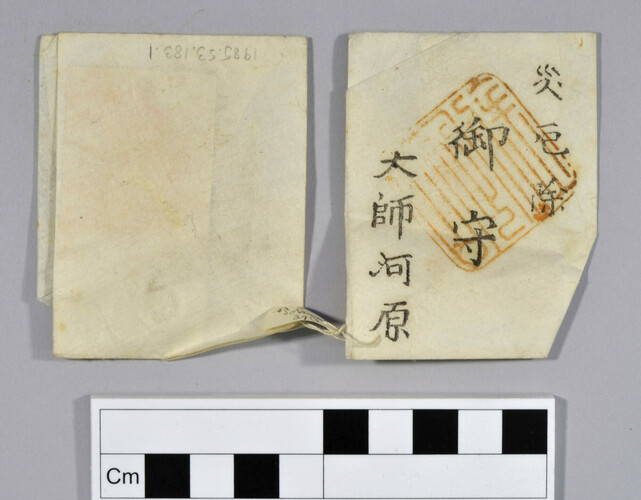 1985.53.183.1Paper charm with characters written in black ink. [MJD 01/02/2013]1985.53.183.1