
- Collection type
- Object
- Description
- Horn [.24] mounted on the helmet, part of complete suit of Japanese armour.
- Long description
- Horn [.24] mounted on the helmet, part of complete suit of Japanese armour. Flat shaped horn, one of a pair, mounted in a socket above the peak of the helmet. It is painted gold and has a small heart cut out. [El.B 4/4/2007]
- Geographical reference
- Cultural groups
- Japanese
- Date / Period
- Date made: Before 1901
- Date collected
- By 1901
- Acquisition information
- Donated: 1901
- Dimensions
- Length: max 250 mm
- Object numbers
- Accession number: 1901.46.1.24
- Research and responses
The following notes are drawn from research compiled by Andy Mills as part of the DCF Cutting Edge project in 2006-2007. This is a very full suit of highly ornate, and archaistic, armour from the Tokugawa Period. It is either a Presentation Armour for diplomatic gifting between high-ranking individuals, or the Parade Armour of a daimyo, one of his close relatives, or a high-ranking samurai retainer.
This kawari-kabuto (‘changed/grotesque helmet’) on a Koboshi-hachi (‘rivet-studded bowl’) base is a particularly fine example of baroque Tokugawa-period armoury. Its basis is a 32-plate suji-hachi, much like that of Object 1. The gilt copper tehen (crown tube) is ornately depicted with chrysanthemum motifs (kiku) which allude to the Emperor (Mikado), as is the fretwork brass plate on the brim. The large gilt copper horns (kuwagata) are of debated meaning, but seem to depict the unfolding leaves of the omodaka plant (also known as katchi-ikusa-gusa ‘victory grass’) (Bryant, 2004: Ch.8). The grotesque fanged face on the helmet frontlet – gold-lacquered over what is probably papier mache – is known as a Shikami – the face of a mythical Oni (Japanese Ogre from Yomotsu-Kuni, the land of the dead) by the name of Yomotsu Shikome, who is associated with eating the living in Japanese myths (see The Armour Book in Honcho-Gunkiko , by H. Arai, published 1964. pp.43-5). Arai recounts the myth in this place, and discussed the supernatural and predatory nature of the Shikami as fitting for a helmet. [SM 08/05/2008]
From the diary (in a private collection) of Arthur Heathcote, who accompanied Henry Martin Gibbs to Peru in 1873: Just before we left Lima Gibbs had offered to him for sale a most curious suit of armour, which on finding that the owner was a gentleman in every way reliable who had been for many years in Japan he bought. It is said to be very rare & certainly most curious, I should much like you to see it & perhaps if you go to Tyntesfield after we get back, you may. The Chinese & Japanese are very numerous in Lima & one can get very pretty things in their shops - but (like everything else in Lima) they are very expensive.
- Associated publications
- Illustrated in colour on page 41 of Pitt Rivers Museum: An Introduction, by Julia Cousins (Oxford: Pitt Rivers Museum, University of Oxford, 2004). Caption (same page) reads: 'Complete suit of decorative Samurai armour; made in Japan in the late nineteenth century.' [JC 8 10 2004]
Search terms: Armour Weapon, Armour, Helmet, Ornament
Further items to explore
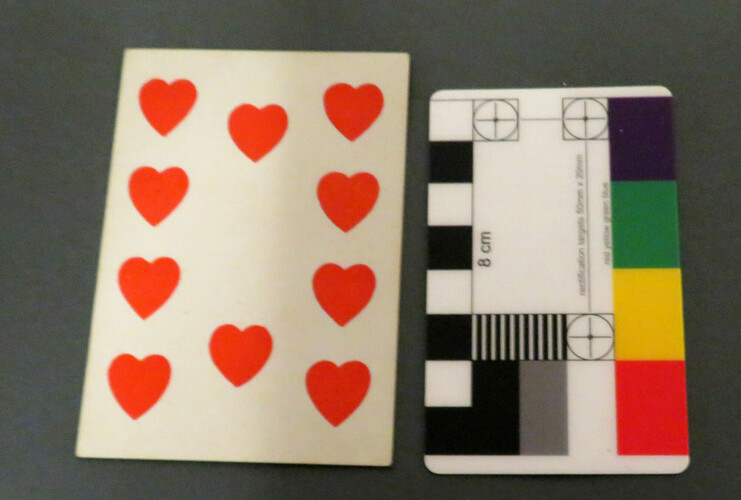 1992.8.3.155Playing card, ten of hearts. Purple coloured reverse with gold border and floral and foliate designs in pink, green and gold. For the other playing cards in this incomplete set of 49, see [1992.8.3 .134 - 154] and [1992.8.3 .156 - 185]. [CW [OPS Move] 24/3/2017]1992.8.3.155
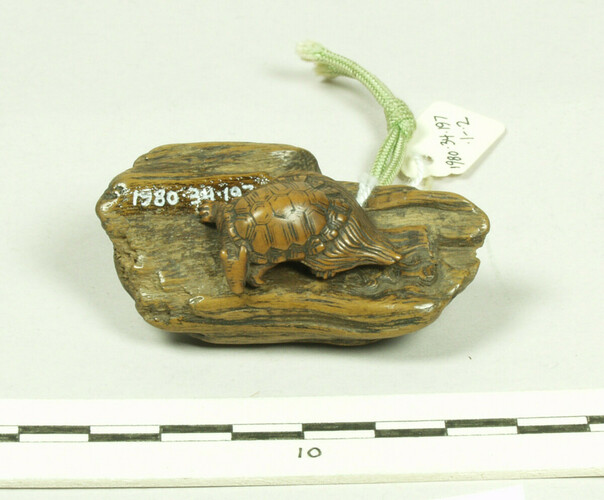 1980.34.197.1Netsuke toggle: natural looking form of wood [.1], with carved ? turtle [.2] that fits in hollowed out section at back. Attached together with length of green cord [L.Ph 'DCF 2004-2006 What's Upstairs?' 5/4/2005]1980.34.197.1
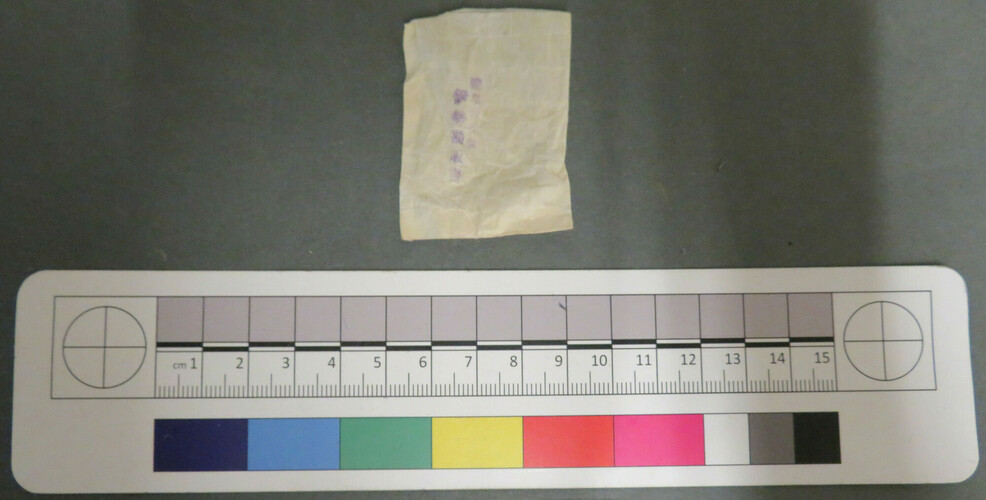 1985.53.686.3Rectangular paper bag, printed with inscription in purple ink. The paper is creased. For associated pigeon figures see [1985.53.686 .1 - .2] [EH [OPS Move] 2/5/2017]1985.53.686.3
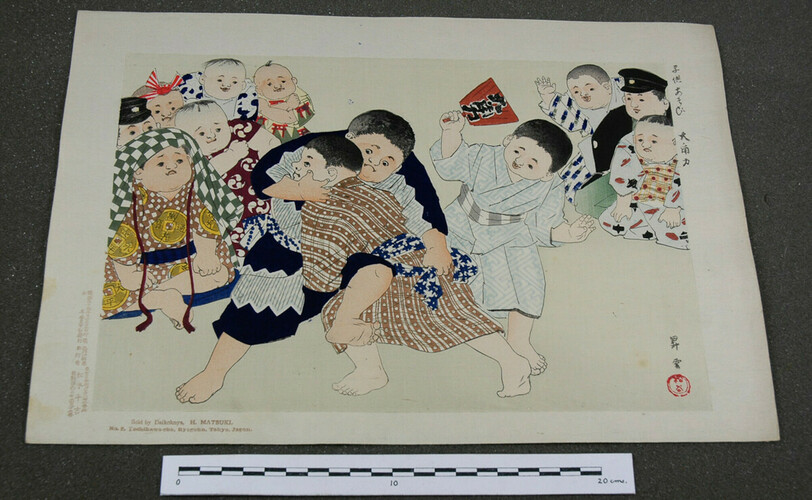 1989.44.127Print of boys playing at wrestling.1989.44.127